
A rigid wooden chessboard can slide, collect grit underneath, or place hard edges directly on a dining table. A plain under-board mat adds a removable layer between the board and table, but it only helps when its footprint, material, and care instructions suit both surfaces.
This guide compares protective mat categories, not named winners or products we claim to have tested. A mat cannot guarantee that a table will avoid marks. Check the table maker's care guidance and the mat listing before use, especially on delicate, recently refinished, high-gloss, or unfamiliar surfaces.
As an Amazon Associate, The Good Chess & Checkers may earn from qualifying purchases.
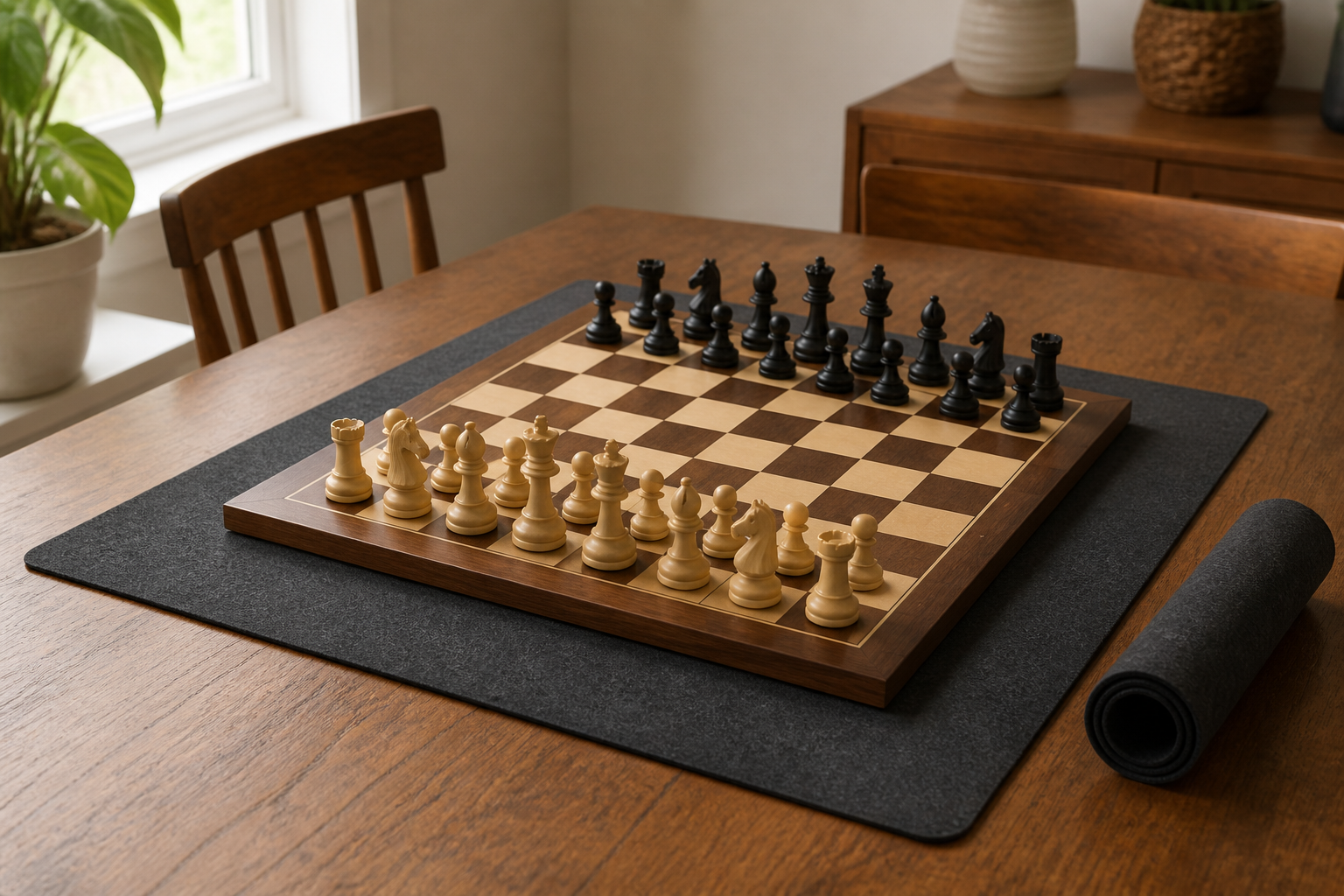
Quick decision aid
Choose plain under-board mat materials
Look for felt, cork, or cut-to-size shelf-liner formats with published dimensions and care guidance. Confirm that the material is meant for contact with your table finish; do not assume every backing is safe for every surface.
How to compare a chessboard under-mat
- Footprint: measure the rigid board's full outer width and depth, including any frame, feet, hinges, or latch.
- Visible border: choose whether the mat should disappear under the board or extend evenly beyond it for easier placement.
- Material: felt is soft and easy to trim; cork is firmer; open-grid liner is grippy but may be unsuitable for some finishes.
- Backing: verify the listing's surface-compatibility and care statements. Rubberized or plasticized backings can behave differently over time.
- Thickness and stability: the board should remain level and should not rock when a clock or player presses near an edge.
- Storage: decide whether the mat can stay flat, roll loosely, or must fit in the same cabinet as the board.
Best all-around category: plain felt mat
A plain felt rectangle creates a soft contact layer without adding much height. It is available in sheets and can often be trimmed to the board footprint. A slightly larger cut makes the layer easy to lift and keeps the board frame away from direct table contact.
Best for: a rigid home board that moves between a cabinet and dining table.
Skip it if: the material sheds, bunches under the board, lacks care guidance, or must handle frequent spills.
Best low-profile category: cork sheet
Thin cork can create a firm buffer while keeping the board close to the tabletop. Look for a smooth, intact sheet that lies flat, then inspect the cut edges and both contact surfaces for crumbs before each setup.
Best for: buyers who want a firmer, natural-looking layer under a flat board.
Skip it if: the sheet curls, cracks when stored, sheds particles, or the seller does not address the intended surface contact.
Best cut-to-fit category: non-adhesive liner
A roll of non-adhesive liner can be trimmed for an unusual board shape and replaced without changing the chessboard. Select a plain sheet rather than a printed chess grid. Lay it flat and test a small inconspicuous area according to the table and liner makers' instructions before committing to regular use.
Best for: irregular board footprints or a household that needs several replaceable pads.
Skip it if: the backing chemistry is unclear, it leaves a pattern, or the liner stretches when the board is moved.
Best for a board that stays out: fitted fabric pad
A neatly cut pad can make sense when a display board has a permanent table position. Bound edges may look tidier and resist fraying, but the finished size must still keep the board level. Lift the board and pad periodically to inspect and clean both surfaces according to their care directions.
Best for: a dedicated chess table or a frequently used rigid board.
Skip it if: the table must be cleared after every game or the edge binding creates an uneven base.
Quick comparison framework
- Choose felt for a simple soft layer that is easy to size.
- Choose cork for a firmer, low-profile buffer.
- Choose cut-to-fit liner for an odd footprint, only after verifying surface compatibility.
- Choose a fitted pad when the board has a regular, dedicated position.
- Choose nothing when the board already has intact, suitable feet and the maker advises direct placement.
Measure and preflight the setup
- Record the board's outer dimensions and locate every foot, hinge, and latch.
- Read the care instructions for the table finish, board base, and proposed mat.
- Choose an even margin or mark a cut line that keeps the whole board supported.
- Test as directed in an inconspicuous area and check that the material does not transfer, curl, or leave a pattern.
- Set the empty board down and press gently at each edge to check for rocking before adding pieces.
- Lift and clean the layers regularly rather than trapping crumbs or moisture beneath them.
Who should skip a protective mat?
Skip the extra layer when the board already has clean, intact feet designed for the surface, the table maker discourages coverings, or a mat would make the board unstable. Also skip any listing that makes broad protection promises without material, backing, dimension, and care details. If you mainly want a board that rolls away, buy a purpose-made playable soft board instead of stacking a rigid board on another chess mat.
Bottom line
For many rigid home boards, a plain felt mat is the simplest category to evaluate: it is thin, visible, and easy to size. Cork offers a firmer alternative, while non-adhesive liner and fitted pads solve more specific footprint or display needs. The right choice depends less on a “best” material than on verified compatibility with the table finish, full support under the board, and a routine that keeps every layer clean and dry.