
A turn indicator is a visible object that points to, faces, or sits beside the player whose move comes next. It can help a beginner group keep the procedure visible without adding time pressure. The best version is simple enough to understand at a glance, easy to move after every turn, and neutral enough to work for both chess and checkers.
This is a category-and-fit guide, not a ranking of named products or a claim that a marker changes learning or behavior. Purpose-made game-turn markers are uncommon, so compare the dimensions and visible design of adaptable tabletop signs, reversible cards, or two-color tokens before buying.
The Good Chess & Checkers may earn commissions from qualifying purchases.
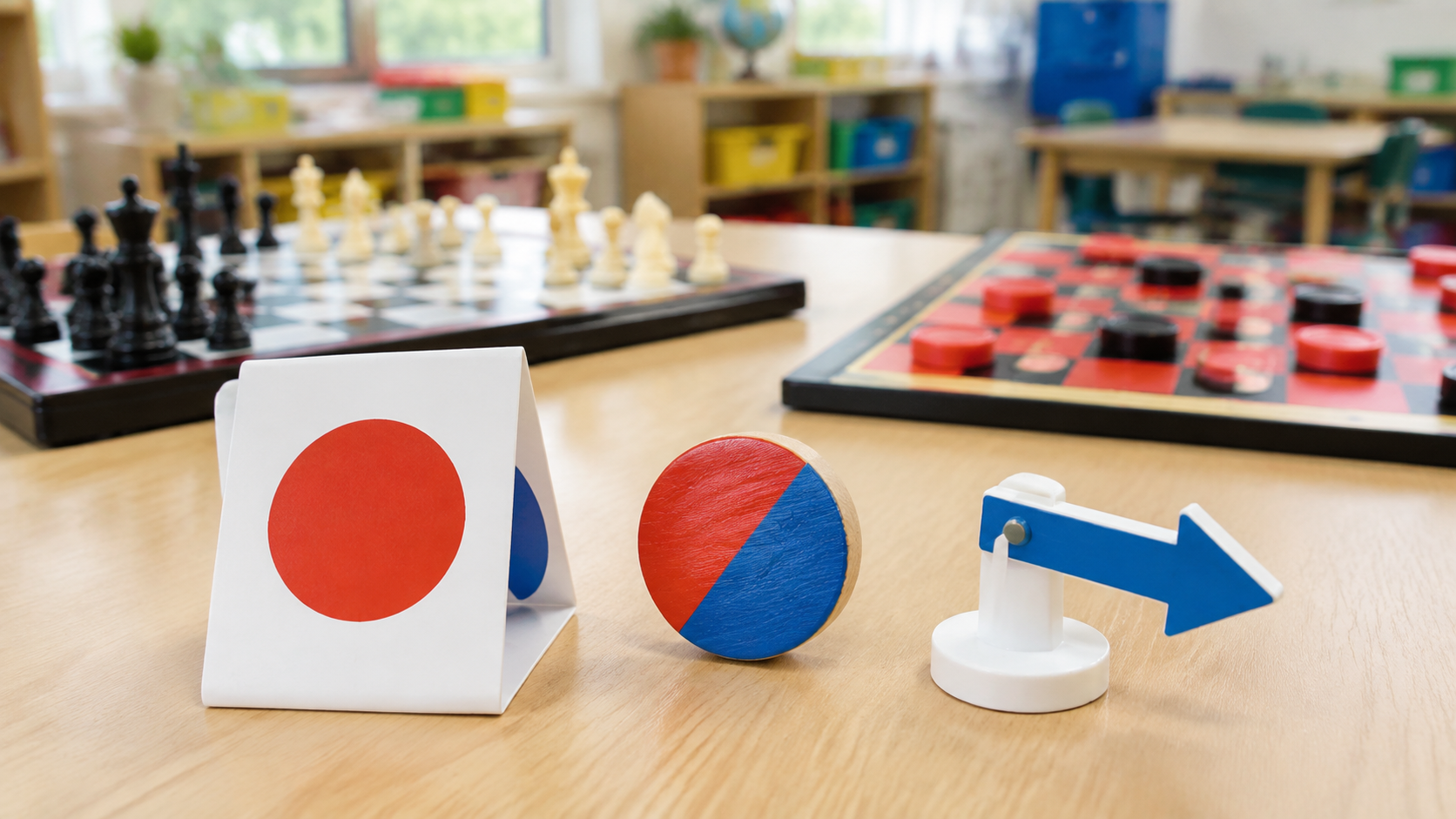
Quick decision aid
Compare reversible tabletop markers by visibility
Favor two clearly different faces or directions, a stable base, rounded everyday classroom construction, and a size the intended group can see. Verify the real product dimensions and visible faces; the category name alone does not establish suitability.
Quick answer
For one table or pair, use a reversible tent card or two-color token with a different high-contrast face for each player. For a teacher overseeing several boards, a small freestanding arrow can be quicker to read from the aisle if its direction remains unambiguous. A homemade folded card is often enough; buy a marker only when repeated use, wipe-clean labeling, or storage consistency justifies it.
What to compare
| Feature | What to verify | Why it matters |
|---|---|---|
| Two-sided meaning | Different colors, shapes, or directions on the real item | Both players should recognize the active side without reading a long label. |
| Visibility | Published height, width, contrast, and intended viewing distance | A table marker and a whole-group signal need different sizes. |
| Base and footprint | Base width, flatness, and table space | The marker should not crowd the board, captured pieces, or lesson notes. |
| Movement | Flip, rotate, slide, or point | The action must be repeatable after every completed move. |
| Game neutrality | No chess-only timer controls or game-specific wording | One marker can serve chess, checkers, and short teaching games. |
| Storage | Folded size, loose parts, and a labeled home | A marker that disappears between sessions does not support a routine. |
Best simple format: reversible tent card
A folded card gives each player a color, symbol, or labeled face. After a move, the player flips or turns it toward the other side. It is inexpensive, stores flat, and can be made from cardstock or a reusable dry-erase tent sign. If words are used, keep them short and readable from both seats.
Skip it if a light card slides or collapses on the actual table, or if the group cannot distinguish its two faces reliably.
Best compact format: two-color token
A chunky token with a different color on each face can sit beside the board without introducing an arrow. Flip it after each move and agree before starting which color belongs to each player. Check the real diameter and thickness so it is easy to handle but cannot be confused with a checker, captured piece, or chess-clock button.
Skip it when it resembles the game pieces too closely or the color difference is the only cue for a group that needs a shape or symbol too.
Best directional format: freestanding arrow
An arrow points directly toward the player to move, which can be useful when a teacher scans several tables. Its direction does not depend on matching piece colors. Measure its base and height, and place it beyond the board edge so it cannot be mistaken for a move instruction.
Skip it for crowded desks, seating at unusual angles, or any setup where the arrow could point ambiguously between players.
Use one routine for both games
- Before play, place the marker outside the board and explain exactly what each face or direction means.
- Set it for the side that moves first under the rules being used.
- Complete the move, including any required capture sequence in checkers, before changing the marker.
- The player who moved flips or turns the marker toward the opponent.
- If the position is paused, record whose turn it is instead of relying on an unattended loose marker.
For beginners still learning the games, pair the marker with concise rule support. The chess-piece movement guide and beginner checkers rules explain what must be completed before the turn passes. Rule variations matter in checkers, especially around captures and multi-jumps.
When a turn marker is better than a clock
A marker shows sequence; a clock measures time. Use a marker when the teaching goal is remembering whose move comes next and there is no need to allocate thinking time. Introduce a clock only when players already complete legal turns reliably and the lesson has a clear reason for timing. A turn marker is not a substitute for recording a paused position or settling a rule disagreement.
Who should skip buying one?
- One pair playing comfortably can place an ordinary neutral token beside the active player.
- A folded index card is enough when the group meets only occasionally.
- Experienced players who already track the move do not need another object on the table.
- A group that needs rule reminders will benefit more from clear chess and checkers rule cards.
- Timed practice needs an appropriate clock and an explained time control, not a decorative turn signal.
Bottom line
Choose a reversible tent card for the clearest two-sided signal, a two-color token for compact tables, or an arrow when direction is easier to scan across a room. Verify visible faces, dimensions, stability, storage, and whether the marker can be distinguished from the game pieces. For most families and small groups, try a homemade version first; standardize a purchased format only after the routine proves useful.