
Chess puzzle cards work best when a child already knows the legal moves but loses interest in a long worksheet. One card can turn a spare five minutes into a focused “find the move” challenge, then go back into the deck for another day.
This is a criteria-led guide to card formats, not a hands-on ranking. We have not used every deck returned by the shopping links. Contents and editions can change, so preview actual card faces and answers, confirm the current listing, and match the challenge level to the learner rather than an age number alone.
As an Amazon Associate, The Good Chess & Checkers may earn from qualifying purchases.
Quick decision aid
Choose reusable chess challenge cards
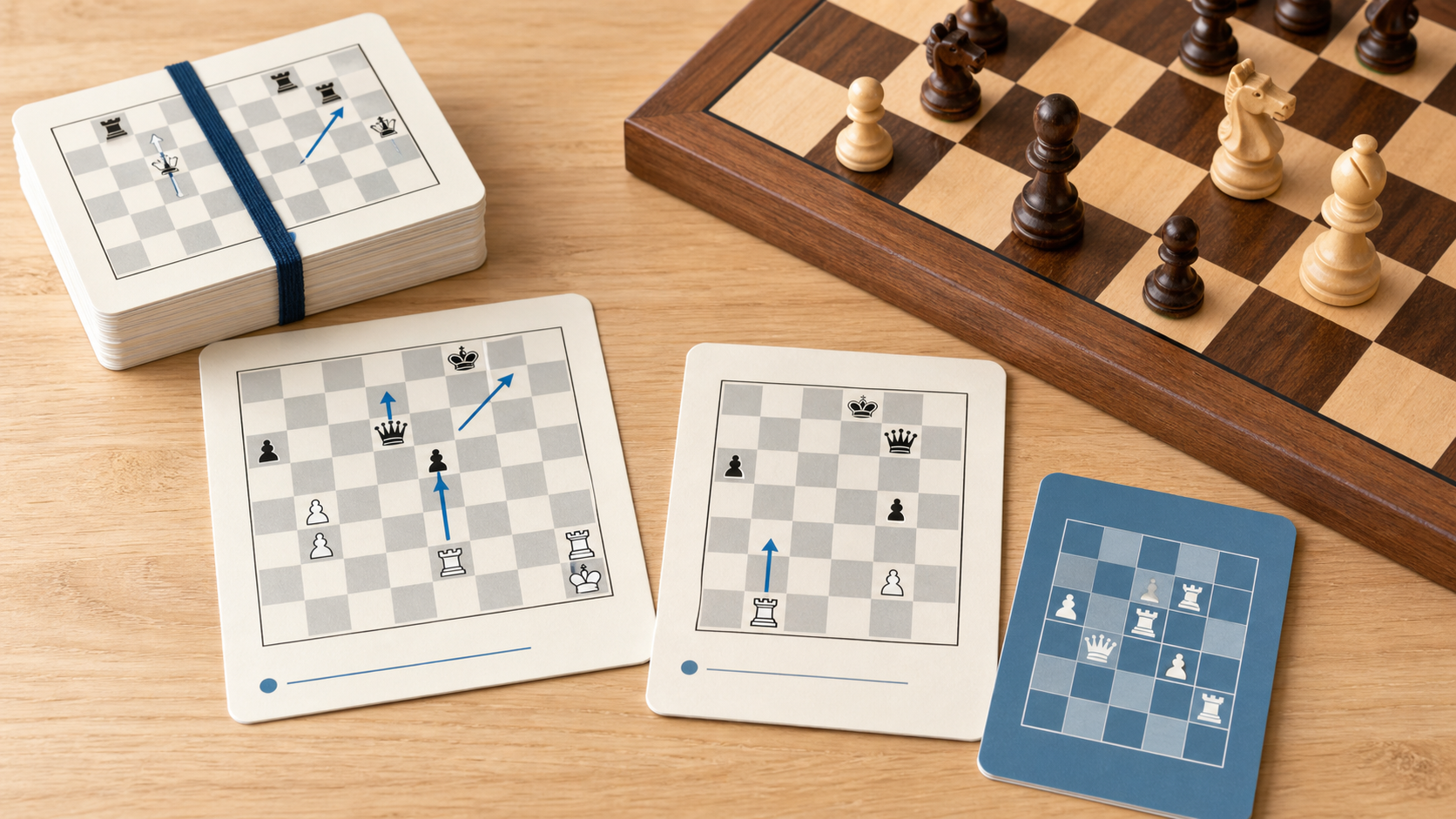
Look for sample cards with readable positions, a clear side to move, ordered difficulty, and answers that explain the idea. A large puzzle count does not help if the first cards assume tactics the learner has never met.
How We Compare Chess Puzzle Cards
- Diagram clarity: pieces, square colors, board orientation, and the side to move should be obvious at the card's printed size.
- Starting level: the easiest cards should match what the child knows now, usually legal movement, capture, check, and checkmate.
- Progression: symbols, colors, numbers, or dividers should make it easy to move from one-step ideas to harder positions.
- Useful answers: a solution should name or explain the idea, not give only a move in notation the learner cannot yet read.
- Card handling: thickness, finish, corners, storage, and shuffle size matter when the deck will move between children or locations.
- Practice flexibility: the cards should support solo solving, an adult-child prompt, or a small group without exposing every answer.
- Connection to a board: positions should be practical to rebuild on a readable chess set when the diagram alone is not enough.
Best Overall Format: Level-Sorted Cards with Explained Answers
The most useful first deck makes its progression visible and lets the adult pull only an appropriate group of cards. Early challenges might ask a learner to find a hanging piece, escape check, or deliver mate in one. More demanding forks, pins, and short combinations can wait in a separate section.
Answers on the reverse keep the activity self-contained, but they should do more than reveal a move. A short reason—such as “the knight attacks two valuable pieces”—helps a child connect the solution with a reusable pattern.
Best for: families and teachers who want one deck to grow with a learner.
Skip it if: levels are unexplained, answers use only dense notation, or flipping the card reveals nearby solutions too easily.
Best for New Readers: Large-Diagram, Low-Text Cards
Large diagrams reduce the effort of decoding a position. Clear piece symbols and a simple marker for “white to move” or “black to move” matter more than decorative borders. A prompt such as “find checkmate” is easier to use than a paragraph of story text when the goal is board recognition.
Low text does not mean no teaching. The answer still needs a brief spoken or written explanation that an adult can share. Preview both sides of a card; a beautiful front paired with an unexplained answer is not a complete learning tool.
Best for: children who know the moves but tire quickly when a chess activity requires much reading.
Skip it if: oversized graphics leave too few useful positions, or the symbols differ so much from the child's board that recognition becomes another lesson.
Best for Family Practice: Prompt-and-Answer Cards
A parent does not need to be a strong player when each card supplies a clear prompt, the correct move, and one follow-up question. Useful follow-ups include “What was undefended?”, “What would the opponent do next?”, or “Can you show the move on the board?” Those questions slow down guessing without turning the activity into a lecture.
Choose a deck that hides the solution while the puzzle is visible. Separate answer cards can work, but they are easier to lose; reverse-side answers are tidier, while a small answer booklet can provide more explanation.
Best for: an adult and child sharing five- to ten-minute practice sessions.
Skip it if: the prompts assume the adult already understands every tactic or cannot be used without a separate manual.
Best for Classrooms and Small Groups: Sortable Challenge Decks
Cards can rotate between tables more easily than workbook pages. Look for visible level markers, card numbers, and a storage box or band that makes a quick count possible. A teacher can give several learners different positions, then ask them to rebuild one on a demonstration or tabletop board.
One card per child is not required. Pairs often benefit from explaining candidate moves to each other before checking the answer. Keep the exercise casual unless the group already enjoys timed challenges; speed can reward guessing instead of careful board reading.
Best for: stations, pairs, and mixed-level groups where challenges need to be redistributed.
Skip it if: the deck cannot be sorted reliably, cards are too small to share, or the setting needs a complete lesson sequence rather than independent prompts.
Best for Travel: Compact Cards with Secure Storage
A small deck is easy to carry and can be solved from the diagram without setting up pieces. Check the actual dimensions: a pocket-size card may also mean a cramped board. Rounded corners, a firm box, or a sturdy band help contain the deck, but no format prevents lost cards if there is no simple count or numbering system.
Best for: quiet practice at a table, in a waiting period, or on a trip when a full board is inconvenient.
Skip it if: the learner needs to move physical pieces to understand a position or the diagrams become hard to read at the portable size.
Quick Comparison Framework
- Choose level-sorted cards for the most adaptable first deck.
- Choose large, low-text cards when diagram reading is easier than paragraph reading.
- Choose prompt-and-answer cards for adult-child discussion.
- Choose numbered, sortable cards for stations and small groups.
- Choose a compact deck with secure storage for travel, after checking diagram size.
Puzzle Cards vs Tactics Workbooks
Cards are better for short, reusable prompts, random review, group rotation, and letting a child choose one manageable challenge. A workbook is better when lessons need a deliberate order, worked examples, room to write, and a visible record of progress. Neither format is automatically more educational.
If the child benefits from a chapter that teaches a fork before asking for ten fork solutions, use the tactics workbook comparison. If the child already recognizes basic patterns and enjoys quick challenges, cards can make review feel lighter.
Who Should Skip Chess Puzzle Cards?
Skip puzzle cards for now if the learner still confuses how pieces move, cannot identify check, or needs every position demonstrated physically. Use a clear beginner board and the piece movement guide, then introduce mate-in-one positions with only a few pieces.
Also skip a new deck when a book, app, or homemade position cards already hold the child's attention and explain mistakes well. Do not buy on puzzle count alone, and avoid listings that show no sample card, no answer format, or no meaningful difficulty information. Cards are a practice tool, not a substitute for playing complete games and talking through what happened.
Bottom Line
For most children who know the rules, the best chess puzzle cards use large readable diagrams, visible difficulty levels, and answers that explain the tactical idea. Choose prompt-and-answer cards for shared family practice, sortable cards for groups, or a compact protected deck for travel. Preview both sides of a real card before buying, and choose a workbook instead when the learner needs structured teaching rather than a short challenge.