
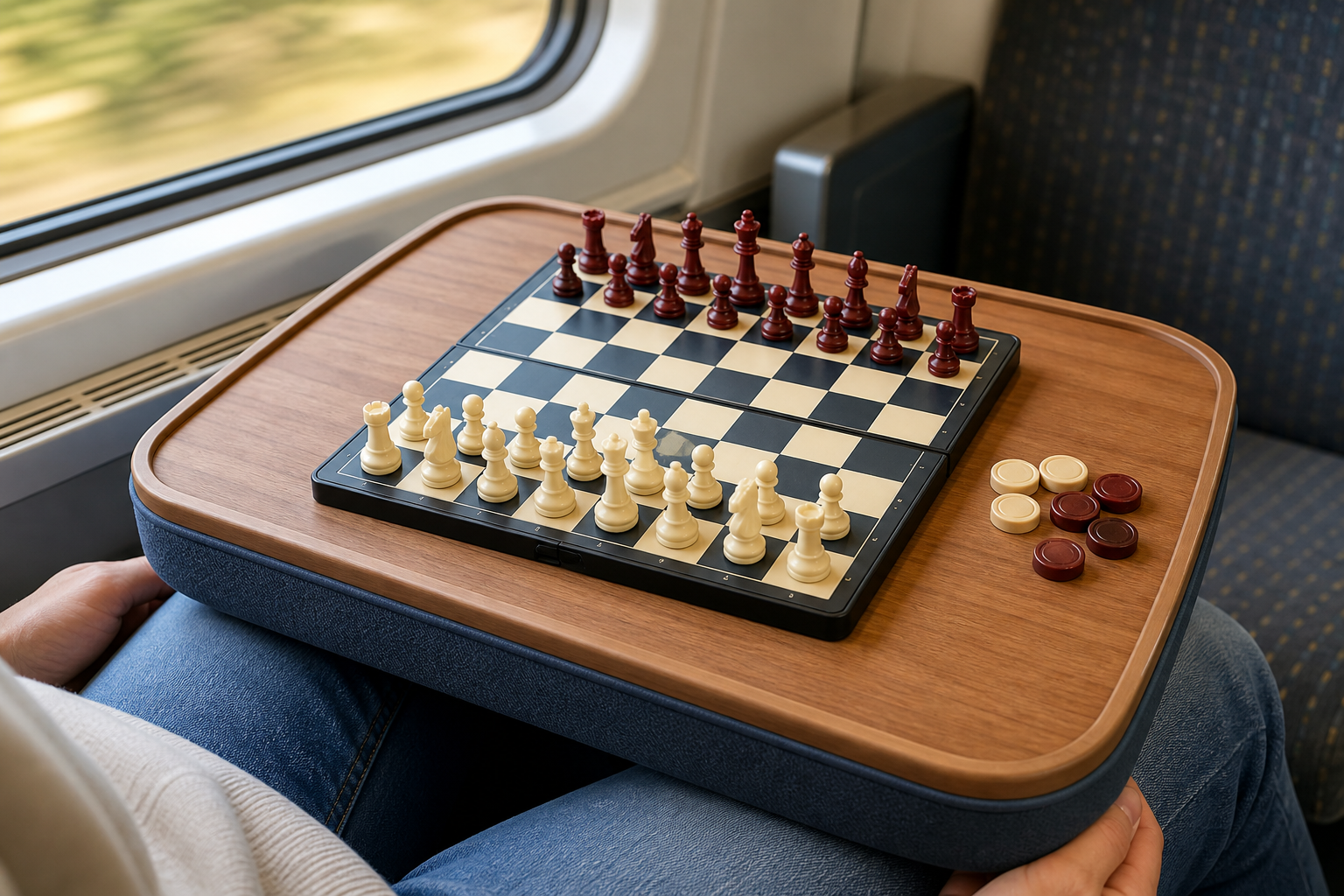
A compact game set can still be awkward when a train seat, hotel chair, waiting area, or sofa offers no level table. A lap desk adds a firm playing surface, but only when its usable top fits the whole board and its edges do not interfere with pieces or players.
This is a category comparison, not a ranking of named products or a claim of hands-on testing. No approved current named-product feed is configured, so use the measurements and checks below to inspect current listings before buying.
The Good Chess & Checkers may earn commissions from qualifying purchases.
Quick decision aid
Start with a firm, low-lip surface
Measure the unfolded board first. Look for a lap desk with enough flat space around it, a cushion or base that sits steadily, and an edge low enough for comfortable piece movement.
Selection criteria that matter
- Usable surface: compare the uninterrupted flat area—not the product's outside dimensions—with the board in its fully open position.
- Edge clearance: a shallow rim can catch a sliding board, while a tall lip may block hands or pieces near the outer ranks.
- Lap stability: a broad cushioned underside can adapt to a seated player; rigid folding legs need enough seat width and may wobble on soft upholstery.
- Surface grip: a matte top or removable thin nonslip layer can help, but magnets or peg pieces are still better when the vehicle moves.
- Legroom and posture: check total thickness, knee clearance, seating position, and whether the desk pushes the board uncomfortably high.
- Carrying burden: compare weight, handle design, thickness, and whether it fits the bag or luggage you already use.
- Piece space: leave a small zone for captured chess pieces, crowned checkers, rule cards, or a storage pouch.
Comparison framework: which lap desk format fits?
Cushioned flat-top lap desks
Choose them when: playing on trains, sofas, in waiting rooms, or on hotel chairs where the seat and player's legs are the support. The cushion should distribute the desk without creating a steep tilt.
Skip them when: the top is barely larger than a laptop, the underside is heavily angled, or thick padding raises the board too high.
Low-rim lap trays
Choose them when: a compact magnetic or peg set needs a little protection against sliding. Confirm the board clears any cup holder, phone slot, or raised channel.
Skip them when: the rim crowds the outer squares or makes it difficult to lift pieces from the board's edge.
Folding-leg bed trays
Choose them when: playing in hotel rooms, campsites, or stationary seating where a larger bridge-style surface matters more than packability.
Skip them when: you need to use the desk inside a narrow train, bus, or airplane seat. Leg spacing and folded bulk can erase the portability advantage.
Compact writing boards and hard pads
Choose them when: using a very small magnetic game and minimal weight is the priority; a backpack or folded jacket can provide soft support underneath.
Skip them when: the board overhangs, the hard edge presses into the legs, or there is no safe place for captured pieces.
Measure the complete setup before buying
- Open the travel board and measure its full width, depth, and hinge profile.
- Add practical side space for hands and captured pieces; do not assume every advertised top dimension is fully usable.
- Check listing photos and diagrams for rims, slots, cup holders, padding seams, and curved corners that reduce flat space.
- Compare desk width with your typical seat, armrest gap, and body position.
- Add the desk, game set, and bag weights to judge the complete carrying load.
- Verify materials, cleaning directions, handle, and folded dimensions in the current listing.
Travel setup cautions
A lap desk makes a surface; it does not secure loose pieces during turns, braking, or turbulence. Use a magnetic or peg set in moving vehicles, keep unused pieces contained, and pause play when conditions are unstable. Follow carrier instructions about aisles, trays, luggage, and device stowage rather than treating a lap desk as approved equipment for every part of a trip.
For choosing the game itself, use the travel chess and checkers set guide. If portability is less important than a larger stable surface at home or a club, compare folding game tables instead.
The broad travel-and-small-space pillar is not built yet, so this page links to the closest travel-set and portable-surface guides rather than inventing a missing hub.
Who should skip a lap desk?
Skip one if your travel set already fits securely on an available tray, if you usually play only at fixed tables, or if another bulky item would make the game less likely to travel. Players using a pocket set may need only a slim hard backing. Families who want a shared four-sided playing surface should choose a table, not balance a lap desk between players.
Bottom line
For most seated travel play, a light cushioned lap desk with a firm low-lip top is the easiest format to live with. Buy by the board's open dimensions, the genuinely usable surface, seated stability, and complete packed weight. A compact desk that fully supports the board is better than a feature-heavy model whose slots, rim, or padding get in the way.