
How to Choose a Chess and Checkers Set for a Small Space
If you want to play chess and checkers at home but do not have much table or storage space, the right set matters more than the fanciest one. A board that is too large may never come out of the closet. A tiny travel set may fit anywhere but feel frustrating for children, new players, or anyone still learning how the pieces move.
This guide explains how to choose a compact chess and checkers set that is easy to read, easy to store, and pleasant enough that people will actually use it. If you are comparing several compact product categories first, use the small-space chess and checkers set buying guide alongside this checklist.
As an Amazon Associate, The Good Chess & Checkers may earn from qualifying purchases.
Product-first guide
Shop compact sets that still read well
Compare compact boards and folding storage first, then use the guide to avoid travel sets that are small enough to fit but too cramped to enjoy.
Helpful product path
Shop the beginner set criteria
Use these tagged Amazon searches to compare current sets against the sizing, storage, readability, and skip criteria in this guide before choosing.
Start With Where You Will Actually Play
Before comparing materials or styles, picture the normal playing spot. A kitchen table, coffee table, classroom desk, picnic bench, dorm desk, or airplane tray all place different demands on a board.
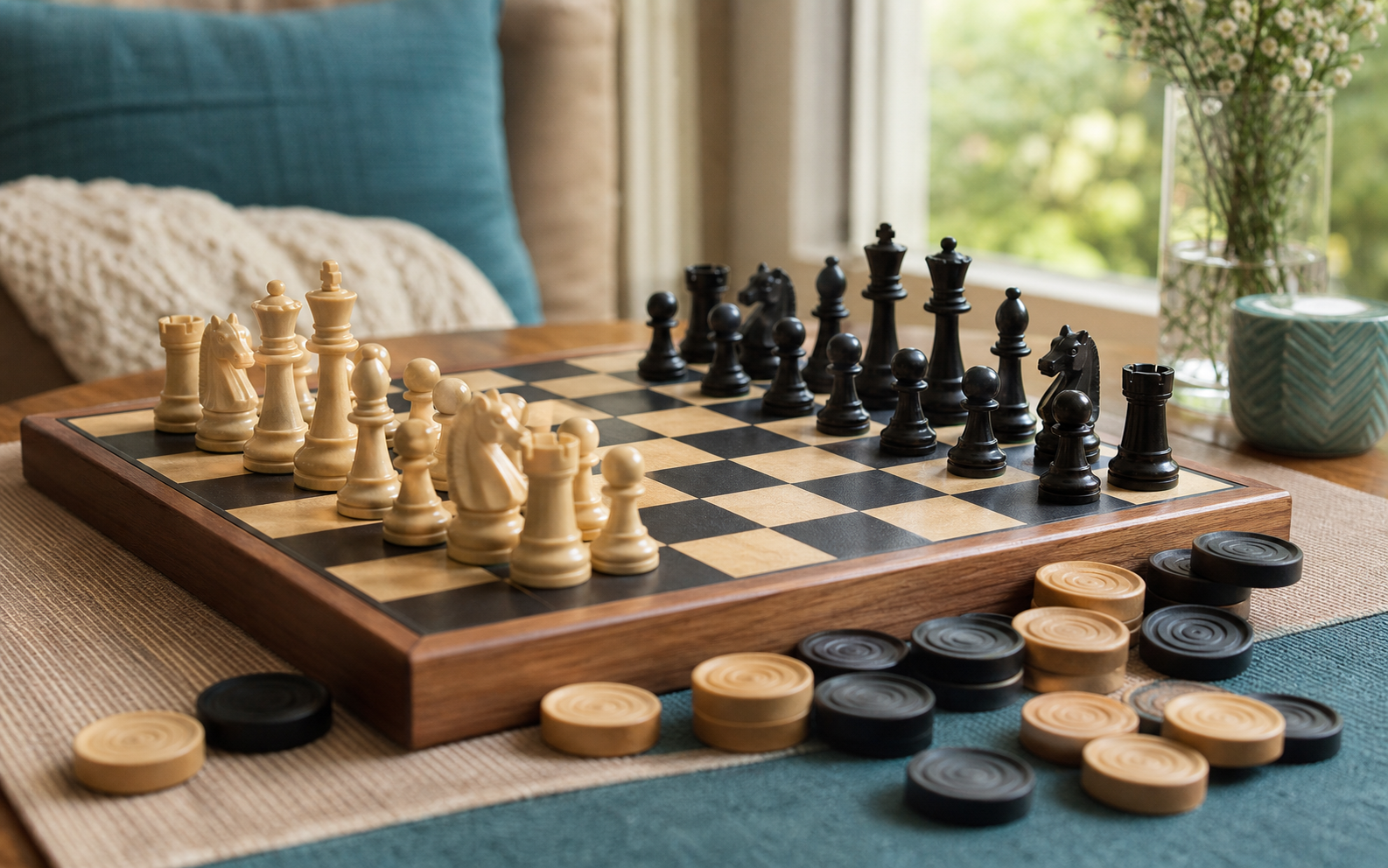
For most small homes and casual family play, look for a board that gives each square enough room for pieces to sit clearly without making the full board awkward to place. Chess uses all 64 squares with different piece shapes, while checkers usually needs flat round pieces that can be stacked when kings are made. A good shared set should handle both without feeling crowded.
Board Size: Compact, But Not Cramped
A small board is useful only if players can still see the position clearly. For beginners, readability is part of learning. If the squares are too small, it becomes harder to notice captures, legal moves, and blocked pieces.
For chess, make sure the king and queen can stand comfortably inside a square without bumping nearby pieces. For checkers, make sure two checker pieces can stack neatly on one square if your rules use crowned kings. If the checkers barely fit when stacked, the set may be annoying during real play.
A helpful rule of thumb: choose the smallest board that still lets players move pieces without knocking over the neighboring ones.
Piece Size and Shape Matter for Beginners
Chess pieces should be recognizable at a glance. Beginners should not have to keep asking which piece is the bishop or which piece is the rook. Sets with very stylized pieces can look nice, but they may slow down learning.
For checkers, the pieces should be easy to grip and stack. Very thin checkers save space, but they can be harder for younger children or older players to pick up. Slightly thicker pieces often feel better during family play.
If the same box includes both chess pieces and checkers, check that the storage area keeps them separated enough that setup does not become a chore.
Magnetic Sets: Useful for Travel, Not Always Best at Home
Magnetic chess and checkers sets can be excellent for cars, waiting rooms, travel, and shared tables where pieces might slide. They are especially helpful if children play on uneven surfaces.
The tradeoff is feel. Some magnetic sets have smaller pieces and flatter boards. That can be fine for travel, but less comfortable for everyday learning. If the set will mostly stay at home, prioritize readability and piece handling over the strongest magnets.
Folding Boards and Built-In Storage
Folding boards are popular for small spaces because the board becomes the storage case. This can be a smart choice if the hinges are sturdy and the latch closes securely.
For families, classrooms, and clubs, built-in storage is often worth it. Loose pieces disappear quickly when a set gets used often. A compact set with organized storage may last longer in practice than a prettier board with no good place for the pieces.
Before choosing a folding board, consider whether the crease in the middle affects play. Most casual players will not mind, but very lightweight boards can sit unevenly if the fold does not lie flat.
Wood, Plastic, Vinyl, and Silicone
Each material has a different strength.
- Wood feels traditional and looks good on a shelf, but it can be heavier and may take more care.
- Plastic is usually practical for children, classrooms, clubs, and frequent use.
- Vinyl roll-up boards are easy to store and carry, especially for clubs, but they need separate piece storage.
- Silicone boards can be flexible and durable, though some players prefer a firmer playing surface.
For a small apartment or family shelf, a folding wooden or plastic set with internal storage is often the simplest choice. For a classroom or club helper managing several boards, roll-up or flat stackable boards may be easier to store in quantity.
Make Sure the Board Works for Both Games
Chess and checkers use the same 8-by-8 board, but the playing experience is different. Chess players need clear piece identity and enough room for tall pieces. Checkers players need smooth movement, good color contrast, and pieces that stack cleanly when kings are used.
Also remember that checkers rules can vary by region and household. Some families require captures when available, some play with different king movement rules, and some introduce children with simplified house rules first. The board itself does not need to solve those differences, but the pieces should support normal stacking and movement.
Storage Questions to Ask Before Buying
A compact set should be easy to put away. Before choosing one, ask:
- Will the board fit on the shelf, desk, drawer, or travel bag where it will live?
- Does the set include storage for both chess pieces and checkers?
- Can a child help clean it up without mixing or losing pieces?
- Does the box close securely if stored upright?
- Are replacement pieces likely to be easy to match if one goes missing?
These details sound small, but they decide whether the set becomes a regular game-night tool or a cluttered box no one wants to open.
Best Fit by Situation
For a small apartment: Choose a folding board with built-in storage and readable pieces. Avoid novelty designs that are hard to identify.
For young children: Choose sturdy pieces that are easy to grip. Strong color contrast helps children see legal moves in both chess and checkers.
For travel: Consider a magnetic set, especially if games may happen in cars, airports, hotels, or waiting rooms. For a deeper travel-specific breakdown, read how to choose a travel chess and checkers set.
For classrooms and clubs: Choose durable, replaceable, easy-to-clean sets. Storage and setup speed matter more than display quality.
For gifts: Pick a set that matches the recipient’s likely use. A decorative wooden set may suit an adult beginner at home, while a portable magnetic set may be better for a family that travels.
Final Checklist
A good small-space chess and checkers set should be compact, readable, durable, and easy to store. The best choice is not always the smallest set. It is the smallest set that still feels comfortable to play.
Look for clear chess pieces, stackable checkers, a board size that fits your real table, and storage that makes cleanup simple. If the set removes friction, beginners and families are much more likely to keep playing.