
When is en passant legal? A beginner decision checklist
Prepared November 9, 2026 · The Good Chess & Checkers editorial desk
En passant is legal immediately after an opposing pawn advances two squares from its starting square and lands beside your pawn. Your pawn captures diagonally onto the square it crossed; remove the pawn beside you. The resulting position must leave your king safe.
This guide uses standard over-the-board chess rules. En passant is a pawn capture, not a move for any other piece. For ordinary movement and check, start with our chess piece movement guide. We do not cover app controls, event penalties or variant rules here.
The five-step decision checklist
- Last move: did your opponent just move this pawn two squares from its original starting square? A one-square advance fails this check. If you cannot establish the last move, the picture alone is insufficient.
- Beside your pawn: is your pawn on the same rank (row), on an adjacent file (column)? White captures from rank 5; Black captures from rank 4.
- Landing square: identify the empty square the opposing pawn crossed. Your pawn goes one square diagonally forward onto it: White toward rank 6, Black toward rank 3.
- Removal square: remove the opposing pawn from beside your pawn’s old square. It does not stay on the board. Move your pawn and remove the captured pawn as one capture.
- King safety: examine the resulting board, including both vacated squares. Does an enemy piece attack your king? If yes, the capture is illegal.
These checks describe whether the move is allowed, not whether it is the strongest choice. In the examples, files run a–h left to right and ranks 1–8 bottom to top from White’s side. K means king, P pawn and R rook; light circles are White and dark circles Black.
A and B: where to land, which pawn to remove
All positions below are original constructed teaching examples, not recorded games, photographs or player tests. Every piece is listed; all unlisted squares are empty. The stated recent moves are exercise assumptions, not a reconstruction of a complete game.
A: White captures upward from rank 5
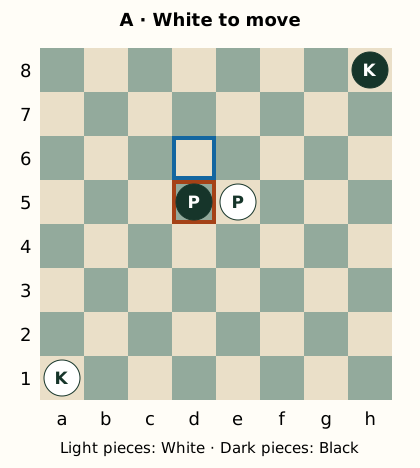
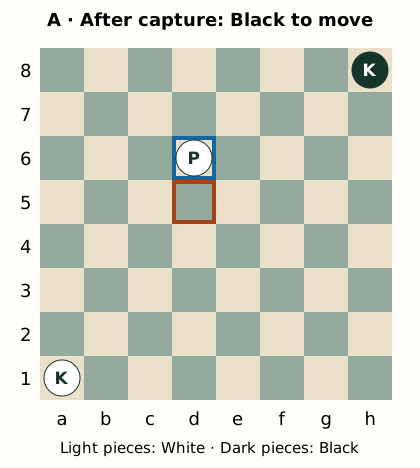
Start with White king a1 and pawn e5; Black king h8 and pawn d7, Black to move. Black plays d7–d5. Now White may capture e5xd6 en passant. Here “x” means captures.
B: Black captures downward from rank 4
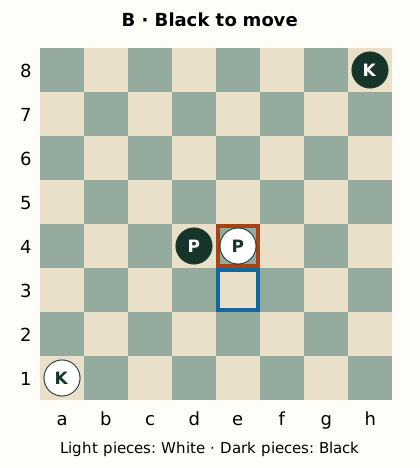
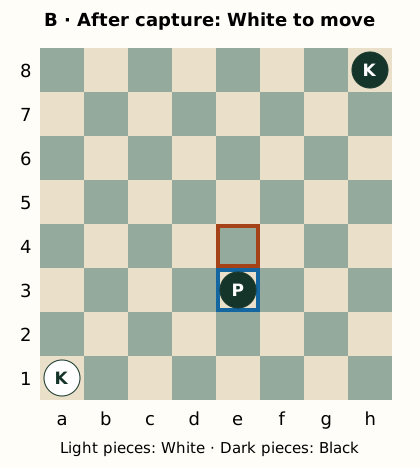
Start with White king a1 and pawn e2; Black king h8 and pawn d4, White to move. White plays e2–e4. Black may capture d4xe3 en passant.
C and D: the same pawn shape can fail
C: arriving by one square does not qualify
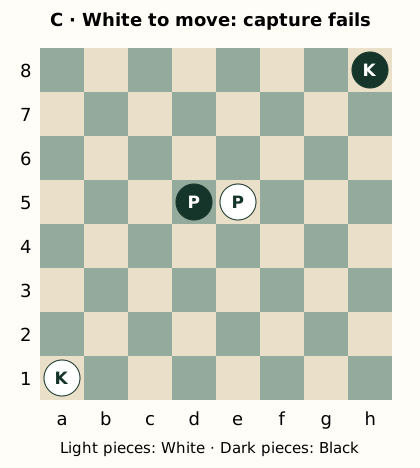
Start with White king a1 and pawn e5; Black king h8 and pawn d6, Black to move. Black plays d6–d5. White to move: the pawns look like A, but the last move was only one square. Do not play e5–d6 as a capture. The destination is empty and en passant is unavailable. Keep this board unchanged when checking that proposed capture.
D: waiting loses this opportunity
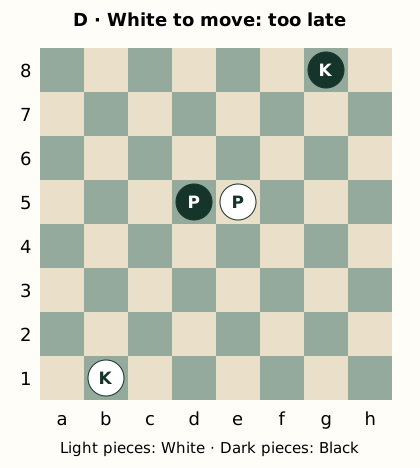
Use A after Black d7–d5. Instead of capturing, White plays Ka1–b1, then Black plays Kh8–g8. Both king moves are safe. White to move again: the pawns are still e5 and d5, but White may no longer capture en passant. The reply had to follow d7–d5 immediately.
E: removing two blockers can expose your king
Start with White king h5 and pawn g5; Black king a8, rook a5 and pawn f7, Black to move. Black plays f7–f5. White to move: the timing and pawn arrangement qualify, but g5xf6 en passant is illegal.
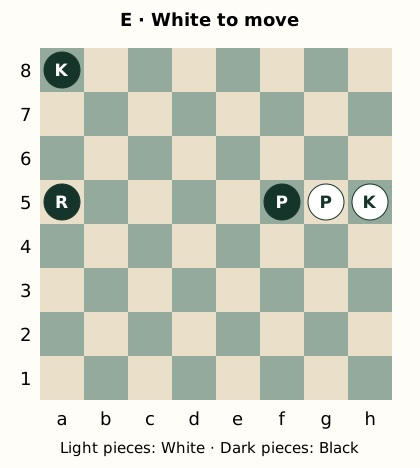
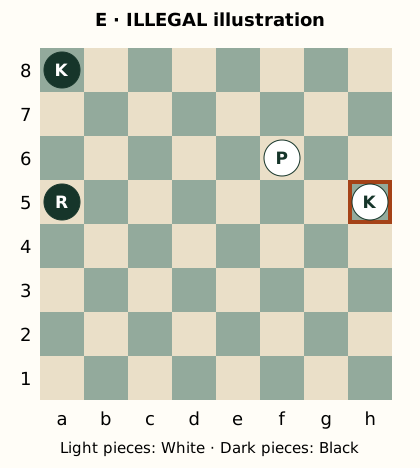
Before f7–f5, g5 already blocked the rook; afterward both pawns block it. The attempted capture clears both blockers at once. Check the whole resulting board, not just the landing square. Being in check does not automatically rule out en passant: it can be legal if it resolves the check and leaves the king safe.
Must you capture? Can you save it for later?
You may choose another legal move instead. That gives up this particular en passant opportunity; it cannot be saved for a later turn. In some positions en passant could be the only legal move, so “optional” does not permit making an illegal alternative.
Try the decision on your own board
Set up A after d7–d5 using a board you already own, or draw the squares on paper. Before moving anything, name the landing square, the removed pawn’s square and whose turn follows. Then compare your answer below.
Show the answer for A
White pawn e5 goes to d6; remove Black’s pawn from d5. Black moves next. The last move was a two-square pawn advance, the pawns were adjacent, and neither king is attacked in the resulting position.
Copyable decision record
Last move: ______ · Two-square advance from starting square: yes / no / unknown
My pawn: ______ · Opposing pawn: ______ · Adjacent on same rank: yes / no
Land on: ______ · Remove from: ______ · My king remains safe: yes / no
Decision: legal / illegal / history unknown · Reason: ______
If you want a reference for several different rules during family games, see how to choose a family chess rule book. You do not need to buy anything to practise these positions.
Rules source and editorial scope
Checked November 9, 2026 against the FIDE Laws of Chess, effective January 1, 2023: Article 3.7.2 covers the initial two-square advance; 3.7.3.1–2 covers en passant and its timing; 3.9.2 covers king safety. The rook-line example also applies 3.3 and 3.5. These diagrams and the worksheet are this publication’s teaching aids, not FIDE artwork or an endorsement.
Prepared by The Good Chess & Checkers editorial desk with AI-assisted research organization and drafting. AI output is not rules evidence. No hands-on tests, user observations or engine validation are claimed. See our publishing approach.