
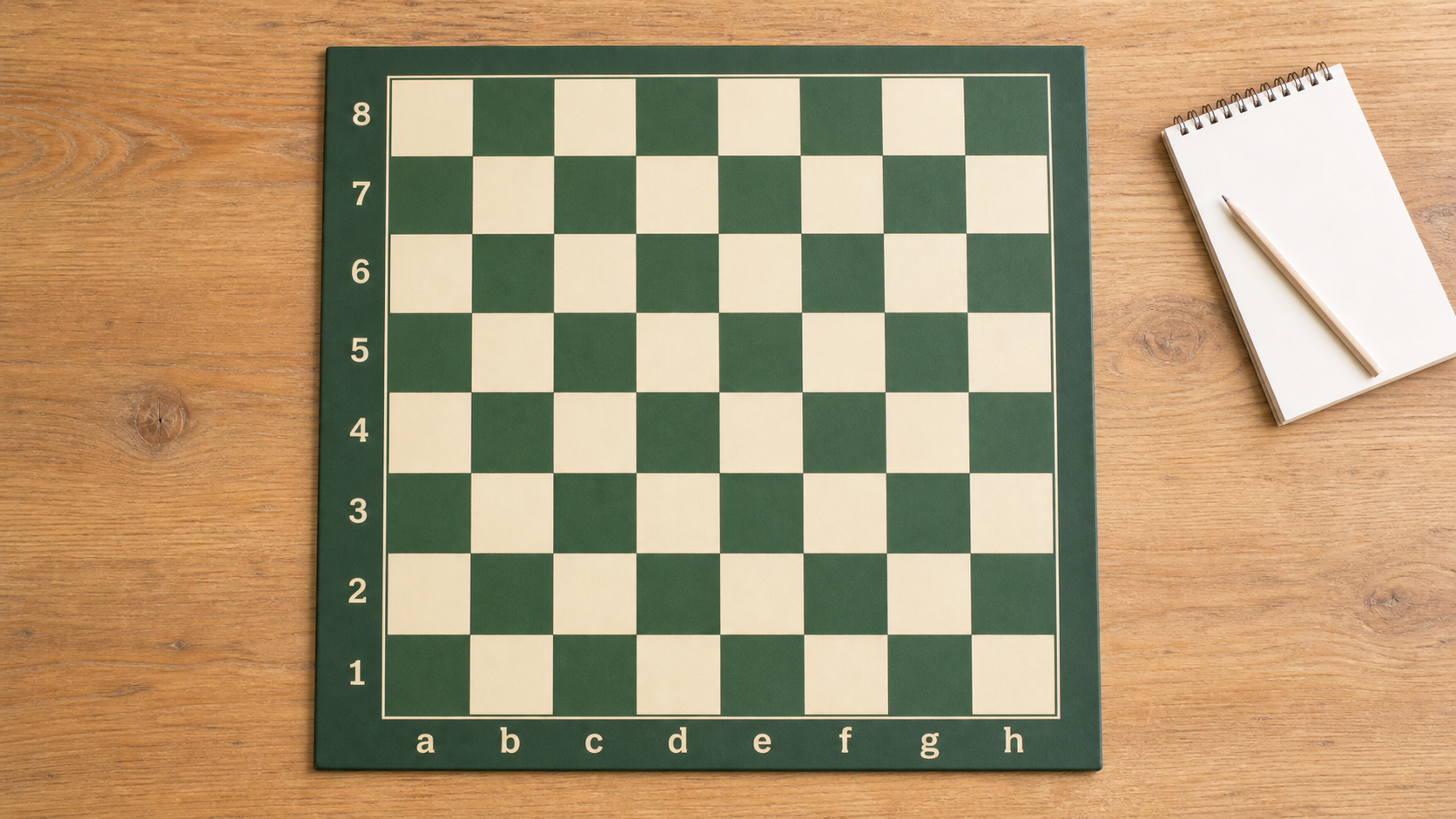
A chessboard with coordinates is worth it when a beginner regularly follows books, videos, puzzles, or lessons that name squares. The edge labels remove the small interruption of finding e4 or f7. They are not required to learn chess, and they do not justify replacing a clear board that already works.
If the learner is still focused only on recognizing pieces and making legal moves, delay the purchase. A paper edge reference or an app can bridge the gap until named squares become part of practice. For the wider learning path, use our beginner chess rules and piece-movement pillar.
The Good Chess & Checkers may earn commissions from qualifying purchases.
Quick decision aid
Compare coordinate-labeled chessboards
Check current listings for readable border labels, correct orientation, square size, contrast, included pieces, material, and storage. We have not tested the products returned by this shopping link.
Quick verdict: buy, skip, delay, or choose an alternative
- Buy when named squares appear in the learner's books, videos, puzzles, coaching, or game notes several times a week.
- Skip when the existing board is clear and games are mainly casual, face-to-face play without notation.
- Delay when the learner is still mastering piece names, legal moves, check, and basic setup.
- Choose a no-cost alternative by placing a printed a-to-h and 1-to-8 reference beside the current board.
- Choose an app when the learner mostly studies digitally and physical-board practice is occasional.
- Escalate the choice to a teacher or club helper if lessons use a specific board size, notation method, or shared equipment.
What coordinates do—and do not—solve
The vertical columns are called files and use letters a through h. The horizontal rows are called ranks and use numbers 1 through 8. Together they name each square: e4, for example, is where the e-file meets the fourth rank.
Printed labels make those names quicker to locate while following instruction. They can also help a beginner check board orientation: from White's side, the letters run a through h from left to right, the numbers rise from 1 to 8, and the lower-right square is light.
Labels do not teach tactics, make pieces easier to recognize, or automatically improve play. A low-contrast board with tiny squares remains a poor choice even if its coordinates are perfect.
Five criteria that decide whether labels are worth buying
- Actual study use: buy for a repeated need to find named squares, not because coordinates merely look instructional.
- Label placement: border labels usually create less visual clutter than letters and numbers printed inside the playing squares.
- Readability: coordinates should be visible from normal playing distance without overpowering the square pattern.
- Board orientation: confirm all letters and numbers are present, ordered correctly, and usable from the learner's side.
- Whole-board quality: square contrast, piece fit, flatness, table footprint, and storage matter more than the labels alone.
Red flags before buying
- Product photos crop off the border or do not show a complete sequence of labels.
- Coordinates are decorative, faint, or printed over busy colors.
- The board is sold alone, but the listing makes the pictured pieces look included.
- A tiny “study” board makes the pieces hard to identify or lift.
- Coordinates appear inside every square and distract a learner who already finds the board visually busy.
- The seller uses “professional” or “tournament” language without giving useful dimensions and materials.
- The new board duplicates one already owned without fixing a repeated learning problem.
Cost, maintenance, and setup tradeoffs
Coordinates are ink or engraving, so the feature itself should not drive an expensive upgrade. Compare the total setup: a board-only purchase may still require correctly sized pieces, a storage bag, or space for a rigid board. Temporary prices and claimed discounts are less useful than whether the board fits the learner's routine.
Material controls maintenance. Roll-up boards need storage that avoids hard creases; soft mousepad-style boards need enough rolled space; wooden boards take more shelf room and should be kept away from spills. Printed border labels can also wear if the board is repeatedly folded or scrubbed, so follow the maker's care instructions.
Setup should make study easier. A coordinate board that stays with mismatched pieces in separate closets may add more friction than a compact existing set plus a paper reference.
Who should skip a coordinate chessboard?
- Casual players who rarely use books, puzzles, notation, or spoken square names.
- Brand-new learners who are already processing piece shapes, moves, captures, and board setup.
- Anyone with a good existing board who can add a removable reference instead of replacing it.
- Players distracted by extra markings who learn more comfortably on a quiet, high-contrast board.
- Families prioritizing both chess and checkers when a clear combo set would be used more often than a chess-specific study board.
Try this no-spend test first
- Orient the current board with a light square at White's lower right.
- Write a through h on one strip of paper and 1 through 8 on another.
- Place the strips along White's near and left edges.
- Follow one real lesson, puzzle, or book diagram using named squares.
- Notice whether the reference reduces friction or becomes visual noise.
- Buy a labeled board only if that benefit repeats across several sessions.
Better alternatives by situation
For occasional notation: keep the current board and use removable paper labels. If recording games becomes a real habit, our beginner notation scorebook guide explains what to compare next.
For mostly digital lessons: use the on-screen coordinates, then recreate only selected positions on the physical board.
For a complete first setup: choose a readable board-and-piece set rather than buying a coordinate board without matching pieces. Start with the complete beginner chess set guide.
For shared chess and checkers play: prioritize square contrast, piece readability, and storage. Coordinate labels are chess-specific and should remain secondary to a set everyone will use.
Bottom line
A chessboard with coordinates is worth buying for a beginner who repeatedly follows named-square instruction and wants to work across books, videos, puzzles, lessons, and a physical board. Choose restrained, correctly ordered border labels on an otherwise clear board.
Skip or delay the purchase when the learner is still mastering basic moves, plays casually, or already owns a usable board. A simple paper reference is the best first test—and may be all the upgrade needed.