
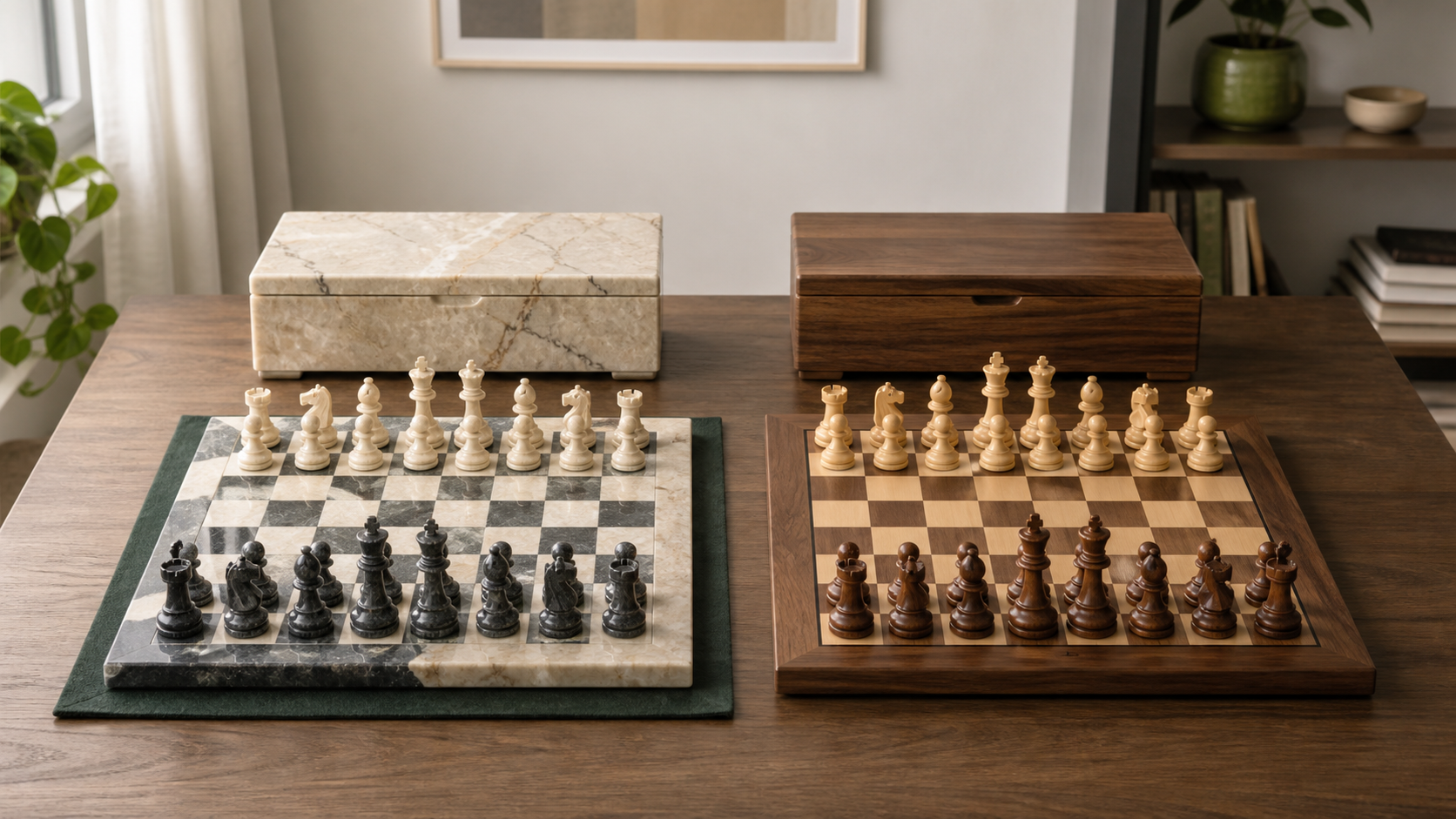
A marble chess set puts material and display presence first. A wooden set usually gives shoppers a wider range of familiar piece shapes, board formats, storage options, and replacement paths. Neither material guarantees a better game: the useful choice depends on how often the set will move, where it will live, and whether every piece remains easy to identify.
Choose by verified dimensions and construction rather than by staged photographs. “Marble” listings can describe natural stone, mixed stone, or stone-like materials, while “wooden” listings may use several woods or veneers. Check the current product description and care instructions for the exact set.
The Good Chess & Checkers may earn commissions from qualifying purchases.
Quick decision aid
Browse stone and wooden chess sets
Verify the stated material, board and square dimensions, piece height and base width, total set weight, underside protection, included storage, and maker care guidance. Do not infer those details from the hero image.
Quick decision
- Choose marble or stone when the set will have a stable display location, its verified contrast and silhouettes are clear, and you are comfortable following its stated handling and surface-care guidance.
- Choose wood when the set will be played and packed regularly, you want more folding or fitted-storage choices, or easy-to-match conventional pieces are a priority.
- Choose neither yet when the listing omits material, dimensions, piece bases, storage, total weight, or care information.
- Skip display-first sets when the main need is travel, classroom use, or a first board that several beginners will move frequently.
Compare readability before material
A chess set must make four things clear: the two square colors, the two piece colors, each piece type, and the edge of every occupied square. Natural veining can be attractive but busy; similar stone tones can also reduce contrast. Wood varies too, so compare actual listing photographs under ordinary light and favor conventional Staunton-style silhouettes when the player is learning.
Measure rather than guessing from the board's outside width. The usable square size should leave comfortable space around the widest piece base. Also check that the king, queen, bishop, knight, rook, and pawn remain distinct from the player's usual seated angle.
Weight changes the whole routine
Stone components can make a set inconvenient to lift even when the footprint fits the table. Use the seller's stated total weight and dimensions to plan the path from delivery to display, including stairs, cabinet clearance, and the surface supporting it. Do not assume material alone tells you how heavy a particular set is.
A wooden set can also be substantial, especially with a thick board or weighted pieces. The practical difference is not “heavy versus light” in the abstract; it is whether the complete packed set suits the person who will move it. If it stays out, measure the permanent play zone. If it gets packed after each game, evaluate the box, handles, latches, and shelf space as part of the set.
Handling, surface care, and storage
Check the maker's instructions for cleaning both the pieces and board. Confirm whether piece bases have felt or another protective layer, and consider a suitable mat beneath the board when the current guidance permits one. Grit trapped under any hard board can mark a table, so keep both contact surfaces clean and lift the board rather than sliding it.
Storage must protect a complete inventory without forcing pieces together. A fitted case can keep pieces separated; a folding wooden board may store them inside; separate boxes need more shelf planning. Before buying, verify that pictured storage is included and that its interior fits the tallest and widest pieces.
Replacement practicality matters for regular play
Natural pattern and color can make a lost stone piece difficult to match closely. A wooden piece may also be hard to match when its species, stain, shape, or production line is unusual. Ask whether the maker or seller describes replacement availability, but do not assume that a matching single piece will remain available later.
For frequent family play, conventional proportions and common colors can make a near match less distracting. Count every piece when unpacking, keep the packaging during the stated return period, and give the storage box a fixed location.
Gift and display fit
A stone set can suit an adult recipient who has requested that look and already has a stable place for it. A wooden set is often the more flexible surprise because shoppers can choose among folding, drawer, and separate-box formats. In either case, confirm the recipient wants chess, has the table and shelf space, and can identify the pieces comfortably.
If presentation is the main goal, compare the set against decorative glass chess-set criteria without assuming that any display material is automatically practical for beginners. If personalization is under consideration, decide between a personalized and standard chess-set gift only after the underlying set passes the playability checks.
Who should skip each option?
Skip marble or stone when the exact material and care instructions are unclear, the set must be moved frequently, visual contrast is weak, replacement matching matters, or there is no stable measured display area.
Skip wood when the listing hides construction details, the square and piece colors blend together, the finish or storage routine does not suit the household, or a buyer is choosing it only because “wood” sounds more playable.
Skip both for a portable club kit or changing classroom inventory. A roll-up board with standardized pieces may be easier to count, replace, label, and carry. For a beginner home set, start with first-set readability and size criteria.
Bottom line
Choose marble or stone when a verified set has clear contrast, recognizable pieces, workable weight, suitable underside protection, and a permanent home. Choose wood when regular handling, storage variety, conventional shapes, and replacement flexibility are more important. The material label is only the start; the complete board, pieces, storage, care instructions, and real household routine decide whether the set works.
The planned family-and-gift pillar is not yet built. Until it is, continue through the site's curated family and gift guide path.