
Choose a round-robin rotation when a stable group wants a planned path to playing everyone. Choose a ladder when attendance changes and members need to arrange games flexibly. Neither format has to rank ability or produce a champion: a casual club can use either simply to widen the mix of opponents.
The practical difference is where the work happens. A round robin asks the organizer to make and repair a schedule. A ladder asks the club to define challenges, record results, and prevent inactive names from blocking the list.
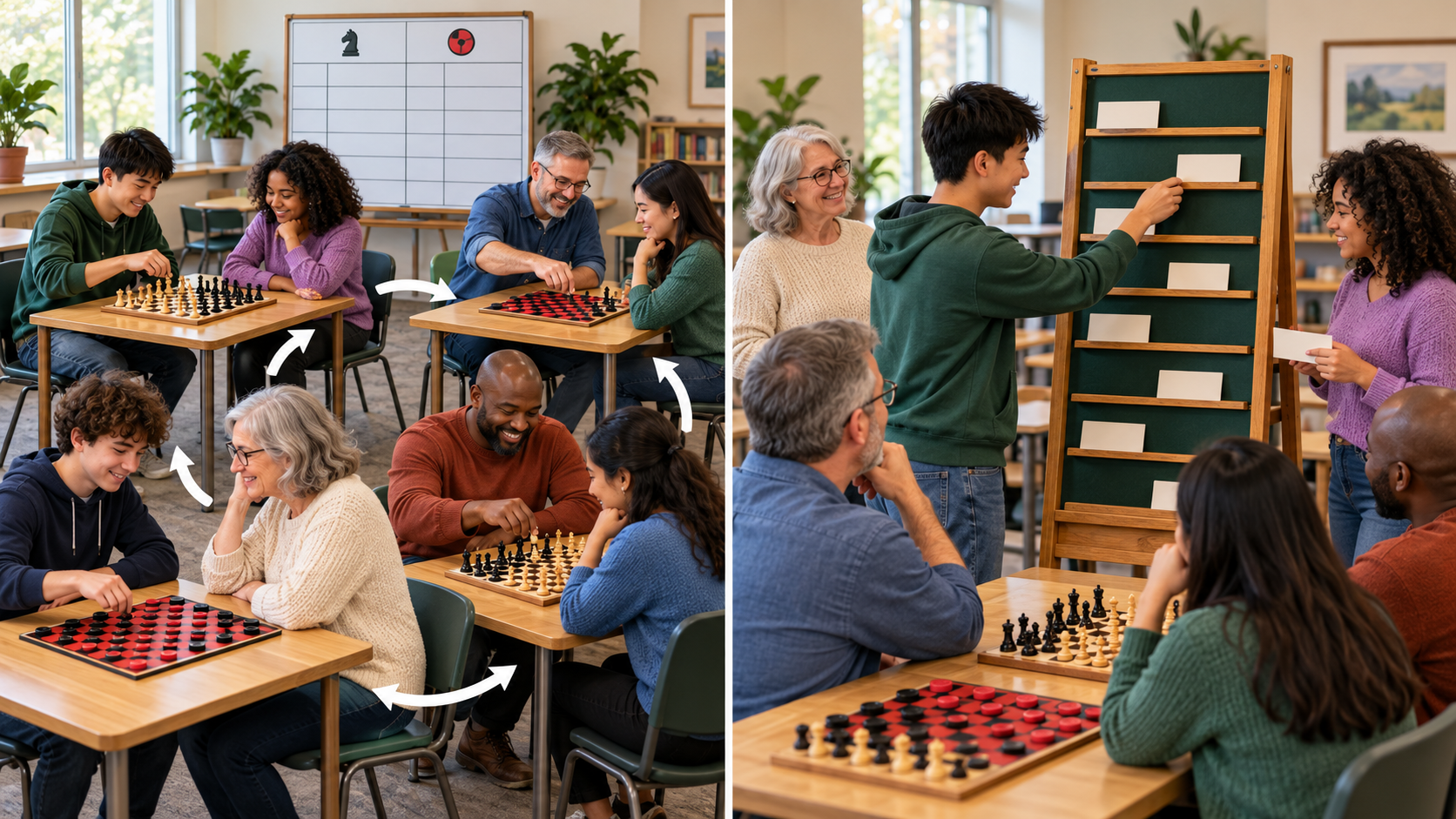
Quick decision
- Use a round robin when the same four to eight people attend most sessions, the club can publish pairings, and members value an even mix of opponents.
- Use a ladder when people join late, miss weeks, or need to arrange games at different times.
- Use a short rotation without standings when the real goal is introductions and varied play rather than competition.
- Skip both when members prefer open play, the organizer cannot maintain records, or public ordering would make the group less welcoming.
Option A: a scheduled round-robin rotation
In a complete round robin, each participant is paired with every other participant once. FIDE publishes Berger pairing tables for chess competitions; its table for five or six players shows five rounds and three pairings per round for a six-player field. That table is useful evidence for the schedule pattern, but a casual club is not required to adopt tournament procedures, scoring, tie-breaks, or ratings. Write local expectations for attendance, unfinished games, and substitutions.
This format gives each member a visible route through the group. It is easy to answer “Who have I not played?” and it reduces repeated pairings when everyone attends. The cost is rigidity: one absence can leave another person without the planned game, and adding a new member changes the schedule.
Who it fits
A round robin fits a small, stable club running a defined series of sessions. It also works for a one-day social rotation when games are short enough and the organizer does not need formal standings.
Option B: an ongoing challenge ladder
A ladder is a locally maintained ordered list. A member challenges someone allowed by the club's rules; the result may move one or both names. There is no single universal ladder rule. The club must decide the challenge range, response window, rematch wait, treatment of draws, inactive-member rule, and whether chess and checkers use separate ladders.
A ladder absorbs late arrivals more easily because a new name can enter at an announced position without rebuilding every future pairing. It also lets members arrange games around attendance. The tradeoff is uneven activity: frequent challengers can dominate the list, friends can repeat the same matchup, and an absent person can become a bottleneck unless inactivity rules are clear.
Who it fits
A ladder fits an open-ended club with variable attendance and members willing to initiate challenges. It works best when one helper owns the record and updates are visible soon after each game.
Six-player worked example
This is a hypothetical planning example, not an official pairing table. Six members—Ari, Bea, Cam, Dev, Eli, and Fran—meet weekly. The club wants each person to play one game per session.
Round-robin version
Five rounds cover all 15 pairings: three games per round, with every member playing once. The organizer can create five rows on a sheet and mark each game played, postponed, or skipped. If Cam misses round two, Cam's opponent needs an open game and the missed pairing needs a later slot. A seventh member cannot be folded into the original five-round plan without revising it.
Ladder version
Start with the six names in a deliberately neutral order—random draw or signup order is clearer than pretending it measures skill. Allow challenges up to two places above, one active challenge per member, and no immediate rematch. If Cam misses a week, other legal challenges can continue. A new member can join at the bottom or another locally agreed entry point, but the club should explain that choice before the first game.
The example exposes the decision: the round robin guarantees a planned variety if attendance holds; the ladder preserves activity when attendance does not.
Compare the full club routine
Attendance and late joins
Count how many people attended each of the last four comparable sessions. If nearly the same group appears, scheduling may be manageable. If attendance swings sharply, a ladder or open-play board is easier to repair. Decide in advance whether a late joiner waits for the next round robin, plays makeup games, or enters a ladder.
Game variety and rematches
A round robin builds variety into the schedule. A ladder needs a rematch limit or challenge-range rule if variety matters. For a mixed chess-and-checkers club, do not count one game as a substitute for the other unless members explicitly want a combined activity; separate lists are usually clearer.
Records and privacy
Keep only the fields needed to run the activity: display name or initials, pairing or challenge, game choice, date, result if used, and next action. Ask before displaying full names or standings publicly. If the group does not want a ranked list, call it a rotation board and record completed matchups instead.
Setup and maintenance
A round robin needs a roster, pairing sheet, absence plan, and a place for postponed games. A ladder needs a visible ordered list, challenge rules, an update owner, and an inactivity review date. Both need a reset point so stale records do not become permanent.
Printable planning fields
Copy these fields onto one sheet before the trial:
- Purpose: varied opponents, flexible games, social introductions, or a locally defined competition
- Game list: chess, checkers, or separate tracks for each
- Expected players and typical attendance range
- Round-robin absence and late-join rule
- Ladder challenge range, reply window, rematch wait, and inactive-name rule
- Result fields, display-name choice, record owner, and update deadline
- Trial end date and the question members will answer afterward
Run a two-session trial
- Use a short round-robin-style rotation in session one. Record attendance, idle time, repeated opponents avoided, and schedule repairs.
- Use a simple challenge list in session two. Keep the challenge range narrow and do not treat the starting order as a skill claim.
- Ask members which format made it easier to get a game, meet another player, and understand what to do next.
- Choose one format for a fixed trial period, publish the local rules, and set a review date.
Who should skip each format?
Skip a round robin when attendance is unpredictable, members cannot make up missed games, or the schedule creates more waiting than play. Skip a ladder when members are uncomfortable initiating challenges, public ordering feels exclusionary, or nobody can keep the list current. Skip both when a sign-up sheet, table rotation, or open-play host already gets everyone a useful game.
Sources and boundaries
The accessible FIDE primary source used here is General Regulations for Competitions, Annex 1: Details of Berger Table. Its five-or-six-player table supports the five-round, three-games-per-round schedule used in the hypothetical six-player example. It does not establish this page's ladder rules or casual-club policies. The earlier handbook foreword URL did not expose round-robin documentation when checked, so it is not relied on here. This page does not import FIDE tournament procedures into a casual club and does not prescribe official scoring, ratings, tie-breaks, eligibility, safeguarding, school policy, or event rules. The ladder workflow and named participants remain original planning illustrations; each club should document its own low-stakes rules.
Next steps
For the room and equipment around either format, use the beginner-friendly chess and checkers station guide. If the group is deciding whether clocks belong in lessons, compare a chess clock with a shared visual timer. Checkers helpers can also review the beginner checkers rules guide before writing local game expectations.
Bottom line
A round robin trades flexibility for a planned, even set of opponents. A ladder trades that even schedule for easier late joins and variable attendance. Test the actual club routine, keep local rules short, provide an unranked alternative, and choose the format that gets more members into clear, welcoming games with less organizer repair work.