
Numbered whole-kit bags are usually worth it when a club repeatedly issues at least several complete sets, different helpers handle setup and return, and missing items are difficult to trace. They are not a cure for poor counting, and buying new bags is unnecessary when durable number tags on correctly sized existing carriers already solve the problem.
The useful idea is one identity per complete kit: bag 4 contains board 4, piece pouch 4, and—if assigned—a clock and rule card marked 4. The number creates a return path. The bag only earns its space when that path makes check-in clearer.
As an Amazon Associate, The Good Chess & Checkers may earn from qualifying purchases.
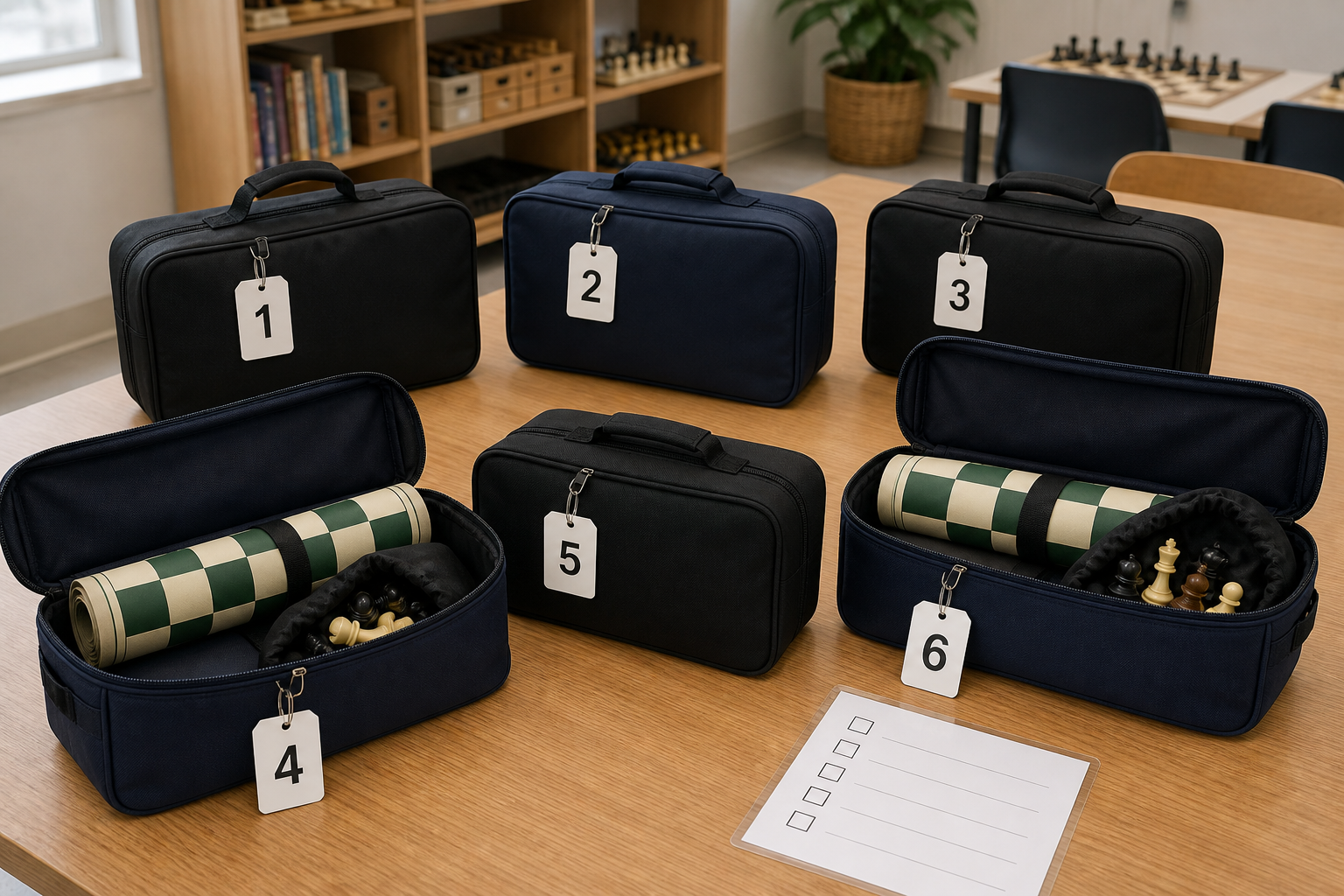
Quick decision aid
Browse label-ready chess equipment bags
Measure the relaxed board roll, filled piece pouch, clock, and papers. Confirm usable interior dimensions, separated storage, closure, handles, and a secure place for your own number tag.
Quick verdict
- Buy or assign one bag per kit when sets move between rooms or vehicles, volunteers issue them independently, and complete-kit accountability matters.
- Add number tags to existing bags when the carriers already fit and contain each kit. This is the sensible first choice for most clubs.
- Use category bins instead when one leader distributes all boards, pieces, and clocks from permanent storage and mixing identical equipment causes no delay.
- Skip the system for one or two sets, occasional play, or a club that does not perform a return count.
The problem numbers can actually solve
A number links an incomplete return to one kit. If bag 3 comes back without a dark bishop, the helper can record that against kit 3 rather than opening every container later. The same number on the board sleeve and piece pouch also makes separated items easier to reunite.
Numbers do not prove that a kit is complete. A bag can be zipped with 31 pieces inside. Pair the identity system with a short visible checklist: board, 16 light pieces, 16 dark pieces, and any assigned clock or teaching card. Keep the check appropriate to the equipment; checkers pieces need their own count and label if the program supports both games.
When numbered bags are worth the effort
Several kits follow the same route
The system becomes more useful as complete kits repeatedly travel from one shelf to separate tables and back. It is especially practical when players or different volunteers carry their own sets. A visible number lets everyone answer “where does this go?” without recognizing a particular board or pouch.
Equipment is assigned as a complete kit
Numbering works best when the club wants every board, army, and optional clock to remain together. If boards and pieces are intentionally pooled by category, forcing them into whole-kit bags adds repacking without supporting the established workflow.
Missing items need a traceable next action
A numbered record can show that kit 5 needs a replacement pawn before the next meeting. Keep the record factual and simple; do not use it to blame a player. The goal is to isolate the incomplete kit, prepare a temporary substitute if appropriate, and restore it before issue.
When bags are the wrong answer
Choose labeled bins or shelves when equipment never leaves the room and one helper distributes it in groups. A board bin, light-piece bin, dark-piece bin, and clock case can use shelf space more efficiently than several bulky bags. The tradeoff is that no individual kit owns its contents.
Skip new carriers when your present bags already fit. Durable luggage tags, hook-and-loop number patches, or laminated cards secured to existing tag loops can create the same kit identity. Confirm that tags cannot fall onto the board, snag a zipper, or hide the handle.
Also skip any bag that forces a board into a sharp fold, lets pieces rub against the playing surface, or lacks enough verified interior space. “Chess bag” wording does not establish compatibility; measure the actual equipment.
A one-week no-spend trial
- Choose four to six current kits and give each a temporary paper number.
- Put the matching number on the board sleeve and piece pouch without using permanent adhesive on the equipment.
- Write a one-line inventory for each kit and place it where the return helper can see it.
- Run the normal setup and return routine for a week.
- Record whether numbering reduced searching, mixed parts, recounting, or delayed repairs.
- Buy nothing unless the improvement is repeatable and the current containers are genuinely unsuitable.
How to choose a bag if the trial works
- Measure from equipment outward: use the board maker’s storage guidance, then measure the relaxed roll or permitted fold, filled piece pouch, and assigned accessories.
- Verify usable space: outside dimensions and styled photos do not confirm interior fit or opening width.
- Separate hard items: clocks and loose pieces should not press against a board surface.
- Make the number replaceable: clubs change kit contents. Prefer a tag loop, label window, or patch area over a number built permanently into an otherwise generic carrier.
- Check the loaded route: consider shelf depth, stairs, doorways, vehicle space, and who carries each kit.
- Standardize the return view: put the board, pieces, and checklist in the same compartments across all bags so helpers do not relearn each kit.
Numbered bags versus color-coded bins
Numbered bags favor complete-set accountability: one player or table receives one self-contained kit. Color-coded bins favor quick bulk distribution: all green boards may live together while pieces and clocks occupy separate containers. A mixed system can work—number complete travel kits and use color labels for shared teaching supplies—but avoid adding codes that no one uses during return. The set-bag versus color-coded-bin comparison walks through the full distribution, counting, shelf, and transport decision.
If one organizer transports several sets personally, a divided multi-kit tote may be easier than six individual bags. If different people carry equipment to tables, individual numbered kits usually create the clearer handoff.
Bottom line
Numbered equipment bags are worth it for a multi-set chess club only when complete kits move often enough for identity and traceability to improve the real check-in routine. Start by tagging existing carriers and testing the workflow. Buy new label-ready bags only when the trial works and the current containers fail verified fit, separation, carrying, or storage needs.