
Choose numbered bags when each table receives and returns one complete chess kit. Choose color-coded bins when one helper distributes boards and pieces in bulk from a fixed storage area. Bags make an incomplete kit easier to isolate; bins make pooled supplies faster to see and refill. The better system is the one that matches how equipment actually moves.
This is a workflow choice, not a claim that one container is universally faster. Before buying anything, run one normal club session with temporary labels and existing boxes. Count the handling steps and note where missing pieces, mixed boards, or crowded shelves create delay.
As an Amazon Associate, The Good Chess & Checkers may earn from qualifying purchases.
Match the container to the handoff
Compare complete-kit bags and open sorting bins
For bags, verify usable interior size, openings, separated piece storage, handles, and a secure label area. For bins, verify internal dimensions, shelf fit, handles, lid clearance if used, and how boards and pieces remain separated.
Quick decision
- Use numbered bags when players carry kits to different tables, different helpers check returns, or sets travel between rooms.
- Use color-coded bins when one storage point serves nearby tables and boards, light pieces, dark pieces, or teaching supplies are intentionally pooled.
- Use a small hybrid when complete playing kits travel in numbered bags but clocks, rule cards, and replacement pieces remain in shared bins.
- Buy neither yet when the club has only a few sets or has not tested labels and current containers during a real session.
What numbered bags do well
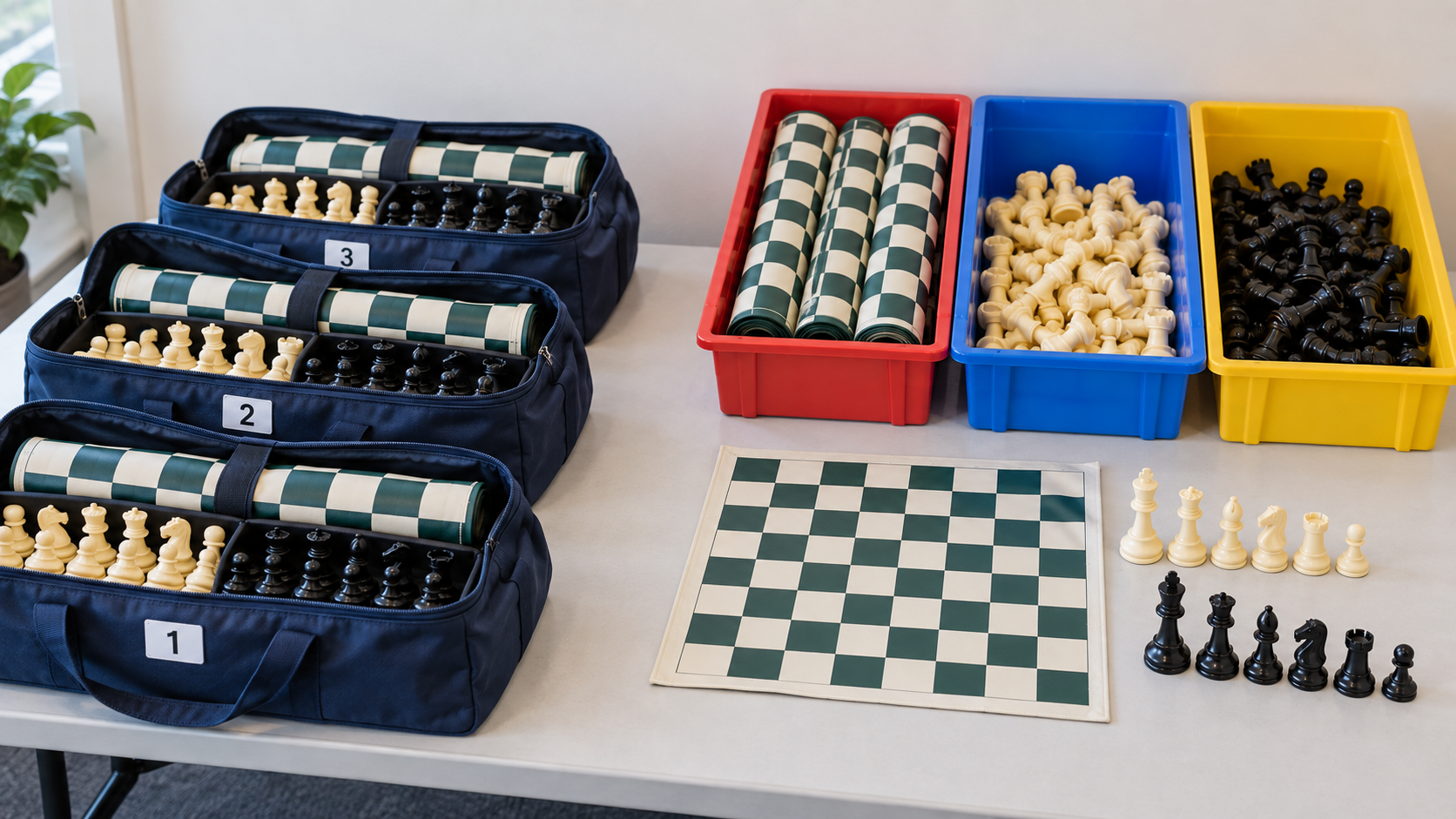
A numbered bag treats the board, pieces, and optional clock as one unit. Bag 2 goes to table 2 and returns with the same contents. If a pawn is missing, the helper can set that kit aside instead of searching every pooled container. This makes accountability concrete without assigning blame to a player.
The tradeoff is repetition. Every bag needs enough usable space and the same internal order. Helpers may open several bags to audit the full inventory, and soft carriers can occupy awkward shelf space. A number also does not prove completeness: pair it with a short inventory card and a consistent return check.
What color-coded bins do well
Bins make categories visible. A red bin can hold rolled boards, a blue bin light pieces, and a yellow bin dark pieces. One helper can place a board and two piece pouches at each table, then see at a glance which category has not returned.
This pooled approach is less useful when several people transport equipment independently. A missing rook belongs to the shared inventory rather than a named kit, and mixing piece styles or sizes can make matched sets harder to rebuild. Color must never be the only cue: add plain-language or symbol labels so the system remains understandable without relying on color perception.
Compare the full check-in routine
Distribution
Bags favor a one-grab handoff. Bins favor an assembly line. Count how many trips and decisions the helper makes from storage to the tables, including the return route—not just the first minute of setup.
Counting and exceptions
With bags, count each kit and quarantine only the incomplete one. With bins, count the pooled total or use pre-counted piece pouches inside the bins. Loose mixed pieces may look efficient until the closing count becomes a long sorting task.
Shelf and transport fit
Measure the actual shelf opening, vehicle space, doorways, and carrying route. Bags can compress but may slump or stack poorly. Rigid bins stack predictably only when their stated external dimensions and lid design fit the space. Do not infer internal capacity from exterior measurements or listing photos.
Chess and checkers together
A mixed-game program should label the game as well as the container. Keep chess armies separate from checkers discs even when boards are shared. Checkers pieces also need an agreed kinging method and a complete count for the ruleset being taught. The storage system should not make checkers supplies an unlabeled leftover category.
Run a no-spend trial
- Choose four existing sets and temporarily number their current carriers.
- Use current household or classroom boxes to create a second pooled station for boards and pre-counted piece pouches.
- Give both systems clear words or symbols as well as colors.
- Run the normal setup, play, return, count, and shelf routine.
- Record trips, unresolved missing items, repacking steps, and the final shelf footprint.
- Adopt the simpler repeatable workflow; purchase containers only when measured fit or condition makes the current ones unsuitable.
Buying checks that prevent a bad fit
- Measure the stored board: follow its maker's rolling or folding guidance and avoid sharp folds that the material was not designed to take.
- Measure filled piece pouches: include extra queens, rule cards, and any checkers pieces assigned to the station.
- Check usable openings: a zipper, tapered bin, handle, divider, or lid can reduce the space shown by outside dimensions.
- Keep hard items separated: clocks and loose pieces should not press against a flexible playing surface.
- Make labels replaceable: kit contents and shelf assignments change, so a removable tag or label window is more flexible than permanent numbering.
- Confirm cleaning guidance: follow the container and equipment makers' instructions rather than assuming every fabric or plastic tolerates the same method.
Who should skip each system?
Skip individual bags when one nearby cabinet supplies all tables, equipment is deliberately pooled, and the extra carriers only add packing. Skip open bins when gear travels between buildings, shelves are exposed to unrelated room use, or multiple helpers need complete self-contained kits. Skip a complicated hybrid when volunteers cannot explain it in one sentence.
If the real problem is verifying piece counts rather than moving containers, compare a counting tray with a reusable checklist. If the question is how many playable stations to fund, use the pair-board versus shared-display guide before adding storage.
Bottom line
Numbered set bags are the clearer choice for complete-kit ownership and distributed handoffs. Color-coded bins are the clearer choice for pooled inventory and centralized setup. Test both with current containers, preserve separate chess and checkers inventories, label with words or symbols as well as color, and buy only after the full return routine exposes a measurable problem.