
Weighted chess pieces are worth it for a beginner who plays regularly on a full-size board and is frustrated by light pieces tipping or sliding. They are an optional comfort upgrade, not a learning requirement. Ordinary readable pieces are enough when they already fit the board and remain stable during normal play.
Do not buy by “double weighted” or “triple weighted” wording alone; sellers do not necessarily use those labels consistently. Decide from useful measurements, construction details, board fit, carrying weight, and the problem you want to solve. For the broader equipment path, start with our beginner chess and checkers set buying pillar.
The Good Chess & Checkers may earn commissions from qualifying purchases.
Quick decision aid
Compare moderately weighted chess pieces
Check current listings for king height, widest base diameter, stated set weight, familiar shapes, flat felted bases, included pieces, and storage. We have not tested the products returned by this shopping link.
Quick verdict: buy, skip, delay, or choose an alternative
- Buy when the learner plays several times a week, uses a full-size board, and light pieces repeatedly tip during ordinary moves.
- Skip when the current pieces are recognizable, correctly sized, and stable enough.
- Delay when the beginner is not yet playing regularly or the board itself still needs replacing.
- Choose ordinary hollow pieces when low cost, easy replacement, or carrying several sets matters most.
- Choose a complete set when both board and pieces are needed and you want their sizes paired for you.
- Escalate the choice to a teacher or club organizer before standardizing several sets or assuming a particular equipment format is required.
What weighting changes
Weight lowers a piece's center of gravity and can make it less eager to tip after a sleeve, hand, or small table bump catches it. The difference is about handling and stability. It does not teach legal moves, tactics, notation, or good board vision.
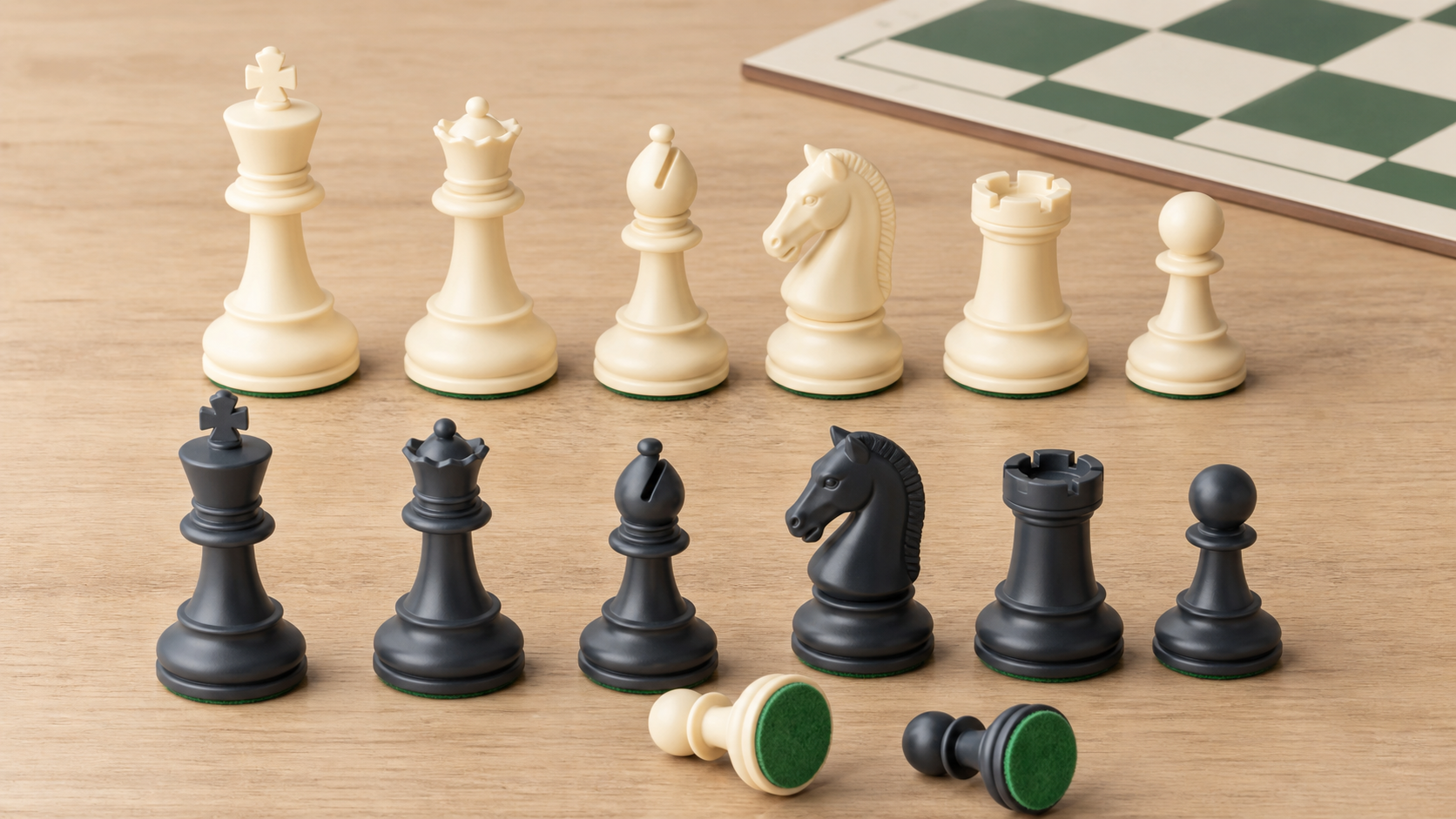
Construction matters as much as total weight. A broad, flat base can be stable without extreme heft, while a narrow or uneven base can still feel awkward. Felt or another base covering may protect the board and help pieces move smoothly, but it should lie flat and remain securely attached.
Five criteria that decide whether weight is worth paying for
- Repeated stability problem: identify real tipping or sliding during play rather than buying weight as a vague quality signal.
- Base-to-square fit: compare the widest listed base with one board square and leave visible space around crowded pieces.
- Recognizable shapes: familiar Staunton-style silhouettes help a beginner more than added weight under confusing themed designs.
- Carrying routine: the advantage at the table becomes extra load in a backpack, classroom bin, or multi-set club bag.
- Replacement practicality: common plastic designs are usually easier to match than unusual colors, materials, or carvings.
Red flags before buying
- The listing relies on “double,” “triple,” “professional,” or “tournament” language without useful measurements.
- No base diameter is provided, so compatibility with the current board cannot be checked.
- Photos hide the bases or show pieces crowded edge to edge inside their squares.
- The set weight is highlighted, but the number of included pieces is unclear.
- Decorative shapes make bishops, queens, kings, or pawns difficult for a beginner to distinguish.
- The storage bag or box appears too tight for crowns, crosses, knights, and any extra queens.
- A separate piece purchase costs more or creates more work than a complete board-and-piece set that fits the actual need.
Cost, maintenance, and setup tradeoffs
Weighted pieces usually add material and shipping weight, but a higher temporary price does not prove better balance or construction. Compare current specifications and the full setup cost, including a compatible board and storage. Do not pay extra merely for a marketing tier.
Inspect felted bases periodically. Loose felt, grit, or adhesive residue can make pieces wobble or mark a board. Count all pieces after play, store them dry, and avoid packing detailed tops tightly against one another. Wooden pieces may need more careful storage than common molded plastic.
Setup is easiest when pieces and board live together. Piece-only upgrades can create mismatched scale or an extra storage bag. Measure first and confirm that the intended shelf, case, and playing table can handle the complete set.
Who should skip weighted chess pieces?
- Occasional players whose current pieces already stay upright during casual games.
- Daily travelers who will notice bag weight more often than tabletop stability.
- Classrooms and clubs moving many sets when lighter matching equipment is easier to carry, count, and replace.
- Owners of compact or travel boards where full-size broad bases will crowd the squares.
- Families needing chess and checkers together if a useful combo set is a better shelf purchase than a chess-only piece upgrade.
- Beginners who still need the board and would be better served by one complete, compatible set.
Try a no-spend stability test first
- Set up the current board on the table normally used for play.
- Play two or three complete games without deliberately testing or knocking the pieces.
- Note whether tipping happens repeatedly, which pieces are affected, and whether the board itself slides.
- Check whether a flatter table surface or nonslip board backing solves the actual problem.
- Measure one square and the widest current piece base.
- Upgrade only if extra piece stability remains the repeated issue.
Better alternatives by situation
If you need everything: choose a complete beginner set so the board and pieces arrive in a compatible scale. Compare the complete chess set formats for absolute beginners.
If pieces are merely unclear: prioritize familiar shapes, contrast, and board fit instead of weight. Our beginner chess piece guide covers the wider decision.
If the board slides: fix the board or table surface first; heavier pieces do not stop the playing surface from moving.
If equipment travels daily: choose lighter, common plastic pieces and a secure bag. A stable home set can remain separate if regular practice later justifies it.
Bottom line
Moderately weighted chess pieces can be worth it when a beginner plays often on a full-size board and genuinely benefits from steadier handling. Choose familiar shapes, broad flat bases, verified dimensions, workable storage, and a weight the player will actually carry and reset.
Skip or delay the upgrade when existing pieces work, play is occasional, or both board and pieces still need buying. Weight is a comfort feature—not a shortcut to learning or a requirement for serious chess.