
An analysis chess set is a physical board used to replay positions from a book, lesson, saved game, or screen. The useful choice is not automatically a miniature board: it is the smallest setup that remains easy to scan, reset, and fit beside your reference material.
This is a product-category comparison, not a named-product ranking or hands-on test. Listings change, so verify the stated dimensions, piece count, storage, materials, and return terms before buying.
The Good Chess & Checkers may earn commissions from qualifying purchases.
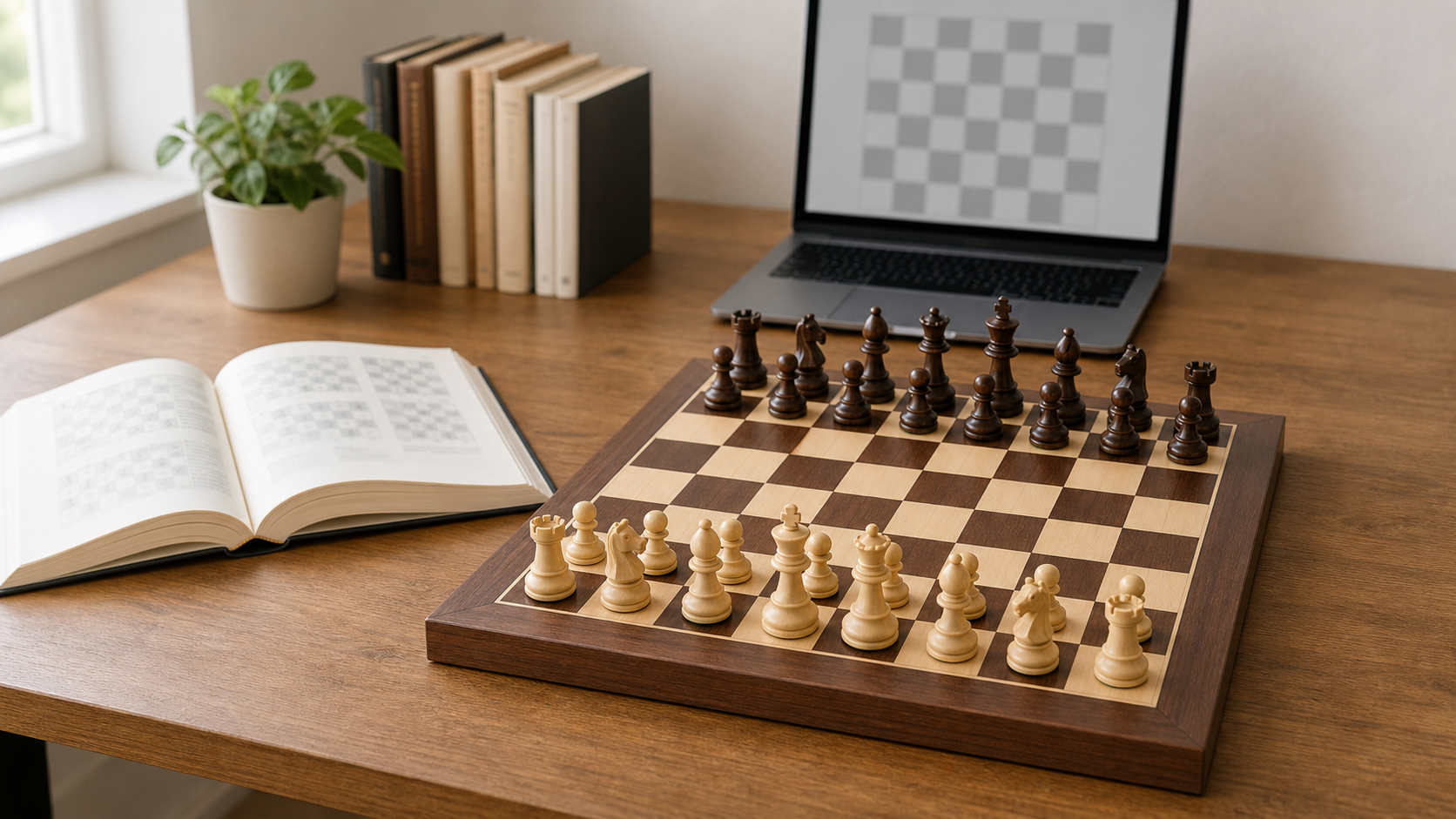
Quick decision aid
Start with your complete study footprint
Measure the board together with the open book, notebook, or screen you use. Then compare square size, recognizable pieces, coordinates, stability, and storage.
Quick selection framework
- Complete footprint: measure the desk area after allowing space for an open book, laptop, mouse, notebook, and your forearms.
- Square and piece size: compare the king's base with the square width and make sure crowded positions remain readable.
- Piece recognition: familiar Staunton-style silhouettes reduce the effort of identifying a position repeatedly.
- Coordinates: edge labels help when a source names squares, provided they are clear and oriented correctly.
- Stability: a flat board and pieces with sensible bases matter more than decorative weight.
- Reset and storage: repeated study is easier when all 32 pieces are quick to sort and the board can stay nearby.
Best for a small desk: compact analysis sets
A compact rigid board leaves room for a book or laptop without reducing the game to a phone screen. Look for pieces with distinct shapes rather than ornamental detail. Check the open dimensions, not just the box size, and sketch the combined layout on your desk before ordering.
Best for: short replay sessions at a desk where a full-size board would crowd the reference material.
Skip it if: the pieces are hard to distinguish or pick up, or the smaller board makes dense positions tiring to scan.
Best for long study sessions: readable full-size sets
If your table can hold both board and reference, an ordinary full-size set may be the better analysis set. Larger squares can make variations easier to follow, and familiar pieces reduce friction when you reset a position several times. A plain vinyl, mousepad, or rigid board can work; the material is secondary to flatness, contrast, and fit.
Best for: a dedicated table, longer sessions, and players who already own storage for the board and pieces.
Skip it if: setup blocks the keyboard, book, or note-taking area, or storing the board turns every session into a chore.
Best for packing away after study: folding sets
A folding board with interior piece storage keeps the study kit together. Check whether the board opens flat and whether fitted compartments slow down repeated resets. A central seam is usually less important than warped halves or a raised hinge.
Best for: shared dining tables, multipurpose desks, dorm rooms, and study materials that must be cleared away.
Skip it if: the fold interrupts piece placement, the storage insert is fiddly, or a simple board-and-pouch setup would be quicker.
Best when you already own suitable pieces: board-only setups
A coordinate board sold without pieces can be a sensible route when your existing army fits it. Measure the piece bases and board squares together: comfortable clearance matters more than whether either item is labeled “analysis.” Keep both sides complete and visually distinct.
Best for: reusing familiar pieces and choosing a desk-sized board independently.
Skip it if: you cannot verify the size match or your current pieces are incomplete, unstable, or difficult to identify.
Physical board or digital-only study?
- Choose a physical set when moving pieces helps you follow a book or you want to practice setting up positions without dragging on a screen.
- Choose digital-only when desk space is scarce, automatic position setup matters, or you need to carry nothing.
- Use both when the screen supplies the lesson and the board is the workspace, but confirm the combined layout is comfortable.
A physical board does not guarantee better learning, and a smaller “analysis” label does not make a set more useful. Choose the format that removes friction from the study routine you will actually follow.
Pre-purchase checklist
- Measure the full desk area available beside your usual book, laptop, or notebook.
- Verify an 8-by-8 board and a complete set of 32 recognizable pieces.
- Compare square width with piece-base diameter and king height rather than judging board size alone.
- Confirm whether coordinates appear on all useful edges and match the orientation used by your lessons.
- Inspect listing images for contrast, flatness, seam height, piece shapes, and storage layout.
- Check whether the open board can remain set up between sessions or must be cleared immediately.
- Ignore unsupported “professional,” “tournament,” or learning-performance claims; buy for measurable fit.
Who should skip a dedicated analysis set?
Skip a separate purchase if your current board fits beside your study material, a borrowed set is easy to keep nearby, or digital replay already suits you. Also skip miniature pieces if handling or quick recognition becomes the main task instead of studying the position.
If you need a board mainly for ordinary games, start with the beginner chess board guide. If notation is the obstacle, the coordinate-board decision guide explains when labels help and when a small reference card is enough.
Bottom line
The best analysis chess set is the one that makes replaying positions simple without crowding the source you are studying. Choose compact for constrained desks, full-size for comfortable long sessions, folding for quick clearing, or board-only when suitable pieces are already available. Measure the complete study layout, then favor recognition, flatness, contrast, and easy resets over marketing labels.