
A good shelf keeps boards flat, pieces together, and the set you use most within easy reach. The useful question is not which shelf has the most cubbies. It is whether the shelf’s clear internal dimensions fit your largest board or box, with room to lift it out without scraping neighboring games.
This is a category comparison, not a list of named winners or a claim of hands-on furniture testing. Measure the games and the room first, then verify the maker’s current dimensions, load guidance, assembly instructions, and wall-restraint information before buying.
The Good Chess & Checkers may earn commissions from qualifying purchases.
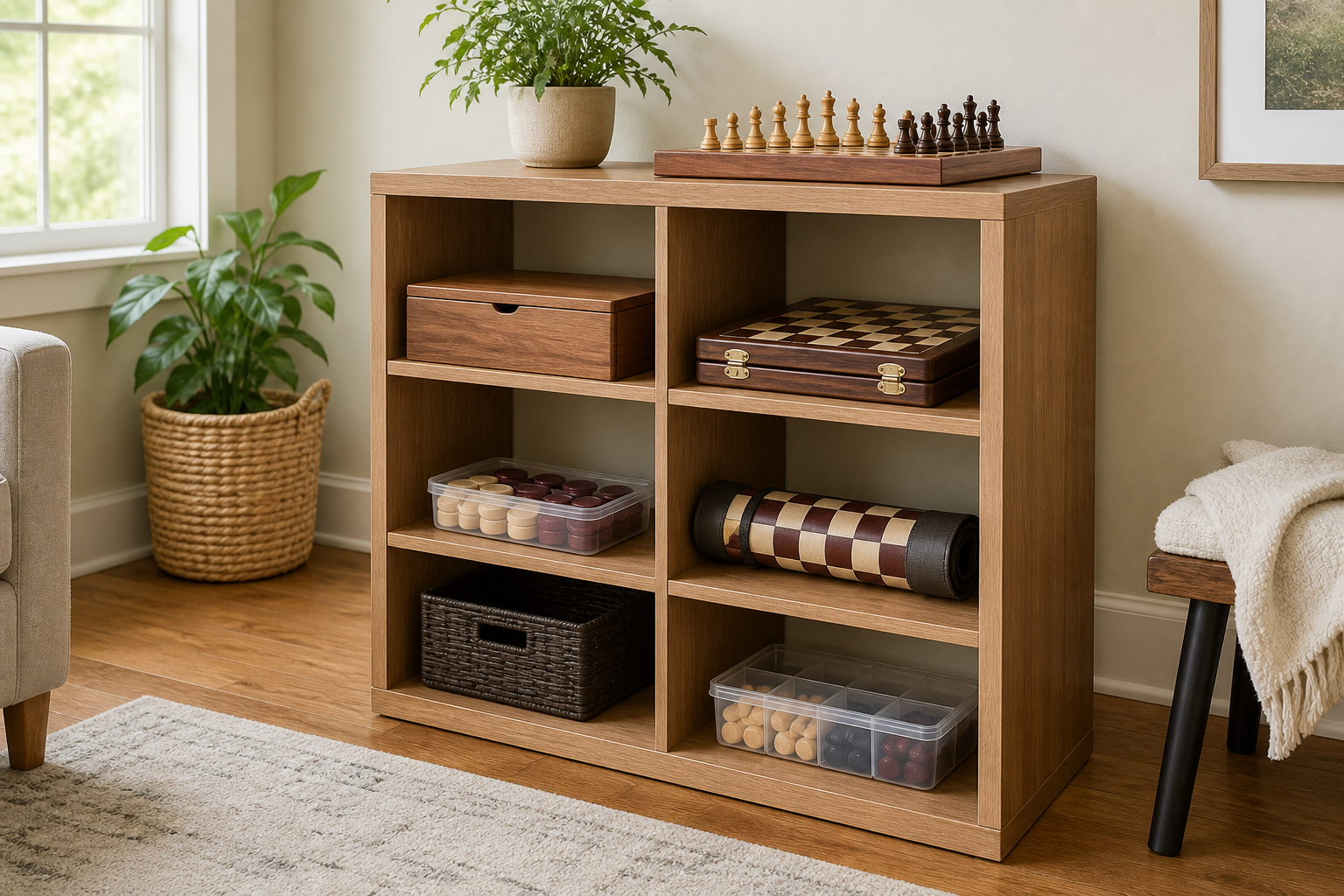
Quick decision aid
Start with the largest board or box
Compare clear shelf depth, opening width and height, adjustable-shelf spacing, base footprint, and the manufacturer’s load and restraint guidance. Overall furniture dimensions do not tell you the usable space inside each opening.
Quick comparison framework
- Usable opening: measure the clear width, height, and depth inside the shelf, accounting for doors, hinges, trim, and a back panel.
- Board orientation: decide whether rigid boards will lie flat, stand vertically in a divider, or remain inside a fitted box.
- Access: leave finger clearance above boxes and avoid stacks that require removing several games to reach one set.
- Load placement: keep denser wooden sets low and follow the manufacturer’s per-shelf and total load guidance.
- Small-part control: use closed containers for checkers, chess pieces, clocks, scorebooks, and replacement parts.
- Room fit: check the furniture footprint, walking clearance, baseboard interference, outlet access, and any specified anchoring or restraint steps.
Best all-around format: adjustable open bookcase
An adjustable bookcase is flexible when the collection mixes shallow board boxes, taller piece containers, and books. Movable shelves let you minimize wasted height while keeping frequently used sets around waist level. Look at the adjustment intervals as well as the maximum opening; wide spacing between peg positions can leave an awkward gap.
Best for: a changing family collection that includes books and accessories as well as boxed games.
Skip it if: the deepest box would overhang, loose pieces need concealed storage, or the room cannot accommodate the maker’s installation and restraint directions.
Best for one-set-per-space organization: cube storage
Cube units give each set or accessory bin an obvious home. They simplify cleanup because a family member can return one container without rebuilding a tall stack. Measure the actual cube opening: a unit that looks roomy in a photo may still be too shallow for a full-size rigid board or long tournament-style box.
Best for: families, classrooms, and casual clubs that value quick visual sorting.
Skip it if: fixed dividers waste too much space or most boards are wider than the openings.
Best for large flat boxes: wide, deep shelving
A wider opening can hold a complete set flat without turning it sideways. This helps protect boxes whose lids lift off and reduces the need to balance them on an edge. Favor several short stacks over one tall stack, and put heavier wooden sets near the bottom.
Best for: boxed wooden combo sets, large family boards, and collections with consistent box dimensions.
Skip it if: the shelf is deeper than the room allows or the wide span lacks clearly stated load guidance.
Best for a mixed game corner: shelf-and-bin system
Open shelves handle complete boxed sets while fitted bins contain loose pieces, chess clocks, rule cards, and replacement parts. Transparent or consistently labeled containers reduce rummaging, but the bin’s outside dimensions must fit the shelf opening and its inside dimensions must fit the pieces.
Best for: shared shelves where chess and checkers equipment gets separated during lessons or family play.
Skip it if: every set already has a durable fitted case or bins would hide which game is ready to play.
Measure before comparing listings
- Measure the largest box or rigid board in all three dimensions.
- Add hand clearance above and beside it so it can be removed without dragging.
- Group remaining gear into flat boards, rolled boards, boxed sets, loose pieces, books, and clocks.
- Sketch which items need a full opening and which can share a bin.
- Compare that plan with the shelf’s clear internal dimensions—not only its outside dimensions.
If the set itself has not been chosen yet, the shared-game-shelf set guide helps match board format and storage footprint before furniture becomes the constraint.
Horizontal or vertical board storage?
Keep a rigid board flat when its construction or maker guidance makes edge storage unsuitable. Vertical storage can save width, but it needs a stable divider or properly fitted board stand so boards do not lean, slide, or rub against hardware. Roll flexible boards only according to their care directions; do not force them into a short cubby by folding them.
Who should skip dedicated game shelving?
Skip a new shelf if the collection is one portable set that already stores safely in a closet, if floor space matters more than display access, or if a low cabinet you already own passes the same dimension and load checks. A family storage plan may solve the problem with labeled bins, carrying bags, or a drawer instead.
Bottom line
The best board-game shelf for chess and checkers is the format whose clear openings fit the collection with retrieval room to spare. Measure first, store dense sets low, give loose pieces a closed container, and reject listings that omit the internal dimensions or guidance you need to use the unit as intended.