
The best chess and checkers storage idea is the one that keeps the next game easy to start. If the pieces are mixed in a drawer, the checkers are missing, or the board has to be cleared from under other games, family game night gets slower before anyone makes a move.
This guide compares practical storage categories rather than ranking specific products. It does not claim hands-on testing, current prices, ratings, safety certification, or live availability. If you are buying a new set because the old storage no longer works, compare this with how to choose a chess and checkers set for a shared game shelf. If the board has to fit a small apartment, use chess and checkers sets for small spaces before choosing a storage format.
As an Amazon Associate, The Good Chess & Checkers may earn from qualifying purchases.

Quick decision aid
Choose the products in this guide
Compare these affiliate product routes first, then use the guide criteria to choose the board, pieces, storage, clock, or learning aid that fits the player.
Helpful product path
What Family Storage Has to Solve
Chess and checkers storage is not just about making a shelf look neat. A good system should make missing pieces obvious, separate chess pieces from checkers, protect the board, and let children or guests help clean up without guessing. If the furniture itself is the problem, use the dimension-first board-game shelf guide before choosing bins or rearranging the collection.
- Piece separation: chess pieces, checkers, extra queens, and rule cards need obvious homes.
- Fast counting: families should be able to notice when the set no longer has 32 chess pieces or 24 checkers.
- Board protection: folding boards, roll-up boards, and flat boards all need different storage habits.
- Child-friendly cleanup: labels, trays, and color cues help newer players put things back correctly.
- Shared-shelf fit: the storage should match the space where the game actually lives, not an ideal closet no one uses.
Best Overall: Labeled Zip Bags Inside the Game Box
Labeled zip bags are the simplest upgrade for many family sets. One bag can hold chess pieces, one can hold checkers, and a smaller bag can hold extra queens, rule cards, or replacement pieces. The original box still holds the board, but the pieces stop becoming one mixed pile.
Use large, easy-to-read labels instead of tiny notes. If children help clean up, labels such as "chess pieces," "checkers," and "rule cards" are more useful than abbreviations. Clear bags also make it easier to spot a missing color before the box goes back on the shelf.
Best for: families who already own a boxed set and want a cheap, low-effort way to stop piece mixing.
Skip it if: the box is broken, the bags keep sliding out, or small loose bags are likely to get separated from the board.
Best for Quick Cleanup: A Shallow Divided Tray
A shallow divided tray works well when the board comes out often and cleanup needs to be obvious. Use one section for light chess pieces, one for dark chess pieces, one for light checkers, one for dark checkers, and a small section for rule cards or spare pieces.
The tray should fit where the game is played or stored. A beautiful organizer that only fits in a distant closet may not help on a weeknight. For a family shelf, a tray with low sides and visible sections is often better than a deep bin where pieces disappear under each other.
Best for: family rooms, game shelves, homeschool tables, and grandparents' houses where the same set is used repeatedly.
Skip it if: the tray has no lid and the set needs to travel, or if the compartments are too small for taller chess pieces.
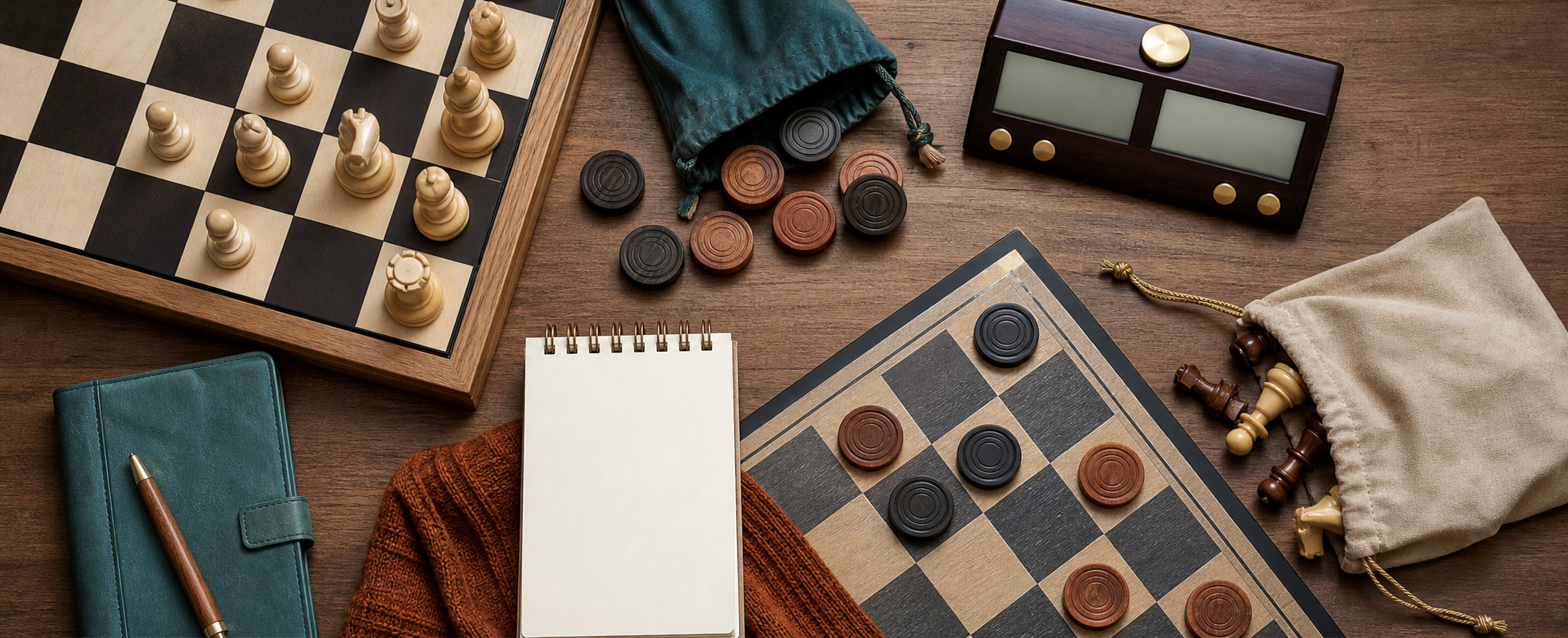
Best for Travel and Visits: Drawstring Bags by Game
Drawstring bags are useful when a set moves between rooms, houses, cabins, or family trips. A soft bag can hold chess pieces, another can hold checkers, and both can sit beside a folding or roll-up board.
Choose bags that are large enough to open wide. If the opening is too tight, pieces get dumped out instead of sorted. Color-coded bags help: one color for chess, another for checkers, and a smaller pouch for rule cards or spare pieces.
Best for: travel sets, family visits, shared custody game bags, cabins, and sets that move between a living room and a dining table.
Skip it if: the board also needs protection, the bags are not labeled, or the pieces are small enough to vanish into sofa cushions.
Best for One-Piece Storage: Folding Sets with Interior Compartments
If the current set is always scattered, a folding chess and checkers set with interior storage can be the cleanest long-term answer. The board becomes the case, so pieces and playing surface stay together.
Interior storage quality matters. Look for compartments that actually hold both chess pieces and checkers without crushing them when the board closes. If the pieces rattle loosely inside, add small cloth bags or divider cards so cleanup still has a system.
Best for: families buying a replacement set, grandparents who want one self-contained game, and small shelves where separate boxes create clutter.
Skip it if: the hinges feel fragile, the latch opens in a bag, the board does not lie flat, or the interior storage makes missing pieces hard to notice.
Best for Multiple Sets: Clear Bins with Set Cards
Families with several boards need a different habit than families with one set. Clear bins can hold a complete set, but each bin should include a simple set card: board type, number of chess pieces, number of checkers, and any house-rule notes.
A set card prevents the "which pieces belong with this board?" problem. It also helps before game night: if the bin says 24 checkers and only 22 are inside, the missing pieces can be found before players sit down.
Best for: larger families, shared playrooms, homeschool groups, small clubs, and game shelves with several boards.
Skip it if: the bins are opaque, too deep, or large enough that unrelated toys and games start sharing the same container.
Best Habit: A Two-Minute End-of-Game Count
The storage container only does part of the work. The best family habit is a quick count before the set goes away: 16 light chess pieces, 16 dark chess pieces, 12 light checkers, and 12 dark checkers. Extra queens, if included, should have their own spot.
This does not need to feel strict. Make the count part of reset, like putting cards back in a deck. For children, a visual card with the expected pieces is easier than a parent calling out numbers from memory.
Best for: every family storage system, especially sets used by children, guests, or mixed-age groups.
Skip it if: no one will maintain the habit; in that case, choose storage that makes missing pieces visible without a full count.
Quick Comparison Framework
- Choose labeled zip bags when the original box is usable but pieces keep mixing together.
- Choose a shallow divided tray when the set lives on a shelf and needs fast family cleanup.
- Choose drawstring bags when the set moves between rooms, homes, or trips.
- Choose a folding set with interior storage when you are replacing the set and want board plus pieces in one case.
- Choose clear bins with set cards when the family owns multiple boards or runs repeated group play.
- Add a two-minute count when missing pieces are the main frustration.
Who Should Skip Buying Storage Accessories?
If the board and pieces remain useful but the original carton or insert has failed, use the replacement storage-box guide to measure complete-set capacity, lid clearance, dividers, and shelf fit before replacing the whole set.
Skip extra storage accessories if the real problem is the set itself. If the board is too tiny, the pieces are hard to identify, or the box is falling apart, bags and trays may only preserve a frustrating setup. A replacement set may be more useful than organizing a set nobody enjoys using.
Also skip elaborate organizers if the family will not return pieces to specific compartments. A simple labeled bag beats a complicated box that only one adult understands.
Bottom Line
For most families, start with labeled bags or a shallow divided tray before buying a new organizer. If the set travels, use separate drawstring bags. If the whole set needs replacing, choose a folding board with sensible interior storage. If several boards share one shelf, use clear bins and set cards.
The goal is not a perfect shelf photo. The goal is a chess and checkers set that comes out complete, goes away quickly, and is ready for the next person who wants to play.