
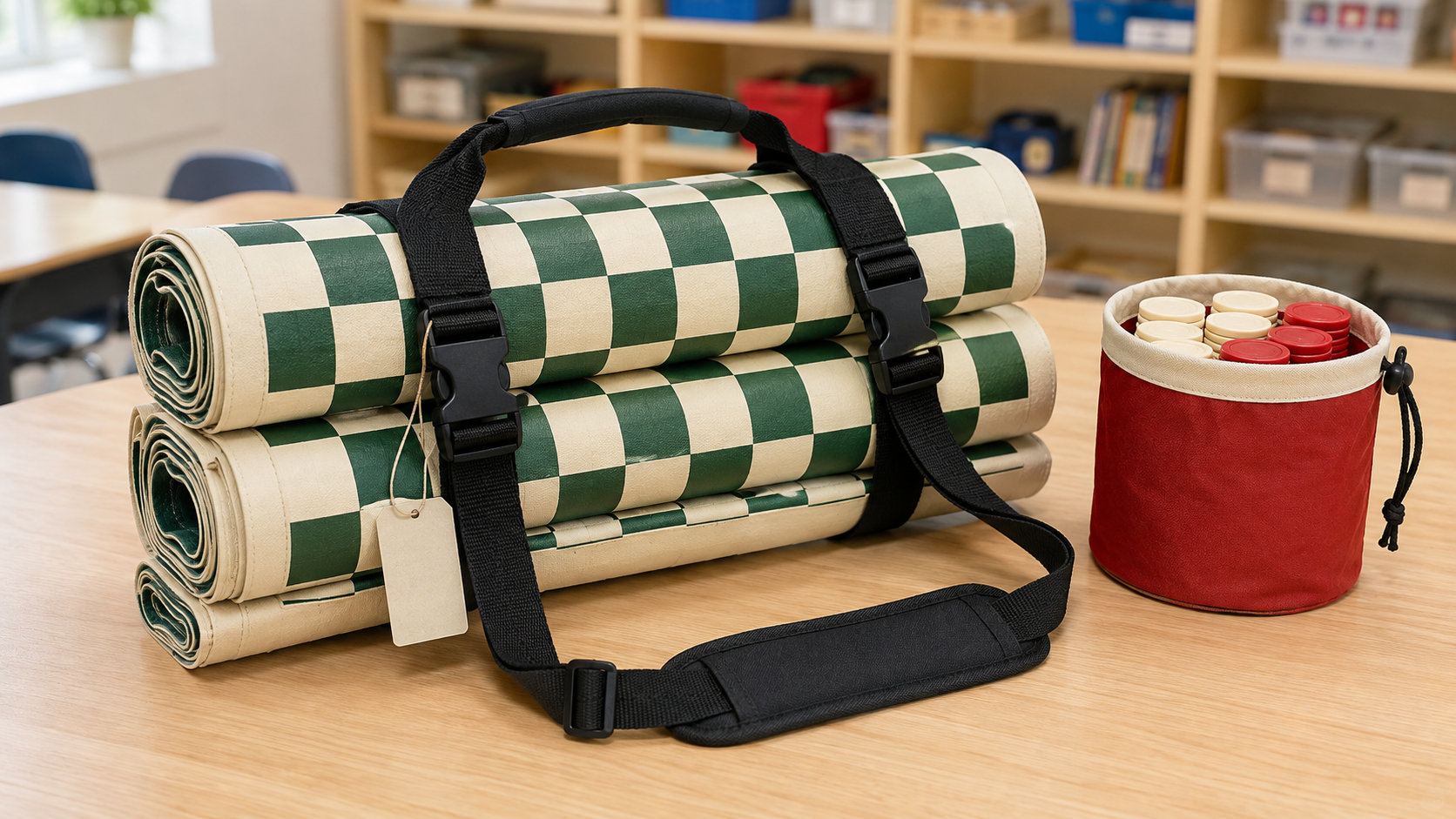
A carrying strap solves a specific problem: moving several roll-up checkers boards while leaving a hand free for the piece bags. It is lighter and less bulky than a full set case, but only when it adjusts to the measured bundle, keeps the rolls together, and gives every loose checker a separate secure home.
This guide compares product categories and measurable fit, not named winners or products we have tested. Current dimensions, hardware, included parts, and stated uses vary. Confirm them on the listing and follow the maker's instructions before loading or carrying a bundle.
The Good Chess & Checkers may earn commissions from qualifying purchases.
Quick decision aid
Compare adjustable straps for rolled game mats
Look for a published adjustment range, two spaced loops, secure buckles, and a carry method that fits the walk from storage to the tables. Keep pieces in a separate closed, labeled bag.
Quick answer
The most useful format for several roll-up boards uses two adjustable loops joined by a handle or shoulder strap. Two loops resist the bundle splaying at either end. A single mat-style sling may suit one board, while a rigid tube or full set bag is better when boards could be crushed or pieces must travel in the same container.
Measure the actual bundle
Roll each board the way its maker recommends, place the intended number together, and use a flexible tape to measure the bundle circumference at both ends. Compare the larger measurement with the strap's published adjustment range. Measure the rolled length too, so the loops can sit well inside the ends rather than slipping off.
Vinyl and mousepad-style boards can produce very different bundle diameters. A strap that fits several thin vinyl mats may not fit the same number of cushioned mats. There is no universal capacity: board thickness, roll tightness, and strap range determine it.
What to compare
| Feature | What to verify | Why it matters |
|---|---|---|
| Adjustment | Published minimum and maximum loop circumference | The loops need to tighten without reaching either limit. |
| Loop spacing | Movable loops or enough connector length | Loops near both ends keep several rolls aligned. |
| Closures | Buckle type, threading path, and instructions | Helpers need a repeatable closure check. |
| Carry method | Short handle, shoulder strap, or both | The route from storage to tables determines the better choice. |
| Label point | Tag loop, card sleeve, or removable-label area | Labels return bundles to the correct shelf or group. |
| Stated use | Materials, care, and maker-stated limits | A similar-looking strap is not automatically intended for the same job. |
Best all-around: two loops with a handle
A short handle works well within one building. The carrier can see the bundle, keep it away from door frames, and set it down without managing a long loose strap. Choose independently adjustable loops so different bundle sizes can be tightened evenly.
Skip it when the walk is long, another bag must be carried in the same hand, or the stated range does not comfortably contain the measured rolls.
Best for longer walks: padded shoulder strap
A shoulder strap can free both hands for doors and a checker-piece tote. Compare its adjustable length with the intended carrier and inspect current photos for how it joins the two board loops. A removable pad can make webbing easier to position, but no strap guarantees comfort at every bundle size or distance.
Follow the maker's stated use. Do not add more boards simply because webbing remains. If the route includes vehicles, crowded halls, or frequent outdoor travel, a zipped set bag or rigid tube may provide a more contained system.
Best for one board: a simple mat sling
One roll may only need a compact adjustable sling if its loops tighten without creasing the board. This works best when a tutor or family carries one board and keeps all 24 checkers elsewhere. Skip it for a loose multi-board bundle, where separate rolls can slide and one central loop gives less control over the ends.
Keep pieces out of the strap bundle
Straps restrain rolled boards; they do not inventory pieces. Put each complete set—12 pieces per side for American checkers, plus any rule cards or spare king markers—in a closed labeled pouch. Other draughts variants can use different boards and piece counts, so label the ruleset as well as the group.
If boards and pieces must arrive as one unit, compare checkers carrying cases and storage bags. A board-only strap earns its place when the program already has a dependable separate piece system.
A repeatable pack-and-carry check
- Count and close the pieces in their labeled bag.
- Roll each board consistently; do not fold it unless the maker allows it.
- Bundle only the rolls that fit inside the verified strap range.
- Place one loop near each end and tighten evenly.
- Close each buckle using the maker's instructions.
- Lift the bundle a short distance in the storage area and stop if a roll shifts or a closure opens.
- Store the empty strap buckled or contained so it does not tangle with other equipment.
Who should skip carrying straps?
- A program moving complete sets should usually choose a bag with board and piece compartments.
- Boards stored where other equipment can press them may need rigid tubes.
- Mixed roll lengths or materials may be easier to manage in separate labeled carriers.
- A family carrying one folding or magnetic set gains little from a board-only strap.
Bottom line
Choose a carrying strap only after measuring the rolled checkers-board bundle. Two adjustable loops, clear buckle operation, a suitable handle or shoulder option, and a label point make the system easier to repeat. Keep pieces in a separate closed bag and switch to a case or tube when containment or crush protection matters more than minimum bulk. Compare a checkerboard strap directly with a full carrying bag before choosing board-only transport. For the wider workflow, continue to the classroom and club station guide.