
Choose a carrying strap when you only need to keep a roll-up checkerboard bundled for a short, dry trip and the pieces already have a secure container. Choose a full bag when the board, checkers, king markers, and rule materials need to travel as one enclosed kit. The decision is board-only simplicity versus complete-kit containment.
This is a product-category comparison, not a named-product ranking or hands-on test. Measure the board after rolling it according to its maker's care instructions, then verify the current strap range, bag interior dimensions, closures, materials, and stated carrying use before buying.
As an Amazon Associate, The Good Chess & Checkers may earn from qualifying purchases.
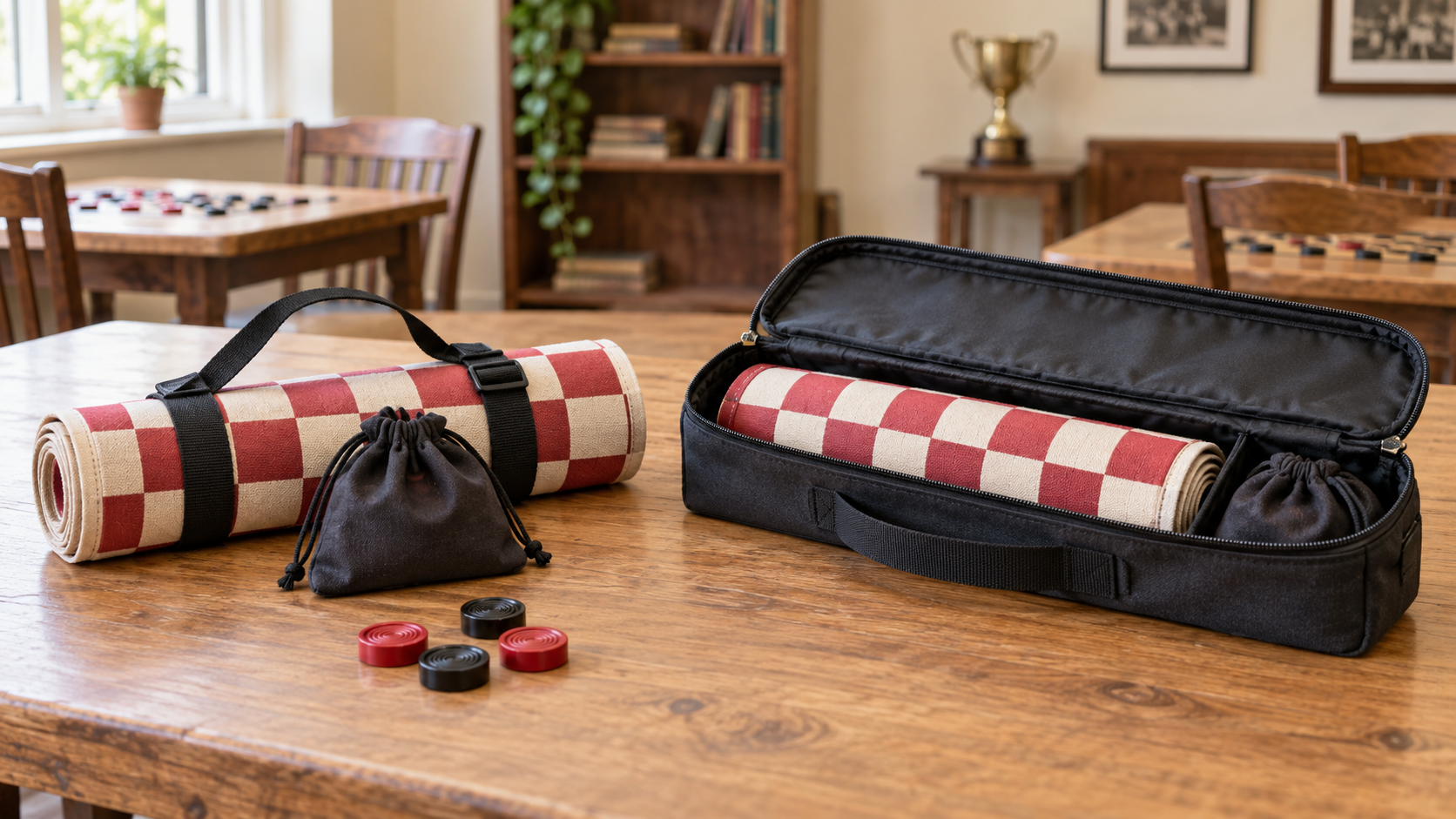
Measure the complete packed set
Compare board retention with enclosed kit storage
For a strap, verify its adjustment range against the rolled-board circumference, strap width, handle, buckle, and contact points. For a bag, verify usable interior length and diameter, opening, closure, handle attachment, and separate space for all 24 checkers and any rule card.
Quick decision
- Choose a strap for one roll-up board, short indoor transfers, minimal storage bulk, and a piece pouch that already has its own place.
- Choose a full bag when the board and every playing piece must stay together through vehicle trips, room changes, loans, or shared storage.
- Use a strap inside a larger tote when several numbered sets travel together and each board must remain bundled without adding a separate long bag.
- Skip both when the board maker calls for flat storage, the board stays permanently in one room, or the original box already contains the complete set securely.
Option A: an adjustable carrying strap
A carrying strap wraps around the rolled board and usually adds a handle or shoulder attachment. It uses little shelf space and gives quick access: release the buckle or fastener, unroll the board, and store the strap until cleanup. It is most useful when the checker pieces already ride in a closed pouch, box, or separately managed club bin.
The tradeoff is exposure. A strap does not enclose the board, contain loose checkers, or keep a rule sheet from bending. It can also create a pressure line if it is overtightened. Confirm that all contact surfaces are smooth, the strap has enough adjustment range for the actual roll, and the fastener does not press into the printed playing surface.
Option B: a full carrying bag
A full bag treats the checkerboard and playing pieces as one kit. A suitable opening lets the rolled board slide in without a sharp bend, while a separate closed pocket or piece pouch keeps checkers from rubbing against the board. The outside can carry one clear set identifier for loans or group distribution.
The tradeoffs are bulk and fit. A bag can be too short for the roll, too narrow once a piece pouch is added, or so oversized that the board shifts during carrying. Outside dimensions do not prove usable capacity: check the interior length, narrowest opening, closure clearance, seams, and any padding that reduces the available space.
Who each option fits
A family carrying one set nearby
A strap is usually enough when the board moves from a game shelf to a nearby room, picnic table, or relative's house and the pieces remain in a dependable pouch. The strap stores compactly and does not add another large container. Use a separate checklist before leaving so the board-only carrier does not make the piece pouch easy to forget.
A bag is better when different family members carry the set or when rule cards, spare king markers, and pieces otherwise end up in separate hands. Keep the bag's contents limited to the game; unrelated hard objects can press against the board.
A classroom or club with several roll-up sets
Straps fit a central system where all piece containers travel in labeled bins and boards are counted separately. They make missing boards visible without multiplying bulky long bags. Full bags fit one-kit-per-table, checkout, or loan routines because the board and pieces can share one identifier.
Neither format replaces a return count. For ordinary American checkers, verify that the kit has 24 playing pieces before it returns to storage; another draughts variant may use a different board or piece count. Record the ruleset with the kit rather than assuming every checkerboard is interchangeable.
Fit checks before ordering
- Confirm that the board may be rolled and note which face should be inward according to its maker's instructions.
- Roll it normally without forcing a tighter bundle. Measure the roll's length, widest diameter, and circumference.
- Pack all checkers in their real closed container and measure that container separately.
- For a strap, compare the roll circumference with the adjustment range and check buckle position, handle clearance, strap width, and contact material.
- For a bag, compare the roll and piece pouch with usable interior dimensions, the narrowest part of the opening, and closure clearance.
- Check the filled package against the shelf, cabinet, vehicle, and walking route where it will actually be used.
Do not infer weather protection from an enclosed shape or a material name. Use only the bag maker's current claims and care instructions, and keep the set away from unsuitable moisture, heat, and crushing loads.
Setup and maintenance
With a strap, place the fastener where it cannot indent the board edge, tighten only enough to retain the roll, and close the pieces in their own container before lifting anything. During setup, put the released strap in the same visible place every time so it is not left behind.
With a bag, place the rolled board in its intended compartment and the checkers in a separate closed pouch. Do not pour loose pieces around the roll. At cleanup, count the pieces, let a board dry fully if the maker permits cleaning, and avoid sealing moisture or debris inside the bag.
Inspect either carrier for loose stitching, cracked buckles, rough hardware, unreliable zippers, or detached handles. Follow the carrier and board makers' cleaning directions; a washable-looking fabric is not proof that every cleaner or machine cycle is suitable.
Skip criteria and no-buy alternatives
Skip a strap if the piece pouch has no reliable carrying plan, the board will be exposed to a crowded vehicle or shared closet, the published adjustment range is missing, or the buckle would sit against a vulnerable playing surface. Also skip it when the carrier needs hands-free support but the listing does not describe the handle or shoulder use you require.
Skip a full bag if usable interior measurements are absent, the opening forces a bend, the checker pouch must press tightly against the board, or the complete set is too bulky for the intended shelf. Avoid generic long bags whose stated use and construction do not support the packed dimensions and carrying routine.
Before buying, test the workflow with the board's original ties if they do not damage it, an existing suitable luggage strap used according to its instructions, or a clean tote large enough to hold the board without bending. A no-spend trial should reveal whether the real problem is board retention, forgotten pieces, or transport between rooms.
Bottom line
A carrying strap is the lean choice when the roll-up board needs a handle and the pieces already have secure, separately managed storage. A full bag earns its extra bulk when one person must carry and account for the entire checkers kit. Measure the normal board roll and piece container, test the real route, and choose the format that prevents the part your current routine actually loses or mishandles.
The planned travel-and-small-space pillar is not built yet. Continue with the roll-up checkers board guide for board-selection criteria or the replacement checkers guide when incomplete piece inventories are the larger problem.