
The best checkers board for a family makes the position easy to read, gives fingers room around each piece, and stores without turning cleanup into a search for loose checkers. A board-only purchase makes sense when you already own usable pieces or want a clearer playing surface without replacing everything.
This guide compares useful board categories, not products we claim to have tested. It does not claim current prices, ratings, durability tests, or live availability. If you need both a board and pieces, use best checkers sets for beginners instead.
As an Amazon Associate, The Good Chess & Checkers may earn from qualifying purchases.
Quick decision aid
Start with readable family checkerboards
Compare current board dimensions and materials, then use the fit checklist below before buying.
How to Choose a Family Checkers Board
- Correct grid: standard family checkers uses an 8-by-8 board. Confirm the grid rather than relying on a product title.
- Checker fit: a checker should sit inside one square with visible space around it. Measure its diameter and compare it with the listed square size.
- Clear contrast: playable dark squares should be easy to distinguish under ordinary room light.
- Useful footprint: leave room around the board for captured pieces and crowned kings.
- Storage plan: a board-only product may not include a pouch, tray, or box.
- Flat surface: folds, seams, rolled edges, and glossy finishes should not make pieces rock or slide.
Best Overall: A High-Contrast Folding Checkerboard
A folding board is the practical starting point for most families. It can open to a comfortable home-playing size and close for a shelf or cabinet. Choose strong square contrast, a fold that settles reasonably flat, and a surface that does not make stacked kings wobble.
Best for: weekly family games, shared shelves, beginners, and homes that cannot leave a board out.
Skip it if: the center seam stays raised or the closed board still has no sensible place for loose pieces.
Best for Leaving Out: A Flat Wooden Checkerboard
A flat wooden board works well on a dining or game table when setup friction matters more than compact storage. Look for recognizable square colors and a simple finish; a decorative pattern that hides legal squares is a poor trade for family play.
Wood does not automatically mean durable or easy to read. Check the listed dimensions, edge construction, finish, and whether your existing pieces contrast with both square colors.
Best for: a regular game table, a family room, or players who prefer a stable board with no center fold.
Skip it if: shelf space is limited, the finish is visually busy, or there is no container for the checkers.
Best for Easy Storage: A Roll-Up Checkerboard
A roll-up board is useful when a rigid board is awkward to store. Vinyl, silicone, and fabric-like surfaces behave differently: some lie flat quickly, some need time after storage, and some collect lint more readily. A simple high-contrast grid matters more than a premium-looking surface.
Best for: game bags, classroom totes, narrow shelves, and families that already have a labeled piece pouch.
Skip it if: the board will stay tightly rolled between every game or the family wants one self-contained box.
Best for Small Tables: A Compact Board That Stays Readable
A compact board should shrink the footprint without making jumps difficult to follow. Measure the table, then subtract space for captured pieces and players' hands. Avoid choosing the smallest option automatically: tiny squares can make stacked kings crowd neighboring pieces.
Best for: breakfast tables, dorm desks, side tables, and occasional travel.
Skip it if: your checkers nearly fill each square or younger players struggle to pick up one piece without moving another.
Best for Mixed Chess and Checkers Play: A Clear 8-by-8 Board
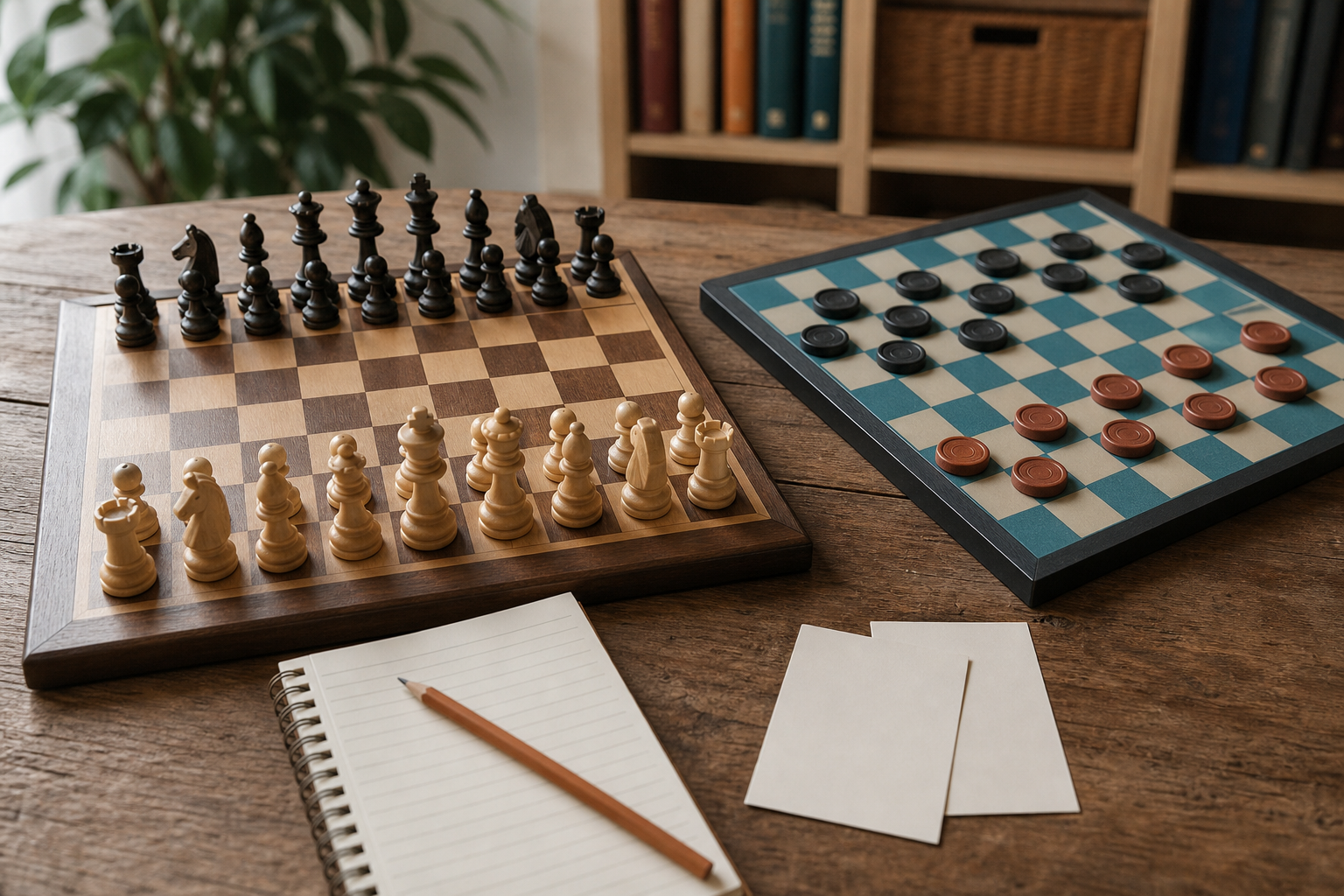
Chess and standard checkers can share an 8-by-8 board, so a board-only purchase can serve both games when the square size fits both checker diameter and chess-piece bases. The compromise is storage: you still need to keep two complete piece groups organized.
Read one board for chess and checkers before choosing this route.
Best for: families that own both piece sets and want one clear playing surface.
Skip it if: the chess pieces crowd the squares or storing both games defeats the space saving.
Best for Learning: A Board with Simple Coordinates
Coordinates around the edge can help families describe a square without pointing across the table, particularly when the board also supports chess lessons. They are optional for casual checkers, and labels should never compete with the playable grid.
Best for: families teaching both games, lesson notes, and players who like naming positions.
Skip it if: labels make the border busy or the board is used only for relaxed checkers.
Quick Comparison Framework
- Choose folding for the best balance of readable play and shelf storage.
- Choose flat wood when the board can stay out and contrast is strong.
- Choose roll-up when storage and carrying matter more than a self-contained box.
- Choose compact only after checking checker diameter against square size.
- Choose a shared 8-by-8 board when both games' pieces fit comfortably.
- Choose coordinates when they support real teaching rather than add clutter.
Who Should Skip a Board-Only Purchase?
Skip a board-only purchase if pieces are missing, the checkers do not stack clearly for kings, or there is no storage plan. A complete set can be better value when replacing the board would leave two other problems unsolved. Also skip any board whose square measurements are absent when you cannot confirm fit another way.
If pieces are the weak point, use best checkers pieces for crowning and kinging. If both parts need replacement, compare complete beginner checkers sets.
Bottom Line
For most families, start with a high-contrast folding 8-by-8 checkerboard that lies flat, fits the existing checkers with space around them, and stores easily. Choose flat wood, roll-up, compact, shared-game, or coordinate formats only when that advantage solves a real household need.