
A checkers bag has two jobs: keep 24 pieces together and make the board practical to carry. The best format depends less on padding or appearance than on whether you use a folding board, a roll-up board, a rigid flat board, or loose pieces at a shared table.
This is a criteria-led category guide, not a hands-on product ranking. We have not tested every case or verified every current listing. Measure your actual board and stacked pieces, then confirm the seller's usable interior dimensions, closure, materials, and included contents before buying.
As an Amazon Associate, The Good Chess & Checkers may earn from qualifying purchases.
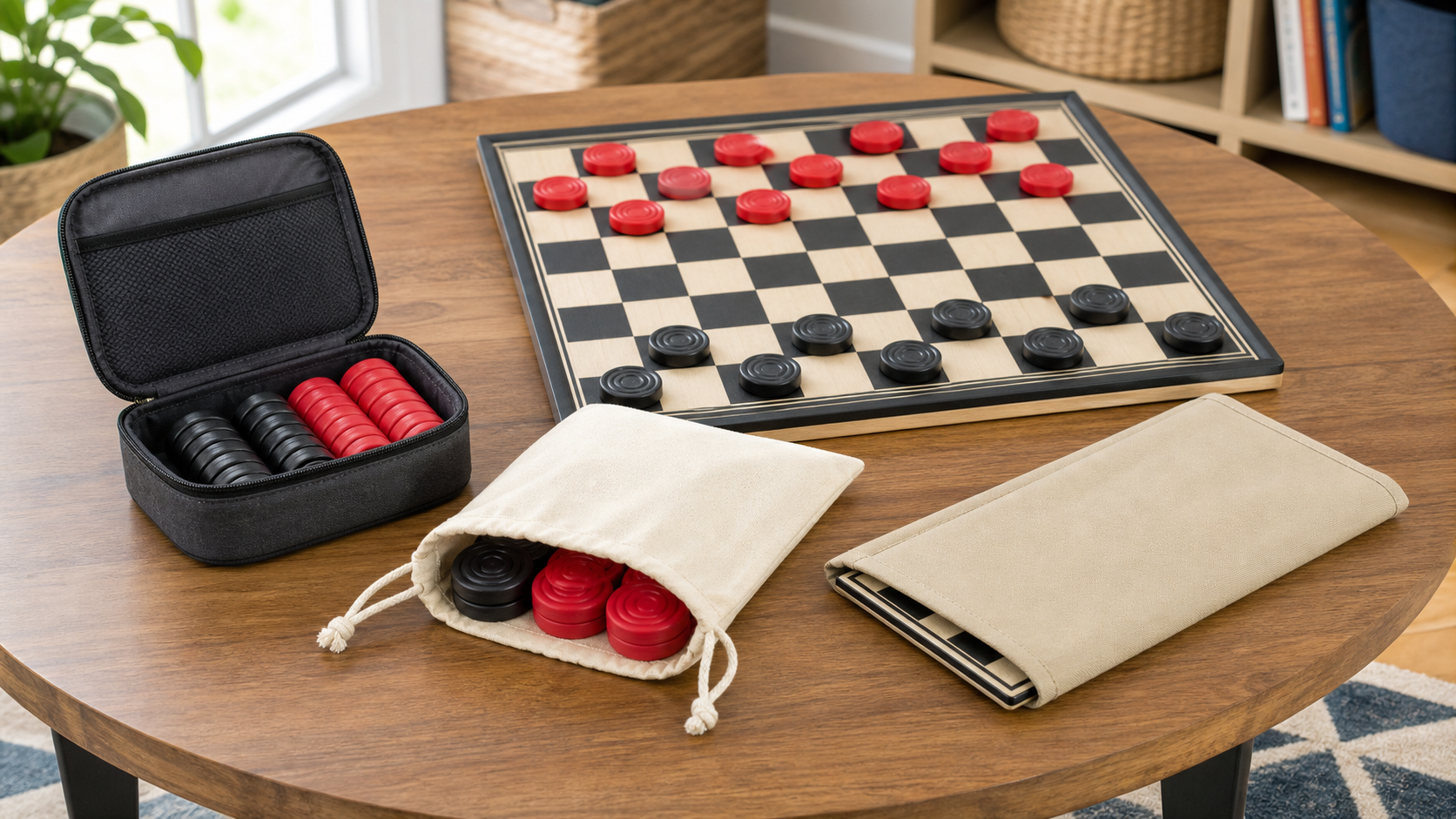
Fit the case to the board
Shop checkers storage formats
Compare piece pouches, flat board sleeves, and complete-set carriers. Verify usable dimensions and whether a listing includes the pictured board or pieces.
How We Compare Checkers Cases and Bags
- Board-format fit: a rigid square board, folding board, roll-up board, and board stored in its own box need different shapes.
- Checker capacity: the bag should hold at least 24 playing pieces plus any spare pieces without forcing its closure.
- Kinging space: stackable checkers take more vertical room when stored in columns, especially if extras are included.
- Containment: a secure zipper, drawcord, flap, or internal pouch should keep pieces from entering the board compartment.
- Carry routine: handles matter for a complete kit; a small piece pouch only needs to fit the shelf, tote, or board case already in use.
- Identification: a label window or writable tag helps shared sets return to the correct board.
Best Overall for Loose Pieces: A Wide Drawstring Pouch
A simple wide-mouth pouch works for families who already have a board box or shelf space. Flat checker discs pack efficiently, and the open mouth makes counting and cleanup easier than a narrow pencil-case shape. Choose enough height for loosely stacked pieces rather than sizing the pouch from 24 perfectly aligned discs.
Best for: home sets, spare checker sets, and boards that already have their own storage.
Skip it if: the board must travel with the pieces or a loose pouch is likely to become separated from the set.
Best for a Folding Board: A Shallow Zippered Case
A folding board becomes a compact rectangle or square, so a shallow zip case can keep the board and checker pouch together. Measure the board when folded, including hinges, trim, handles, or latches. A case that is deeper than necessary lets pieces and the board shift; one that is too tight can press on the fold or zipper.
Best for: a folding checkers board carried between homes, lessons, or casual group sessions.
Skip it if: the folded board already latches securely with an internal piece compartment.
Best for a Roll-Up Board: A Long Board Sleeve
Roll-up boards store best as a loose cylinder rather than a sharp fold. A long sleeve or tube-shaped carrier should match the rolled board's length and leave enough diameter that the material is not compressed. Store the checkers in a separate closed pouch so discs cannot work into the roll and create pressure points.
Best for: flexible club-style checkers boards that move regularly.
Skip it if: the board maker recommends flat storage or the board develops curl when kept rolled.
Best for a Rigid Flat Board: A Padded Sleeve
A rigid board needs a sleeve wider and taller than its full outside dimensions. Light padding can protect the board from ordinary contact in a closet or vehicle, but padding does not make a case suitable for heavy stacking or rough handling. Check that the opening is wide enough to insert the board without scraping its edges.
Best for: one-piece boards that travel occasionally and do not have a fitted box.
Skip it if: the board stays on one table, has a sturdy original box, or is too large to carry comfortably in a square case.
Best for Shared Sets: A Labeled Complete-Set Carrier
For a club, library, or recurring family group, one carrier per board reduces mixing. Look for a dedicated closed piece pocket, a simple handle, and an exterior label area. Keep a count card inside so the person packing up can check for 12 pieces of each color before the bag returns to storage.
Best for: several sets that move between a cabinet and playing tables.
Skip it if: all boards and pieces already travel together in one labeled bin and individual carriers would add unnecessary cleanup.
Quick Comparison Framework
- Choose a piece pouch when only the checkers need containment.
- Choose a shallow zip case for a measured folding board and its pieces.
- Choose a long sleeve for a board designed to be stored rolled.
- Choose a padded flat sleeve for an occasional-trip rigid board.
- Choose labeled complete-set carriers when several shared sets must stay matched.
Measure the Set Before Shopping
- Identify whether the board stores flat, folded, or rolled; do not force it into a different format.
- Measure the stored board at its widest, longest, and thickest points, including hardware.
- Count 24 checkers plus spares and stack them as they will actually sit in the pouch.
- Add practical clearance for seams, padding, zippers, and your hand at the opening.
- Compare those measurements with the listing's usable interior—not merely the exterior size or product photo.
A generic “board game bag” may be made for boxes rather than bare boards. A “checkers case” may include a miniature set instead of being an empty carrier. Read the current included-contents description and return policy before deciding that a format will fit.
Who Should Skip a Dedicated Checkers Case?
Skip another bag when the original set box remains sturdy, a folding board already stores its pieces securely, or the set never leaves one cabinet. A shared labeled bin may be simpler than individual cases for several inexpensive sets. Also skip listings that omit usable dimensions, show no closed piece compartment, or cannot explain whether the pictured board and checkers are included.
Keep Checkers Storage Checkers-Specific
Checker discs are flatter and easier to stack than chess pieces, but kings must remain easy to form during play. If you are replacing pieces as well as storing them, use the guide to stackable checkers for crowning. For a mixed shelf containing both games, the broader family chess and checkers storage guide covers bins, labels, and replacement routines.
Bottom Line
For loose checkers, start with a wide drawstring pouch. Add a board carrier only when its shape matches how the board is meant to store: shallow for folding boards, long for roll-up boards, and flat for rigid boards. Measure the full set, keep pieces in their own closed compartment, and choose labels and handles only when they solve a real shared-use or transport problem.