
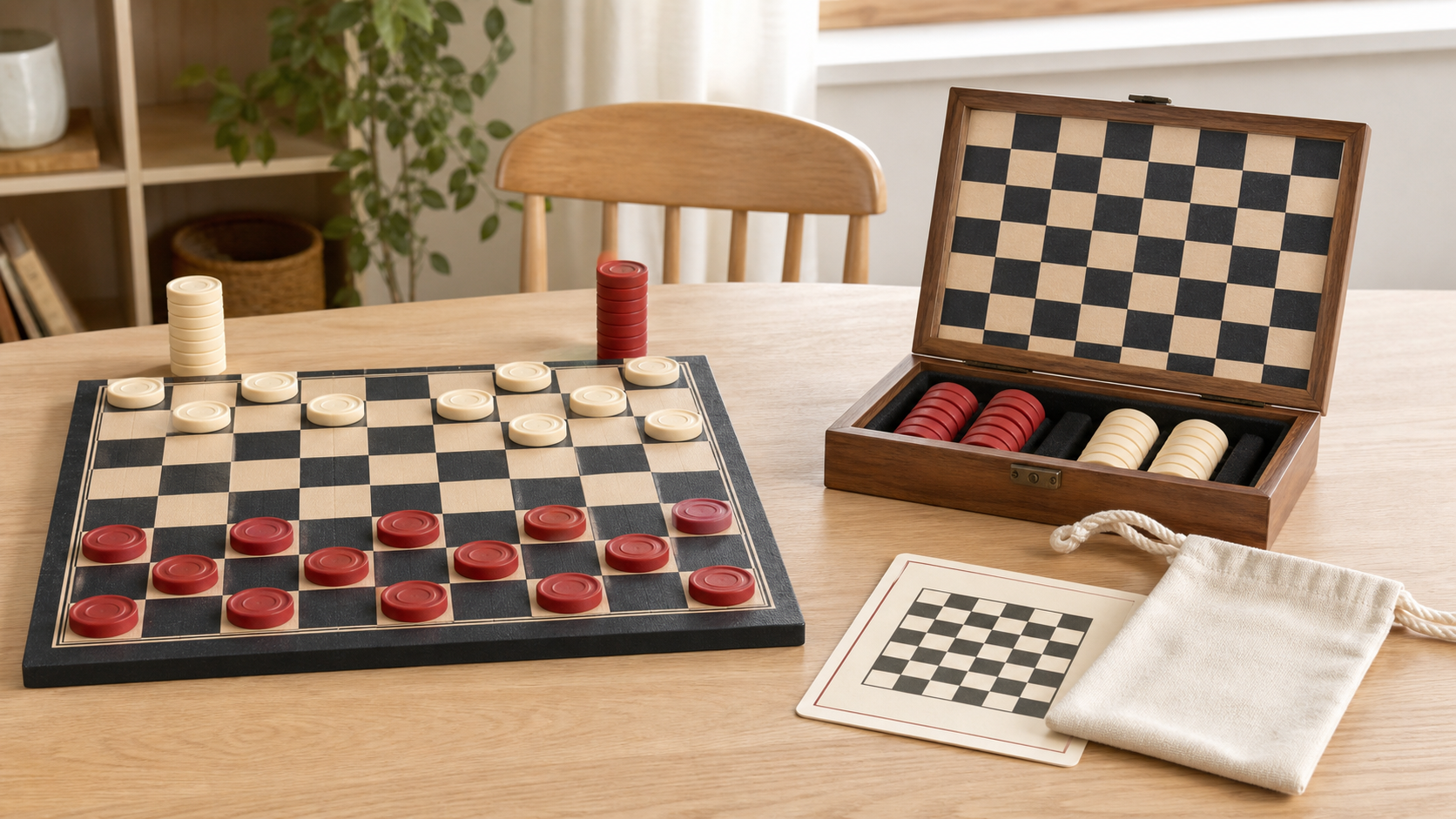
A good learning set lets a child see the diagonal paths, move one checker without bumping its neighbors, and crown a king without inventing a new marker. For most families, that means a medium-size, high-contrast board with pieces that stack securely and a storage method a child can actually use.
This is a criteria-led guide to set formats, not a hands-on product ranking. We have not tested every set or verified every current listing. Check the maker's current dimensions, contents, age guidance, materials, and care instructions before buying.
As an Amazon Associate, The Good Chess & Checkers may earn from qualifying purchases.
Quick decision aid
Choose checkers-first learning formats
Compare complete sets with high-contrast boards and stackable pieces. Confirm that the listing includes 24 checkers, that each piece fits comfortably inside a square, and that the storage closes with every piece inside.
How We Compare Checkers Sets for Children
- Visible playing squares: the two square colors should be easy to separate, because checkers use only the dark squares.
- Piece-to-square fit: a checker should sit fully inside one square with room for a child's fingers around it.
- Clear kinging: pieces should stack steadily so a crowned king remains obvious while it moves backward or forward.
- Board stability: the board should lie flat and resist sliding during ordinary moves.
- Complete, countable pieces: a standard starting game needs 12 checkers per side; extras are useful only if they do not confuse setup.
- Child-manageable storage: a wide pouch, tray, or simple folding compartment should make counting and cleanup easy.
- Lesson fit: the set should support short practice games without adding printed tricks, extra games, or decorations that hide the board.
Best Overall: A Medium High-Contrast Set
A straightforward tabletop board with matte, contrasting squares is the strongest first choice for most children. It provides enough room to trace diagonal paths without turning every move into a reach across an oversized board. Round pieces with a shallow rim are easy to lift and often stack more reliably than smooth domed pieces.
Best for: first games at a family table and short parent-led lessons.
Skip it if: the board curls, reflects overhead lights, or uses similar colors that make the playable squares hard to follow.
Best for Learning Kings: Deep-Rim Stackable Checkers
Stacking one checker on another is a common way to mark a king in American checkers. Pieces with nesting rims or shallow grooves tend to show that change clearly. Test the idea from listing dimensions and close product photos: two stacked checkers should remain inside one square without leaning over nearby pieces.
Best for: children who understand basic moves and are beginning to play full games with promotion.
Skip it if: the pieces are so tall when stacked that they topple easily, or the set uses a different king marker that may be misplaced.
Best for Independent Cleanup: A Folding Set with Simple Storage
A folding board can keep the game and its pieces together, but the useful feature is not folding by itself. Look for a board that opens flat, a closure a child can manage, and an interior compartment that does not require every checker to be fitted into a precise slot. Count pieces before closing so a missing checker does not become tomorrow's surprise.
Best for: homes where the set moves between a table, shelf, and grandparent's house.
Skip it if: the center seam creates a ridge, the latch is fiddly, or loose pieces spill as soon as the case opens.
Best for Short Lessons: A Plain Board with a Separate Rule Card
A plain board keeps attention on moves and jumps. A separate, readable rule card can sit beside the board for reminders, then disappear once the child no longer needs it. This is usually clearer than a board covered with arrows, words, or numbered lesson prompts.
Best for: adults teaching one rule at a time and children who benefit from a visible reminder.
Skip it if: the card teaches a rules variant different from the one your family intends to play. Agree in advance about required jumps, multiple jumps, and how kings move.
Best for Two Games on One Shelf: A Readable Combo Set
A chess-and-checkers combination set is practical when the child wants to learn both games and storage space is limited. Judge its checkers equipment on its own: the discs still need to stack, the board still needs clear dark squares, and the checker count must be complete. Chess pieces do not make a weak checkers set better.
Best for: families that expect to alternate between chess and checkers.
Skip it if: checkers is the only current interest or sorting two games' pieces will add friction to each lesson.
Quick Comparison Framework
- Choose a medium high-contrast set for the clearest first-game experience.
- Choose deep-rim stackable pieces when learning crowned kings is the next goal.
- Choose a folding set when child-manageable cleanup and transport matter.
- Choose a plain board plus rule card for focused, one-rule-at-a-time teaching.
- Choose a combo set only when learning chess too outweighs the extra sorting.
A Five-Minute Fit Check Before Buying
- Confirm the set has an 8-by-8 board and 12 checkers for each side.
- Compare checker diameter with square size; listing photos alone can hide crowding.
- Look closely at how two pieces stack to mark a king.
- Check the open board footprint against the table where lessons will happen.
- Confirm how all pieces are stored and whether the child can open, count, and pack them.
- Read the maker's current age guidance and included-parts information rather than relying on a search result headline.
Who Should Skip a Child-Focused Checkers Set?
Skip a special learning set when a clear, complete board already at home fits the child's hands and attention. The game does not require lesson graphics or novelty pieces. Also skip very small travel sets for first lessons, decorative boards with weak contrast, and any listing that leaves piece count, board dimensions, or kinging method unclear.
If the real decision is which game to introduce first, use Checkers First vs. Chess First for Kids. For stack shape and replacement fit, see the checkers pieces for crowning and kinging guide.
Bottom Line
For most kids learning checkers, start with a medium high-contrast board, 24 comfortable stackable pieces, and storage simple enough for the child to help reset the game. A folding case solves a storage problem; a rule card solves a reminder problem; a combo set solves a two-game problem. Buy the format that removes the real obstacle instead of adding features to a game that works best when the board stays clear.