
An after-school program rarely has the same number of players, helpers, or free tables every day. The best equipment is therefore not the fanciest single set. It is a flexible group kit that is quick to count, simple for beginners to read, inexpensive to repair, and easy for a volunteer to put away correctly. Caregivers choosing an activity rather than buying group gear should start with the separate guide to whether an after-school chess program fits a beginner child.
This is a criteria-led category guide, not a hands-on product ranking. We have not tested every item returned by the shopping links. Confirm current contents, dimensions, materials, and the number of complete sets in each listing before ordering.
As an Amazon Associate, The Good Chess & Checkers may earn from qualifying purchases.
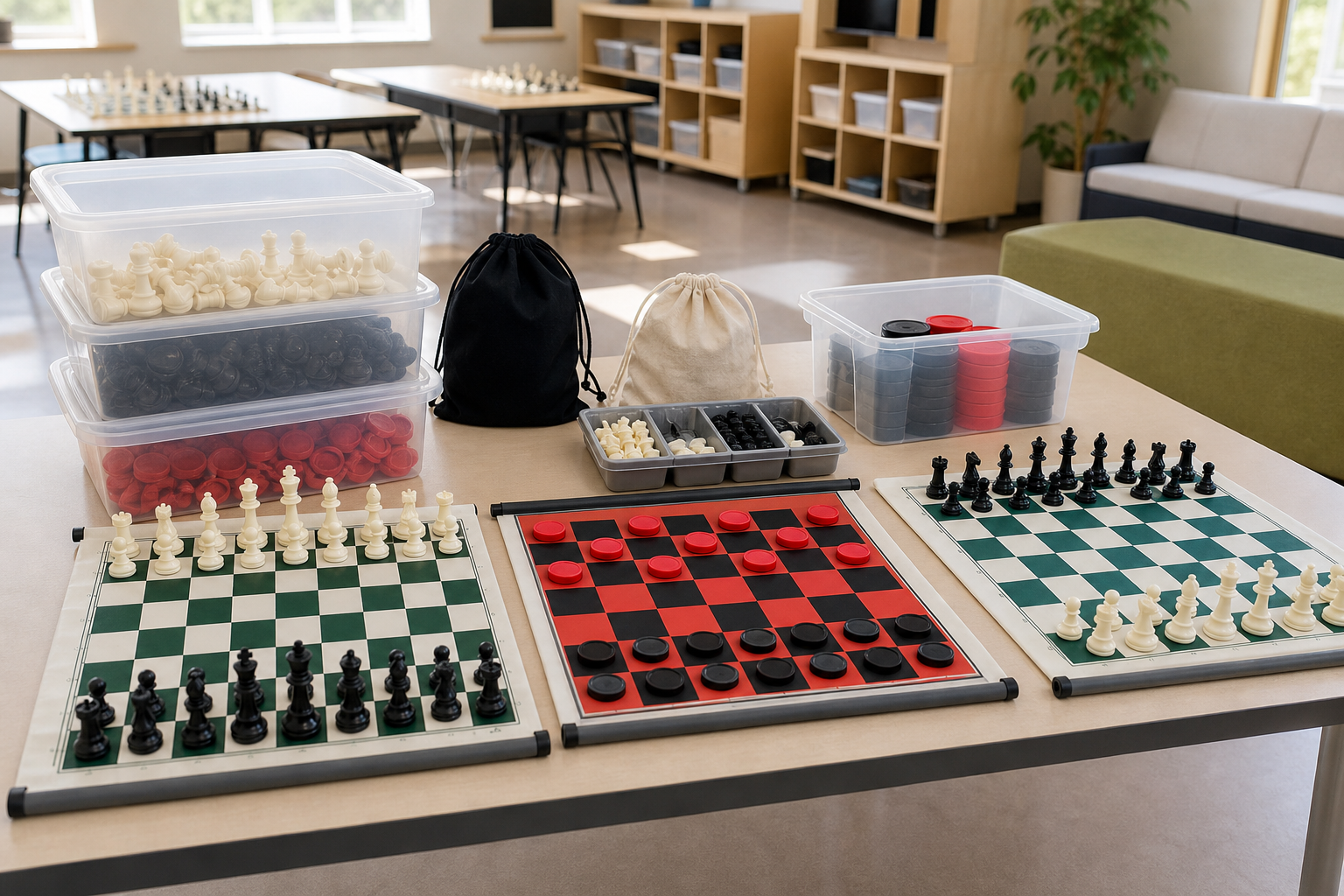
Build for the busiest ordinary day
Shop flexible group-play equipment
Start with matching full-size boards and replacement-friendly plastic pieces. Add checkers, separate bags, and one clearly organized reserve kit instead of buying decorative boxed sets that are difficult to count or repair.
How We Compare Sets for After-School Programs
- Flexible capacity: equipment should scale from a quiet day to a busy day without forcing every player into the same activity.
- Board readability: clear 8-by-8 squares and familiar chess-piece shapes reduce explanations and setup mistakes.
- Repeat-use durability: flexible boards, ordinary plastic pieces, and simple bags are usually easier to maintain than delicate display sets.
- Fast inventory: helpers need to see whether every bag contains a complete chess set or enough checkers for the local rule set.
- Replacement fit: common colors, shapes, and sizes make one missing pawn or checker less likely to retire a whole board.
- Storage footprint: the complete kit must fit the shelf, cabinet, cart, or vehicle available between sessions.
- Mixed-game value: chess and checkers should both have a clear path to the table rather than sharing incomplete pieces by accident.
Best Overall: Matching Roll-Up Boards with Separate Piece Bags
For most recurring programs, matching roll-up boards and recognizable plastic pieces provide the easiest base. Boards stack or roll into a compact space, do not depend on hinges or latches, and can be numbered to match their piece bags. Choose a square size that gives the chess pieces room without making each table unnecessarily wide.
Keep chess pieces and checkers in separate, easy-to-identify bags. A board can support either game, but mixing every component into one large bin slows setup and makes missing pieces harder to spot. Check the listing carefully: a “chess and checkers board” may include only a printed board, not both complete piece sets.
Best for: programs with changing rooms, rotating volunteers, and equipment that must pack down after every session.
Skip it if: boards must remain permanently flat, the available shelf cannot hold rolled boards without crushing them, or the program wants self-contained sets that children can borrow individually.
Best for Variable Attendance: A Core Kit Plus Reserve Sets
Do not divide the total enrollment by two and assume that is the correct number of boards. Some children will watch, solve a puzzle, or play in a small teaching group, while a busy day may include unexpected guests. A practical approach is to keep a dependable core kit for normal attendance and a few simple reserve sets that come out only when needed.
Reserve boards should match the main equipment closely enough that the same setup directions work. Store them in a clearly separate section so volunteers do not open every bag on an ordinary day. This makes capacity visible without creating extra cleanup each session.
Best for: drop-in programs, mixed-age groups, and sessions where attendance changes with sports, weather, or transportation.
Skip it if: attendance is fixed and every learner receives an assigned set; in that case, a numbered one-set-per-pair system may be simpler.
Best for Fast Reset: Numbered Boards, Bags, and Bins
A modest set becomes much easier to manage when the board, piece bag, and storage position share one number or color. At cleanup, a helper can count eight pawns, two rooks, two knights, two bishops, one queen, and one king per side without searching the entire cabinet. Checkers should be counted according to the variant the program actually teaches.
Use removable labels or tags that do not cover playing squares or leave a rough surface on flexible boards. A small divided reserve tray can hold common replacement pieces, but it should not become the place where incomplete sets quietly accumulate.
Best for: short sessions where cleanup time competes with pickup, snacks, homework, or room turnover.
Skip it if: the program cannot maintain the labels consistently; unlabeled matching bags are better than a numbering system nobody follows.
Best for Beginner Teaching: High-Contrast Boards and Familiar Pieces
Beginners should not have to decode themed chess figures, low-contrast squares, or checkers that disappear against the board. Familiar Staunton-style chess shapes make it easier to use books, diagrams, and volunteer explanations. Checkers should be broad enough to handle and stack securely when a king is represented by two pieces.
If both games use the same boards, confirm that the checker colors remain obvious on the playable squares. Also establish the rule version before buying teaching materials: capture and king rules can differ among checkers variants. For a simple starting lesson, link helpers to how to play checkers and how chess pieces move.
Best for: mixed-experience groups and programs supported by volunteers who need equipment to reinforce clear instructions.
Skip it if: the group already uses a specialized chess format and changing equipment would create more confusion than it solves.
Best for Easy Repairs: Common Plastic Pieces with a Spare Plan
Replacement-friendly equipment matters more in a recurring group than premium materials. Choose common colors and recognizable shapes, then verify piece height and base diameter before ordering extras. A replacement pawn that is too wide for the board or noticeably different from the rest can still be distracting.
Keep a small documented reserve rather than scattering spare pieces across bags. When a set is incomplete, repair it at the end of the session and note what left the reserve tray. For broader options, see the guide to replacement chess and checkers pieces.
Best for: programs that expect regular handling and want to keep complete sets in service longer.
Skip it if: the existing sets use unusual themed, magnetic, or fitted pieces that ordinary replacements cannot match.
Quick Comparison Framework
- Choose matching roll-up sets when compact storage and repeatable setup are the main priorities.
- Add reserve sets when attendance changes from week to week.
- Number boards and bags when fast counting and reset matter most.
- Choose high-contrast boards and familiar pieces for mixed beginner groups.
- Standardize common plastic pieces when easy replacement matters more than presentation.
Who Should Skip This Setup?
Skip a general after-school kit if the program is actually a dedicated chess club preparing players for a specific organized format. That group may need standardized chess-only equipment, notation supplies, and clocks selected with its organizer. This guide makes no tournament or federation-equipment claim.
Also skip bulk ordering until the program has confirmed its storage space, table sizes, expected attendance range, checkers variant, and who will own the inventory routine. A smaller complete kit is more useful than a large pile of mismatched boards and pieces that volunteers cannot reset.
Bottom Line
For most after-school programs, start with matching roll-up boards, readable plastic chess pieces, stackable checkers, and separate numbered bags. Buy for normal attendance, keep a few compatible reserve sets for busy days, and maintain one small replacement tray. That combination supports chess and checkers without pretending every session, room, or group will look the same.