
An after-school chess program can be worth it when a child is curious about chess, the sessions genuinely welcome their starting level, and the recurring schedule works for the whole household. Try one visit or the shortest available commitment when possible. Wait when the child is unsure, the pickup routine is difficult, or the provider has not clearly explained its teaching, supervision information, full fees, and cancellation terms.
The program is not automatically a better choice than learning at home, attending a free club, or choosing a different activity. The useful question is whether this particular child will get regular chances to make moves and ask questions in this particular program—not whether chess classes promise an outcome.
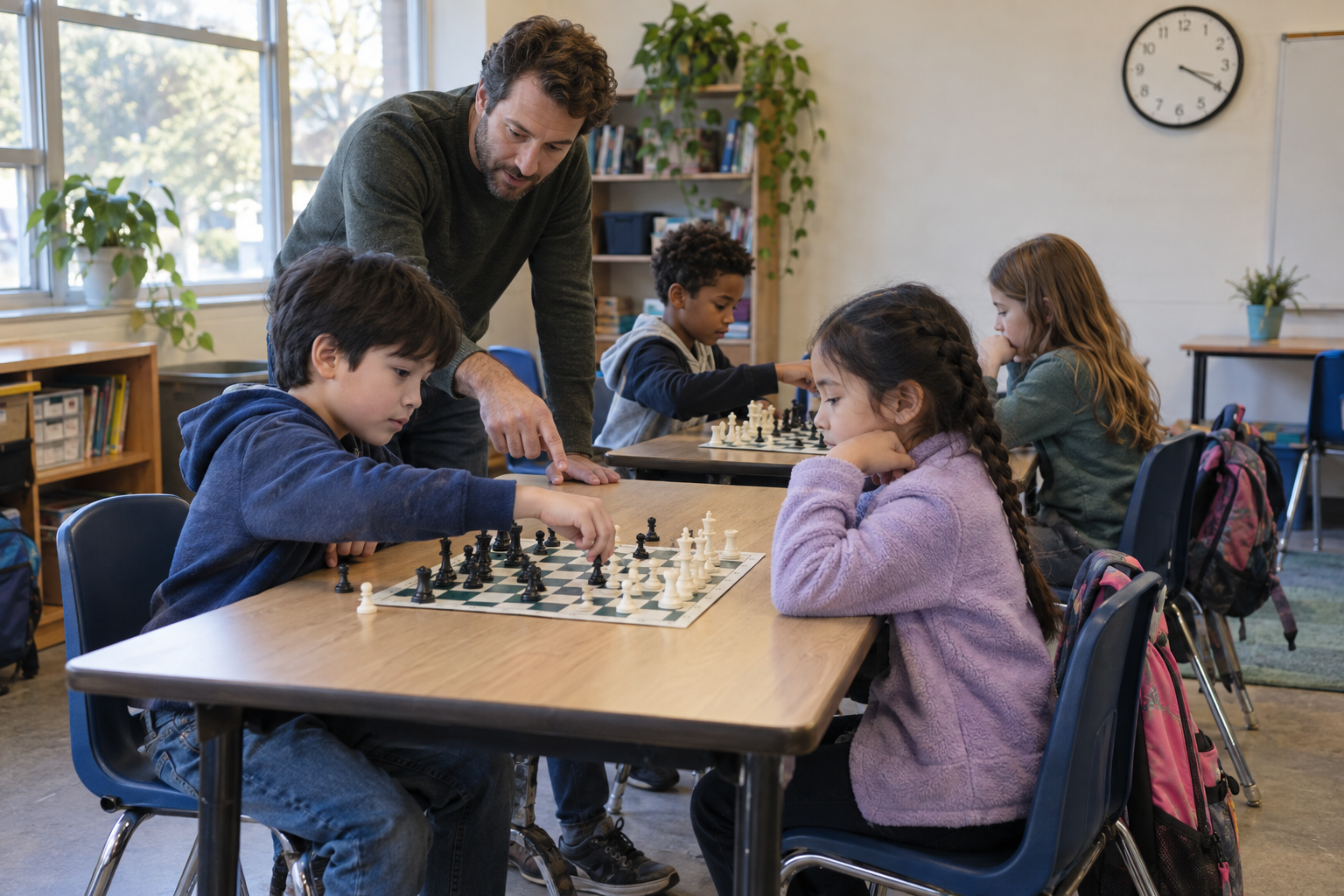
Quick verdict: enroll, trial, wait, choose an alternative, or skip
- Enroll when the child wants to attend, the published starting level fits, the routine is workable, and the provider has answered the practical questions below.
- Try one session or a short block when interest is real but the group pace, teaching style, or end-of-day energy level is still unknown.
- Wait when chess is the adult's idea more than the child's, the learner still finds ordinary piece movement frustrating, or the family cannot sustain the weekly schedule.
- Choose an alternative when a free school club, a few home games, a library group, or another activity better fits the current need.
- Skip when the provider will not state who runs the session, how beginners participate, what the full commitment costs, or what happens at dismissal and after missed sessions.
Why a recurring program is a distinct decision
An after-school program usually repeats over several weeks and sits inside an already long day. That creates a different choice from a one-day workshop, holiday camp, casual family game, or adult class. A caregiver is evaluating not just lesson content but also weekly attendance, dismissal, communication, transport, the child's remaining energy, and the terms for the whole enrollment period.
Do not infer those details from a school name or a polished registration page. Read the current program information and ask the named organizer about anything missing. Arrangements can differ by provider, venue, term, and session.
Nine things to verify before enrolling
- Starting level: Ask what “beginner” means. Confirm whether children may arrive knowing no moves, or whether they should already know piece movement, check, and checkmate.
- Typical session: Find out how time is divided among explanation, puzzles, guided positions, free play, and cleanup. A child should have meaningful chances to make decisions rather than only watch.
- Grouping: Ask how organizers handle mixed experience and what happens when a child repeatedly finishes early or needs more explanation.
- Current staff information: Use only information the provider publishes or gives directly. Ask who leads the activity and who the caregiver should contact with questions; do not assume credentials or oversight from the venue alone.
- Supervision and dismissal: Read the provider's current arrival, attendance, pickup, late-pickup, absence, and emergency-contact procedures. This guide cannot assess or guarantee any program's safeguarding practices.
- Schedule fit: Put every session, school closure, transport leg, and likely conflict on the household calendar before paying.
- Complete cost: Add tuition, registration charges, equipment or workbook requirements, transport, and any optional event fees. Verify current amounts directly rather than relying on an old listing.
- Missed-session and cancellation terms: Check refunds, transfers, credits, makeups, withdrawal deadlines, and what happens if the organizer cancels.
- Equipment: Ask whether boards and pieces are supplied and whether anything must travel to and from school. Do not buy gear until the program confirms what it uses.
Use the child's response as evidence
Before making a long commitment, play a few relaxed games or piece-movement activities at home. The goal is not to test talent. Notice whether the child returns to the board voluntarily, enjoys deciding between moves, and can tolerate losing a piece or restarting a position without the activity becoming miserable.
After a trial session, ask concrete questions: “Did you get to move pieces?”, “Was anything confusing?”, “Did you know who to ask for help?”, and “Would you like to go back next week?” A simple description is more useful than pressing for an enthusiastic verdict immediately after pickup.
How to judge the teaching format
A beginner-friendly format explains terms before depending on them and lets children practise the idea on a board. Ask for a sample outline or description of a normal meeting. A named curriculum is not enough on its own; you still need to know how much time children spend listening, solving, playing, waiting, and receiving help.
Mixed-level groups are common, but the organizer should be able to explain the routine for different starting points. There is no universal ideal group size. The practical check is whether every child can see demonstrations, use a board, get an opponent or activity, and receive help under the program's stated arrangement.
Red flags and reasons to pause
- Promises of guaranteed improvement, ratings, tournament success, or results by a fixed date.
- No clear description of beginner prerequisites or a normal session.
- Pressure to pay for a long term before the family can inspect the format or ask questions.
- Unclear total fees, dates, missed-session terms, cancellation rules, or equipment requirements.
- No clear caregiver contact or current information about arrival, attendance, and dismissal.
- Claims about instructor credentials or affiliations that cannot be checked with the named source.
- A child consistently says they do not want to attend, even after ordinary first-session nerves have been heard and discussed without pressure.
Who should wait or skip?
- A child who currently has no interest in chess and is being enrolled mainly because an adult values the game.
- A beginner who needs quiet one-to-one explanations while the program expects learners to follow fast group instruction.
- A family whose transport or pickup schedule makes regular attendance unreliable.
- A child whose after-school energy is already spent and who would rather try chess at a calmer time.
- Anyone asked to commit before the provider supplies the information needed to evaluate the program.
Lower-commitment alternatives
Start with the free guide to how chess pieces move and short home sessions with an ordinary board. The guide to teaching chess and checkers without overwhelming kids helps adults keep the first activities small. A free school or library club may fit a child who mainly wants casual games, but caregivers should still verify that group's current format and procedures.
If the household needs a board, choose it for readable pieces, useful contrast, storage, and the table available—not because enrollment implies a special set. The after-school chess and checkers set guide is written for organizers buying shared equipment; families can instead begin with the first chess set guide or borrow a complete set before buying.
Bottom line
An after-school chess program is worth considering when the child wants the group experience and the provider's current prerequisites, teaching routine, staff information, schedule, dismissal process, fees, and terms all fit. Use the smallest practical commitment to learn whether the format works, and judge fit by participation and willingness to return—not promised results.
Wait when important facts are missing or the weekly routine is fragile. Home play, a free group, or another activity can be the right next step without closing the door on a program later. The planned family pillar is not yet built, so the site's chess learning library is the current route to beginner rules, teaching help, and equipment guidance.