
Once a club owns several chess clocks, a loose storage bin becomes awkward: buttons catch, units rub together, and nobody can see which clock is missing. A useful carrying case gives every clock a defined compartment and makes the full set easy to count, label, move, and return.
This is a product-category comparison, not a ranking of named products or a claim of hands-on testing. Clock shapes vary, so measure the club’s actual units and verify each listing’s current internal dimensions, divider layout, materials, and included contents before buying.
The Good Chess & Checkers may earn commissions from qualifying purchases.
Quick decision aid
Measure every clock before choosing the case
Compare usable compartment length, width, and depth with the largest clock in the club. Allow clearance for rocker switches, top buttons, feet, and padding rather than relying on the case’s outside dimensions.
Quick comparison framework
- Clock capacity: count the clocks that routinely travel together and leave one clearly labeled space per unit.
- Compartment fit: measure the largest clock, including controls and feet, then compare those measurements with usable internal space.
- Divider design: padded adjustable dividers suit mixed clock shapes; fixed compartments make counting faster when the fleet is standardized.
- Protection: look for padding around the perimeter, between clocks, and beneath them without assuming a soft case is crush-proof.
- Access and closure: the opening should expose every compartment, while the zipper or other closure should shut without pressing controls.
- Club workflow: label windows, inventory cards, handles, and shoulder straps should fit the walk between storage, vehicles, and playing tables.
Best all-around format: adjustable padded divider case
A rectangular equipment case with movable padded dividers is the most flexible choice for a club with clocks of different widths or shapes. Arrange the compartments so the clocks sit upright or flat without pressure on their top buttons. Small gaps are useful for cables or instruction cards only when those items cannot move against a display.
Best for: clubs with a mixed fleet or plans to replace clocks gradually.
Skip it if: the dividers attach weakly, the interior dimensions are missing, or volunteers are likely to rearrange the layout and lose the inventory pattern.
Best for identical clocks: fitted multi-clock case
Fixed compartments can make setup and pack-down especially clear: an empty space shows immediately that a clock is still on a table. The tradeoff is compatibility. A compartment tailored to one body shape may not accept a wider replacement clock or an analog clock with protruding controls.
Best for: clubs that use one standardized clock model or clocks with matching dimensions.
Skip it if: the club expects the fleet to change or the listing does not provide each compartment’s usable measurements.
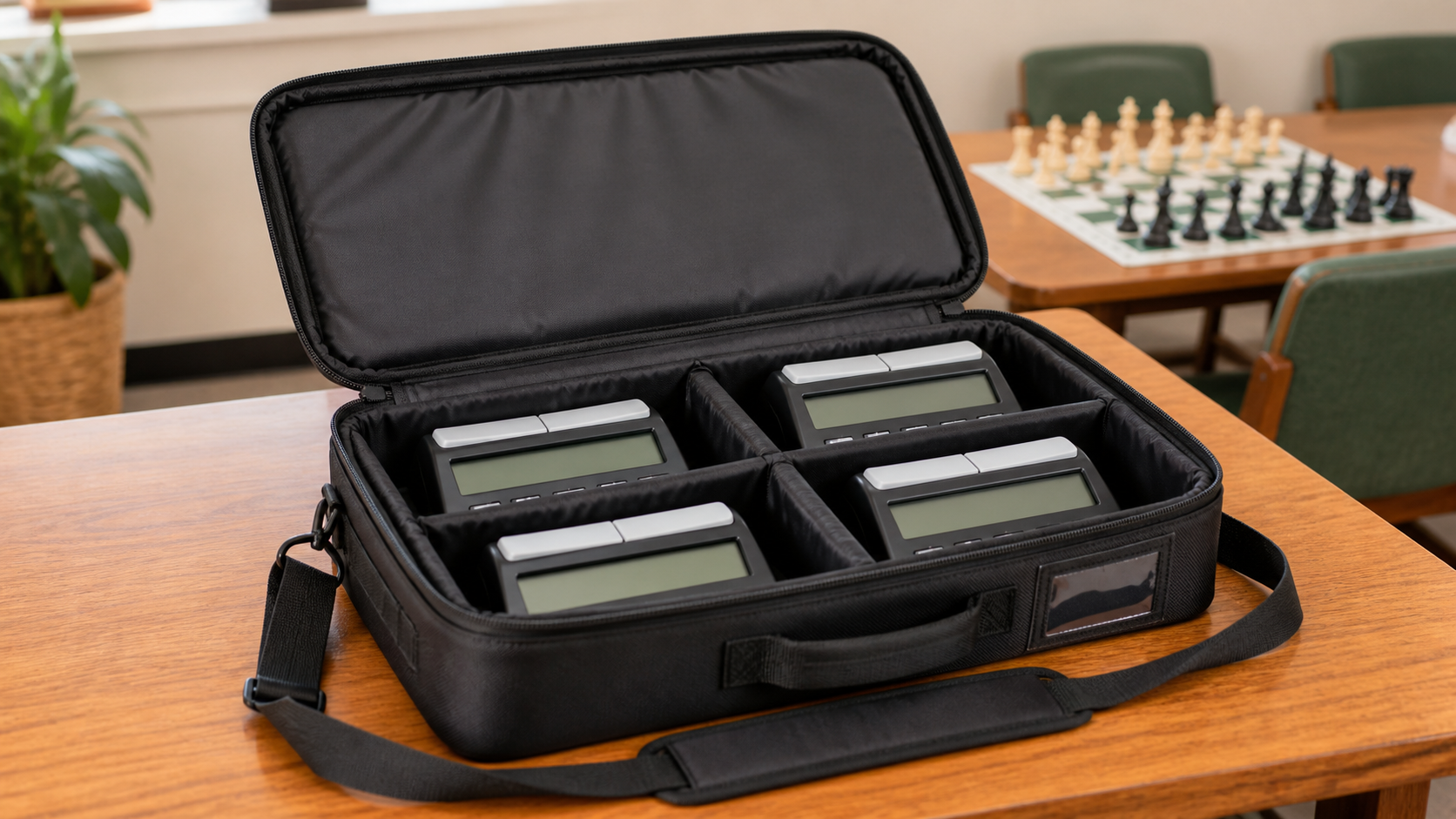
Best for a small club: compact four-clock case
A smaller divided case keeps the load manageable for one volunteer and fits more easily on a shelf. Four-clock capacity can cover a modest session or divide a larger fleet into numbered zones. Check loaded weight and handle placement; a compact case can still feel unbalanced if all clocks sit on one side.
Best for: small weekly clubs, tutors, or larger clubs that issue equipment in table groups.
Skip it if: the organizer would need several loosely tracked cases and a single larger case would remain comfortable to carry.
Best for storage-room organization: stackable hard-sided equipment case
A rigid outer shell can resist ordinary shelf bumps better than an unstructured fabric bag, provided the clocks still have fitted padding inside. Confirm that the closed case stacks as intended and that latches, hinges, and handles do not interfere with neighboring bins. Hard-sided does not automatically mean suitable for shipping, impacts, moisture, or unattended outdoor storage.
Best for: clubs moving clocks between a closet, cabinet, and nearby playing room.
Skip it if: the shell adds too much weight, lacks internal dividers, or would be treated as protection for conditions the maker does not claim.
Best low-cost approach: padded camera-style organizer
A generic padded equipment organizer can work when its dividers match the clock dimensions and the case opens fully for counting. Treat it as a fit problem, not as proof that a camera bag protects chess clocks. Avoid pockets that put plugs, spare batteries, pencils, or keys directly against displays and buttons. If the clocks stay in one approved room, compare fixed chess clock wall shelves and cubbies before buying a travel case.
Best for: clubs that can verify the fit of every compartment before committing to several cases.
Skip it if: the case forces clocks onto their controls, hides units under layers, or leaves too much room for movement.
How to measure a clock-case system
- Record the length, width, and height of each clock at its widest points, including feet and controls.
- Group identical clocks and identify the largest unit that must share the case.
- Add modest clearance for lifting the clock and for the divider padding; do not compress buttons to make a compartment work.
- Lay out the proposed compartment grid and reserve a separate flat pocket for instructions or an inventory card.
- Compare the estimated loaded weight, case dimensions, handle position, and shoulder-strap setup with the actual route to the playing room.
Labeling and checkout matter as much as padding
Number the case and each clock so volunteers can return a unit to the same compartment. Keep a simple inventory card under the lid with clock numbers and a pre-session check for visible damage or depleted batteries. If clocks are assigned one per board kit, the chess set carrying bag guide covers the different decision of moving a complete board, pieces, and one clock together.
Who should skip a dedicated clock case?
Skip a new multi-clock case if the club owns only one or two clocks that already have suitable individual storage, if clocks never leave a protected cabinet, or if each complete table kit travels in its own measured bag. Also delay the purchase when the club is about to standardize or replace its clock fleet; buying around dimensions that will soon change creates avoidable waste.
Bottom line
The best chess clock carrying case for a club is the one that gives every measured clock a padded, countable position without pressing its controls. Adjustable dividers suit mixed fleets, fitted compartments suit standardized ones, and clear labels turn either format into a more reliable setup and pack-down system.