
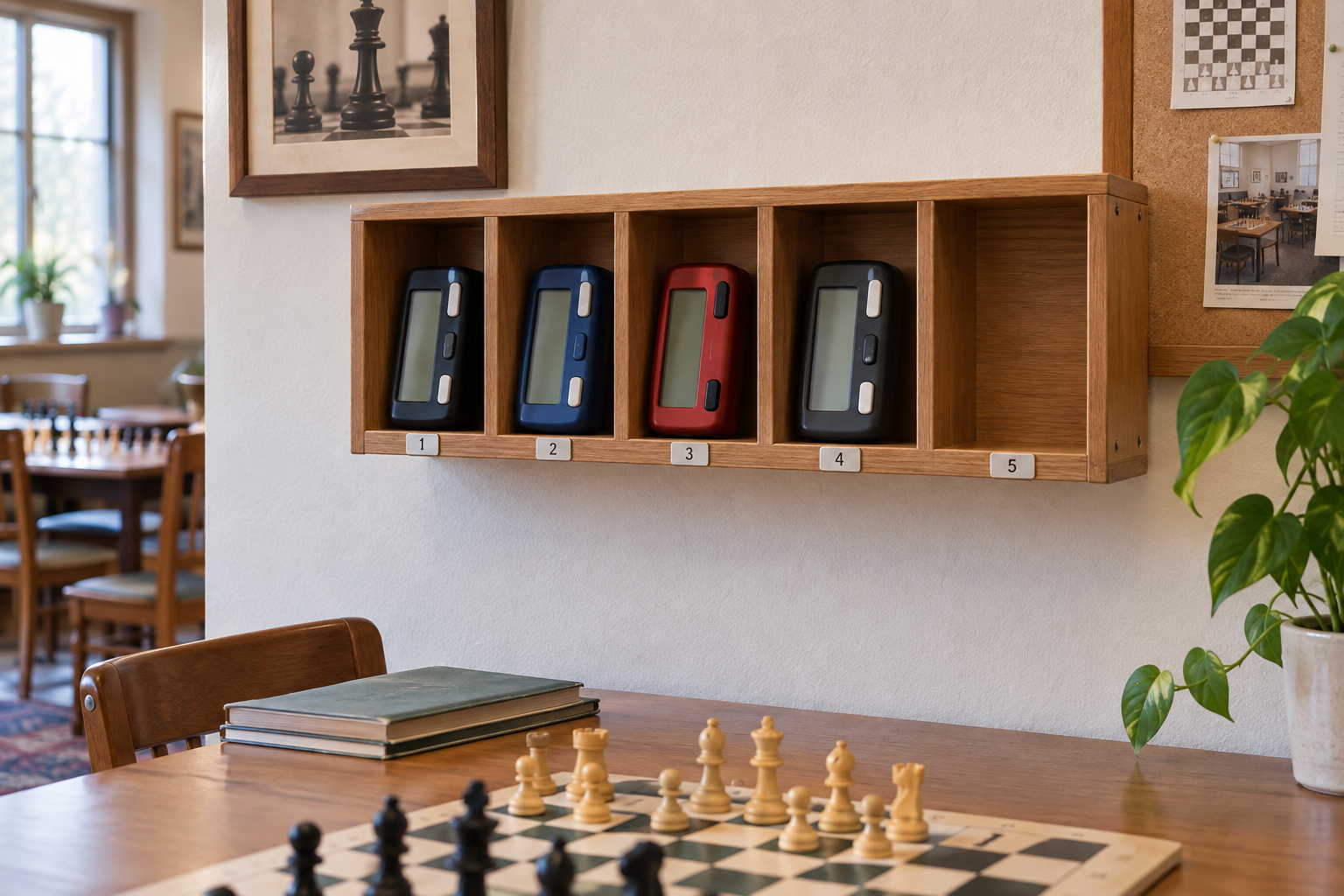
A shallow wall cubby can make several club chess clocks easy to count and retrieve when they stay in one room. The useful format is not simply the shelf that holds the most clocks. It is the one whose verified internal dimensions fit each clock without pressing its buttons, whose open spaces reveal missing units, and whose placement supports the club's issue-and-return routine.
This is a product-category guide, not a ranking of named shelves. We have not tested every item returned by the shopping route and make no claims about current prices, ratings, availability, load capacity, or suitability for a particular wall. Measure the clocks and location, follow the shelf maker's instructions, and have the facility owner approve any installation.
As an Amazon Associate, The Good Chess & Checkers may earn from qualifying purchases.
Quick decision aid
Measure one clock and the whole storage route
Record each clock's width, height, and depth with buttons and feet included. Then verify the cubby's usable openings, front lip, divider spacing, exterior footprint, mounting instructions, and clearance for hands.
Quick decision
- Choose separate cubbies when several clocks stay in one approved room and helpers need to see the inventory at a glance.
- Choose one shallow shelf with dividers when clock sizes vary and the divider positions can be verified or adjusted.
- Choose a padded carrying case when clocks regularly move between rooms, buildings, or vehicles.
- Skip a new shelf when a lockable drawer, labeled bin, or existing cabinet already provides an orderly fixed home.
Start with usable dimensions, not shelf names
Measure every clock model in the club. Include protruding player buttons, feet, switches, and cable ports. An opening should allow a helper to lift the clock without scraping the display or accidentally pressing controls. Exterior shelf dimensions do not reveal usable compartment space.
Make a cardboard mock-up of one opening and try the largest clock. Test removal with one hand while standing at the intended shelf height. If the clock must be tilted sharply or gripped by a button, the opening is too tight for the routine.
Compare three fixed-storage formats
Individual cubbies
A clock in every opening makes the count obvious, and a number beneath each space can connect the clock to an equipment log. Fixed dividers are less adaptable when the club later changes clock shapes, so verify the widest and tallest unit before choosing.
Open shelf with removable dividers
An adjustable layout can accommodate mixed clock sizes. The divider system still needs enough clearance to keep units from rubbing, and the shelf needs a front edge or other maker-designed retention feature appropriate to its intended use. Do not improvise claims about restraint or protection.
Lockable cabinet or drawer
A closed cabinet may be the better fixed option in a shared room. It hides the visual count, so use numbered positions, a simple checklist, or follow the measured-fit framework in the chess clock drawer organizer guide. Follow the furniture maker's instructions and the facility's access policy.
Plan the issue-and-return routine
- Give each clock and storage position the same short identifier.
- Store controls facing the same direction so helpers can scan the row quickly.
- Keep manuals, spare batteries, and cables in a separate labeled container so loose items do not rest against displays or switches.
- At issue, record the clock number with its board or table.
- At return, switch off the unit as its manual directs, inspect it, and restore it to the matching space.
One empty cubby is useful only when the equipment log explains why it is empty. A visible gap without a record does not distinguish a clock in play from one awaiting attention.
Keep the power routine separate from storage
Check each clock's manual for battery removal, charging, and long-term storage guidance. Do not assume rechargeable and replaceable-battery units should follow the same routine. If a cable is required, give it a labeled pocket or nearby container rather than wrapping it tightly around the clock.
A wall shelf does not need built-in charging to be useful. Combining power and storage introduces outlet, cable, and facility constraints; use only maker-supported equipment and an approved room plan.
Mounting and placement are facility decisions
Confirm the shelf maker's mounting surface, hardware, and installation instructions, then obtain approval from the person responsible for the room. Wall construction and permitted attachment methods vary. This guide cannot determine a safe mounting method or load for a specific site.
Place approved storage where adult helpers can see and reach every clock without leaning over active boards. Avoid door swings, crowded walkways, direct heat, and locations where clocks could be mistaken for general-use devices. If the room cannot support a permanent installation, use a cabinet, drawer, or case instead.
Run a no-spend shelf trial
Before buying, arrange the clocks in separate labeled spaces on an existing cabinet shelf. Ask a helper to issue two clocks, identify the missing numbers, return them, and retrieve the manuals or power accessories. The trial reveals the opening width, label position, hand clearance, and documentation routine the club actually needs.
Who should skip a wall shelf?
Skip this category if clocks travel, the room is shared without secure storage, installation is not approved, or the club owns only one or two clocks that already fit a drawer. A club set bag or hard case may fit mobile equipment better, while a labeled existing cabinet may solve fixed storage without another purchase.
Bottom line
A chess clock wall shelf makes sense for a stable, approved club room where visible counting and fast access matter. Choose by measured opening size, hand clearance, divider layout, labeling, and the complete return routine. When security or transport matters more than instant visibility, use a cabinet or padded case instead.