
The best first opening book does not ask you to memorize twenty moves. It teaches why beginners develop pieces, contest the center, protect the king, and connect the rooks—then shows what to do when an opponent leaves the expected path.
This is a category comparison, not a ranked list of books we tested. No current named-product feed is configured, so the choices below describe useful book formats and the pages to preview before you buy.
As an Amazon Associate, The Good Chess & Checkers may earn from qualifying purchases.
Best category for a true beginner
Start with principles and annotated games
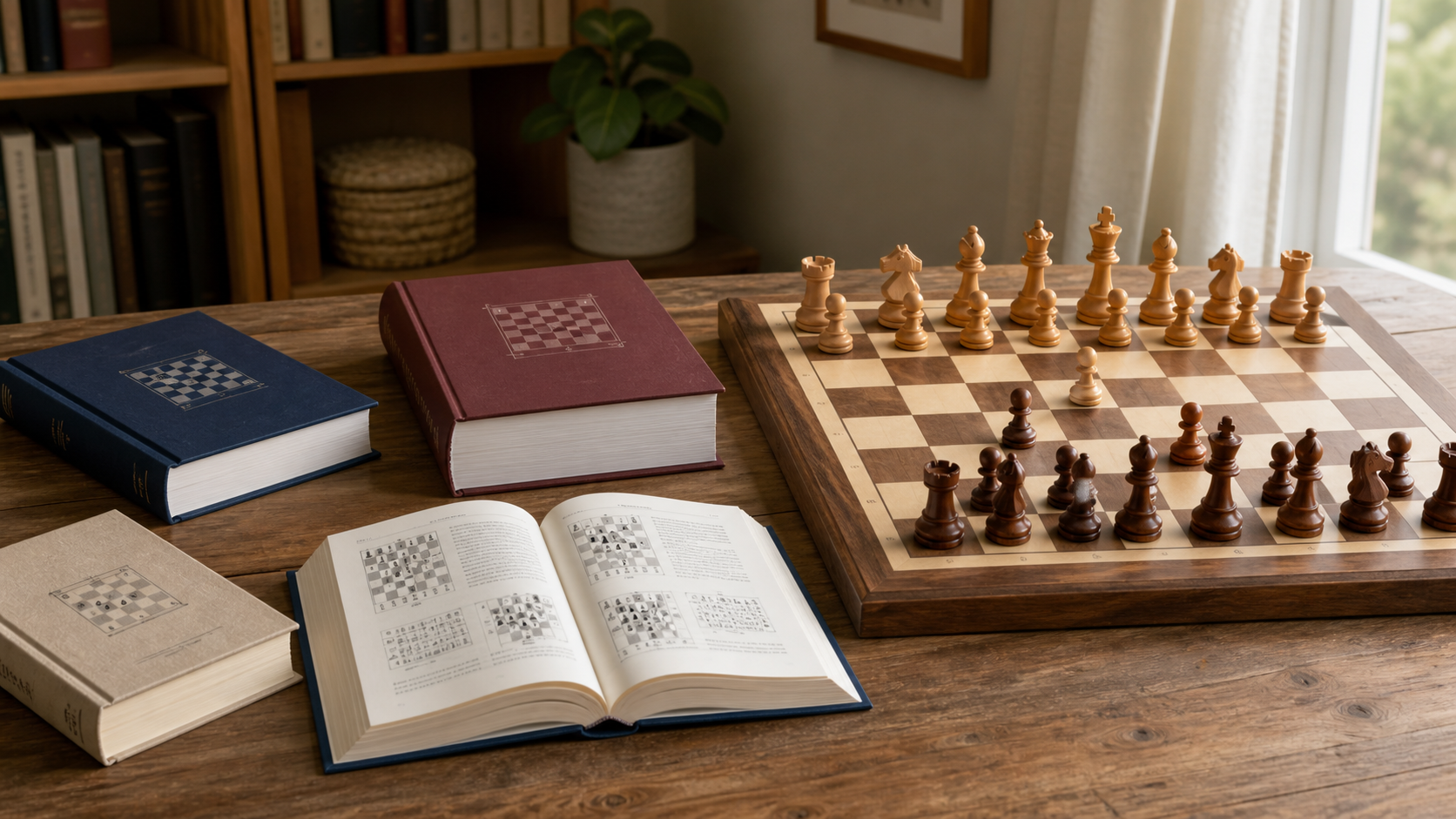
Look for a beginner opening guide that explains plans in plain language, uses frequent board diagrams, and follows complete short games. A compact principles-first book is usually a better first purchase than a large opening encyclopedia.
Selection Criteria That Matter
- Principles before move lists: the first chapters should explain development, center control, king safety, and common early mistakes.
- Plain-language plans: a useful guide tells you what each side is trying to achieve, not only which move is most common.
- Frequent diagrams: absolute beginners should not need to reconstruct every position from notation alone.
- Notation support: choose a book that introduces algebraic notation or gives enough diagrams to keep it from becoming a barrier.
- Complete sample games: seeing an opening lead into a middlegame helps prevent the false idea that the game ends after development.
- Manageable scope: one or two simple setups taught well are more useful than a catalog of every named variation.
- Exercises with explanations: good questions ask for a plan or candidate move and explain why alternatives fail.
- Edition clarity: match the author, publisher, and edition shown in the listing; marketplace results may combine formats or revisions.
Comparison Framework: Which Book Format Fits?
Principles-first introduction
Choose it when: you know the rules but still move the same piece repeatedly, bring the queen out too soon, or forget king safety. Look for short chapters, diagrams, and examples of both sensible and faulty development.
Skip it when: you already apply the basic principles consistently and can explain the plan behind your usual first several moves.
Annotated mini-game collection
Choose it when: you learn best from complete games with comments after nearly every move. The strongest beginner versions explain the losing mistake without pretending every quick win is forced.
Skip it when: sparse notation makes you lose the position or the examples mostly feature traps without showing sound alternatives.
Simple system or starter-repertoire guide
Choose it when: you want a repeatable starting plan and understand that opponents will vary. Preview whether the book explains typical pawn breaks, piece placement, and what changes against different replies.
Skip it when: the sample pages are long move trees, assume tournament knowledge, or promise an opening that wins automatically.
Puzzle or workbook format
Choose it when: you already understand development principles but fail to notice early tactical mistakes. Check that answers explain the idea rather than giving only a move.
Skip it when: you still need connected explanations. A workbook can test knowledge, but it is rarely the clearest source for learning the framework from scratch.
Reference encyclopedia
Choose it later when: you regularly review recorded games and need to investigate one specific branch.
Skip it now when: you are an absolute beginner. Dense references solve lookup problems; they are usually poor first teachers.
Preview a Book Before Buying
- Open the contents and count how quickly the book reaches named variations. Principles and example games should come first for a new player.
- Read one sample explanation. It should state a goal, not merely label a move good or bad.
- Check diagram frequency and orientation. Make sure you can tell whose move it is and view the board from the intended side.
- Look for complete games or clear transitions into middlegame plans.
- Inspect an exercise and its answer. The solution should explain the plan, the opponent's threat, or the tactical point.
- Confirm the exact format and edition. A pocket edition, ebook, and large workbook may provide very different diagram sizes and writing space.
How to Use an Opening Book Without Memorizing
Set up a physical board and play through one annotated game slowly. After each early move, say its job aloud: develop, defend, contest a square, prepare castling, or respond to a threat. Then close the book and rebuild the first position where the plan became clear.
Record one of your own games and compare only the first moment when you ignored a principle or did not know what to do. If the real problem was a fork, pin, or hanging piece, use the beginner tactics workbook guide. If games reach simplified positions and then drift, the beginner endgame book guide is the better next step.
The broad beginner chess rules-and-strategy pillar is not built yet, so this page links to the closest practical foundations and sibling study guides.
Who Should Skip an Opening Book?
Wait if piece movement, check, checkmate, and castling are not yet comfortable. A rules guide and short board sessions will remove more friction than opening study. Also skip a purchase if you already own a general beginner book with an unread opening chapter—use that chapter for several games before deciding what is missing.
Players who mainly lose pieces in one move should spend more time on board vision and elementary tactics. Players who already analyze recorded games may need a focused repertoire guide instead of another general introduction.
Bottom Line
For an absolute beginner, the best opening-book category is a principles-first guide with frequent diagrams and annotated complete games. Choose a workbook only after the ideas make sense, a starter repertoire only when you want a repeatable plan, and an encyclopedia only when you have a specific line to research. Preview the exact edition and buy the format you can comfortably use beside a board.