
Loose chess pieces are easy to misplace and awkward to carry in a box made for something else. A simple drawstring pouch is enough for many sets, while weighted pieces, travel kits, and shared equipment can justify padding, compartments, or a visible label.
This is a criteria-led category guide, not a hands-on product ranking. We have not tested every bag or verified every current listing. Count and measure your pieces, then confirm the seller's usable dimensions, materials, closure, and included contents before buying.
As an Amazon Associate, The Good Chess & Checkers may earn from qualifying purchases.
Quick decision aid
Choose chess piece storage formats
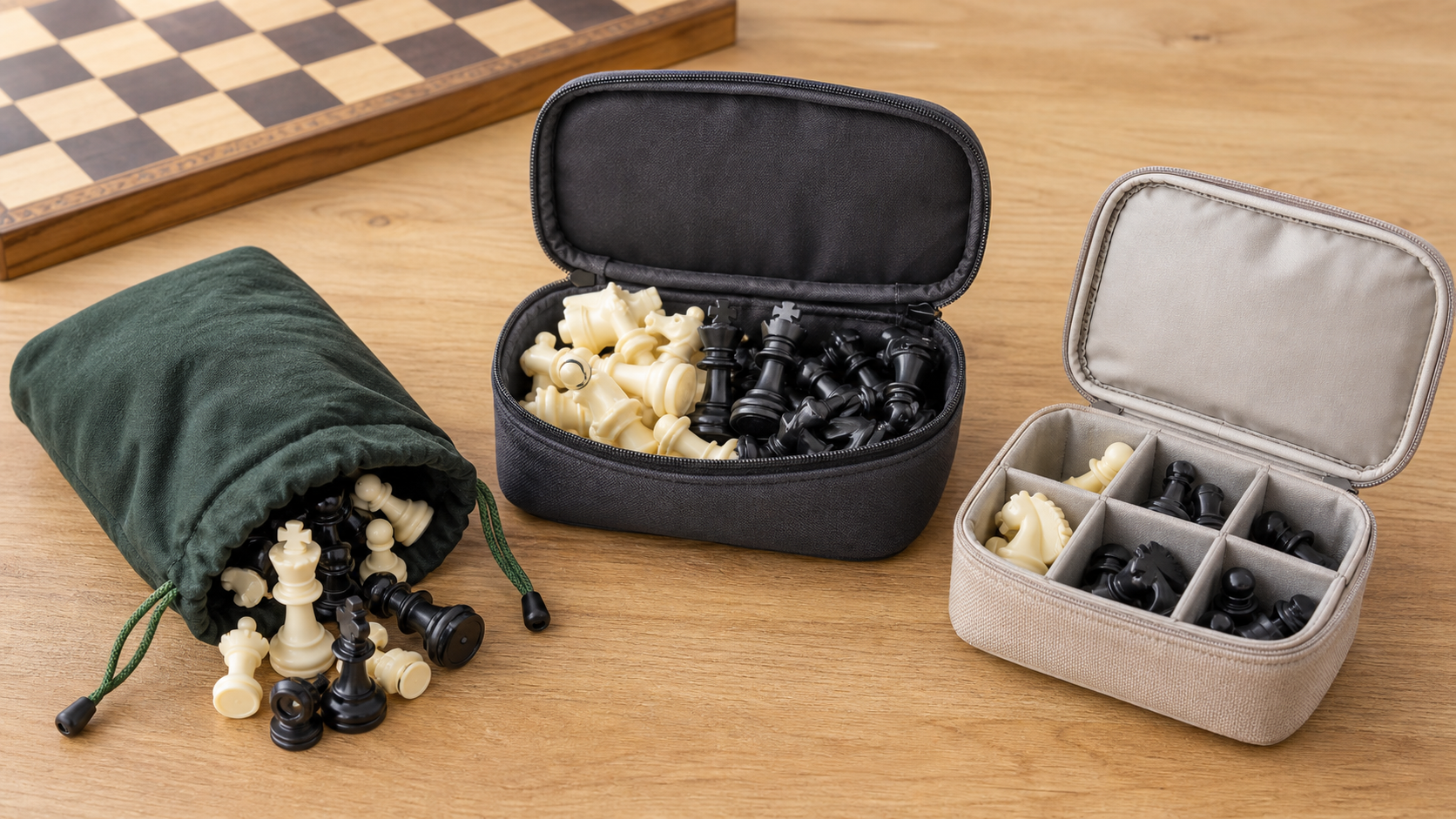
Compare soft drawstring pouches, zippered padded cases, and divided organizers. Check the usable interior and opening—not only the outside dimensions—and verify whether the listing is for a bag alone.
How We Compare Chess Piece Bags
- Usable capacity: the complete set should fit without forcing the closure or pressing tall pieces sideways.
- Opening and closure: a wide opening speeds cleanup, while a secure drawcord or zipper helps keep pieces contained.
- Interior contact: soft lining or separated sections may matter for finished wooden or weighted pieces.
- Portability: the filled bag should fit beside the board in the shelf, tote, or travel case you already use.
- Identification: a label area or different pouch colors help distinguish sets, spare pieces, or two players' armies.
- Practical protection: choose only as much structure as the pieces and storage routine require.
Best Overall for Most Sets: A Wide Drawstring Pouch
A soft, wide-mouth pouch is the simplest answer for ordinary plastic pieces and many home sets. It packs into odd spaces, opens fully for fast counting, and avoids the rigid footprint of a case. Look for a drawcord that closes the opening evenly and enough height that the king does not hold the mouth open.
Best for: complete plastic sets stored in a cabinet, bin, or board bag.
Skip it if: the pieces have a delicate finish, the pouch will be crushed under other equipment, or you need each piece kept separate.
Best for Weighted Pieces: A Padded Zippered Case
Weighted pieces make a soft pouch dense and can knock against one another during transport. A lightly padded case adds structure and keeps the load from shifting as freely. Check that the zipper path will not catch crowns, felt bases, or drawstrings, and avoid a case so tight that pieces must be packed in a precise puzzle every time.
Best for: heavier sets that regularly travel between home, class, or a club.
Skip it if: the pieces stay on one shelf or the padding makes the case too bulky for the existing board bag.
Best for Finished Wooden Pieces: A Soft-Lined Pouch
A smooth interior can reduce rough contact with painted, polished, or felted surfaces. The lining should be clean, securely attached, and roomy enough that pieces are not squeezed together. A divider between light and dark armies can make setup faster, but it is optional when both sides fit comfortably.
Best for: wooden or display-oriented pieces that need gentler storage than a bare plastic bin.
Skip it if: the maker already provides fitted storage or specifies a different storage method.
Best for Fast Setup: Two Labeled Pouches
One pouch for each army makes it obvious which side is incomplete and lets two players set up at the same time. Choose matching pouches with clearly different colors or labels. This system also works for spare-piece inventories, provided the label states the set number and contents.
Best for: families, lessons, and shared sets where quick counts matter.
Skip it if: two small pouches are more likely to become separated than one complete-set bag.
Best for Maximum Separation: A Divided Organizer
A divided case can stop pieces from piling together and can make missing types easy to notice. It is the most space-hungry option, and fixed cells may not fit tall kings or wide rooks. Measure the tallest piece, widest base, and number of compartments before considering this format.
Best for: carefully finished pieces, teaching collections, or organized spare-piece stock.
Skip it if: the dividers waste space, the case will be carried vertically without secure compartments, or setup speed matters more than separation.
Quick Comparison Framework
- Choose a drawstring pouch for compact, low-fuss storage of ordinary pieces.
- Choose a padded zip case when heavier pieces travel often.
- Choose soft lining when surface contact is a bigger concern than minimum size.
- Choose two labeled pouches for quick setup and easier counts.
- Choose a divided organizer only when individual separation justifies the extra bulk.
Measure Before You Buy
- Count the pieces, including extra queens or replacements that will live with the set.
- Measure the king's height and the widest piece base.
- Group the full set as loosely as it should sit in storage and estimate that bundle's width, depth, and height.
- Add room for your hand to load and remove pieces without pulling on crowns or bases.
- Compare those measurements with the listing's usable interior, opening, divider layout, and closure.
Product photos can explain shape, but they do not establish fit by themselves. Confirm material and care information on the current listing, and remember that “chess bag” may mean a board carrier, a piece pouch, or a complete set.
What About Checkers Pieces?
A loose checker set can use the same basic pouch logic, but flat discs pack differently from tall chess pieces. Checkers also benefit from an opening wide enough to count pieces and from separate storage when multiple rule sets use different counts. For a mixed family shelf, compare the broader chess and checkers storage guide.
Who Should Skip a Dedicated Piece Bag?
Skip a separate bag when the board has secure fitted storage, the original box remains sturdy, or loose pieces never leave a labeled drawer. A full-kit carrier is a better choice when the board and clock travel with the pieces. Also skip any listing that omits usable dimensions, cannot close around the complete set, or appears to rely on a product photo rather than clear material and capacity details.
Bottom Line
For most ordinary chess sets, a wide drawstring pouch is the best balance of capacity, easy cleanup, and compact storage. Add padding for heavy pieces that travel, soft lining for finishes that need gentler contact, or dividers only when separation is worth the extra bulk. Measure the complete set and its tallest piece before choosing the bag.