
A piece tray is useful when a tournament-style set needs more organization than a loose pouch provides. The right format keeps both armies easy to count, fits the tallest king and widest base, and still leaves room for the roll-up board, clock, and scorebook in your carrying bag.
This is a category comparison, not a ranking of named products or a claim of hands-on testing. Listings change, so measure the complete set and verify current interior dimensions, materials, closures, and included contents before buying.
As an Amazon Associate, The Good Chess & Checkers may earn from qualifying purchases.
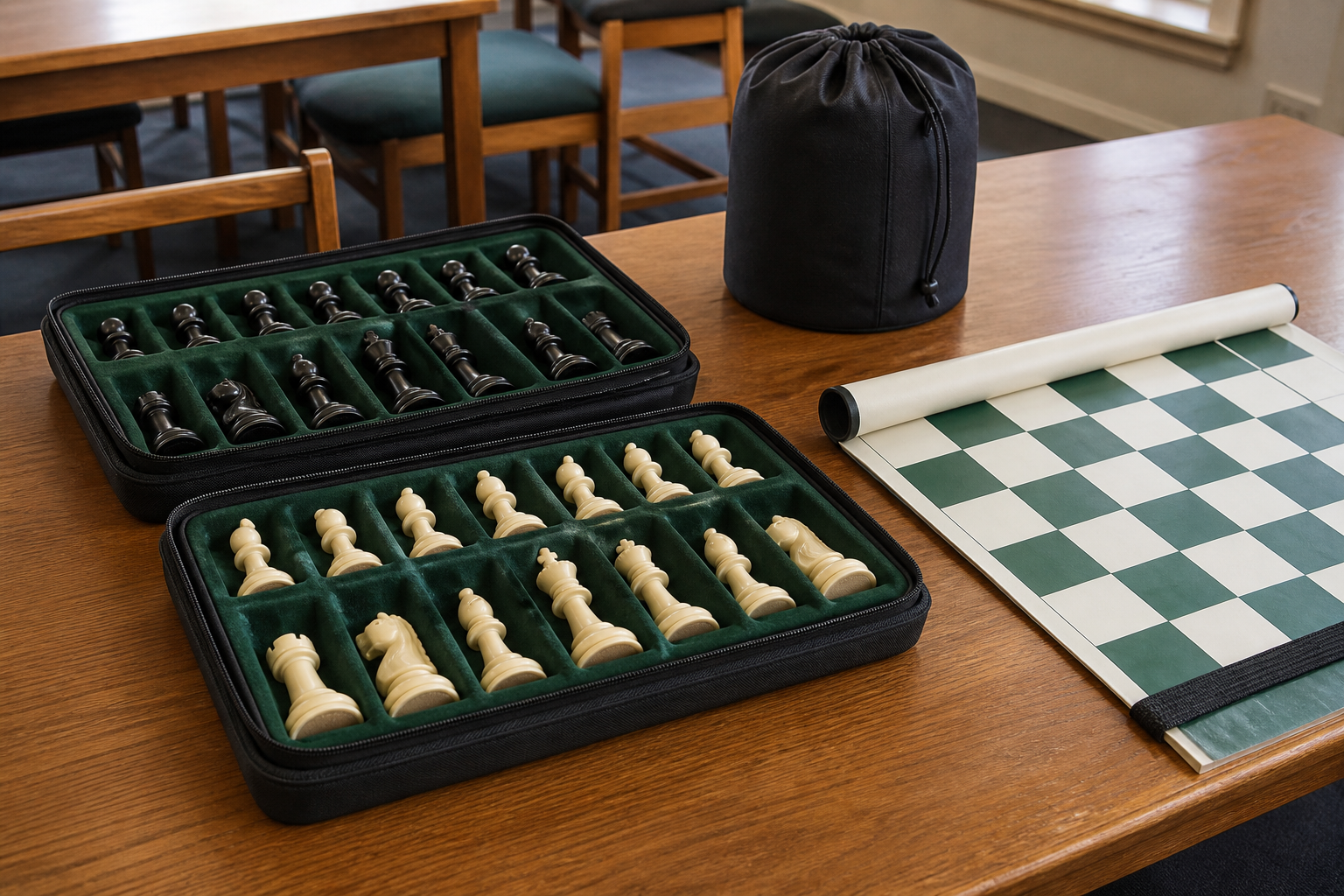
Measure the king and base first
Shop chess piece tray formats
Compare padded divided trays, two-army organizers, and zippered tray cases. Confirm usable cell dimensions and total capacity rather than relying on exterior measurements or product photos.
How to compare chess piece trays
- Usable cell size: measure the king height and widest base; a fitted-looking photo does not prove compatibility.
- Complete-set capacity: allow for 32 standard pieces plus any extra queens used for promotion.
- Compartment layout: fixed cells protect separation, while adjustable dividers can make better use of uneven piece sizes.
- Lining and contact: a smooth, securely attached lining is more useful than padding that squeezes crowns or felt bases.
- Closure and orientation: a tray carried vertically needs a lid or case that prevents pieces from leaving their cells.
- Whole-kit fit: measure the packed tray against the board bag, shelf, cabinet, or club tote it must share.
Best overall format: two padded army trays
One shallow tray for white and one for black makes counting straightforward and lets two players set up at once. A soft lining limits hard contact, while a low profile is easier to stack beside a rolled board than one deep box. Look for clearly separated cells and enough clearance above the tallest pieces when closed.
Best for: a complete weighted plastic set used regularly at home or a club.
Skip it if: two separate trays are likely to become separated or the carrying bag has room only for a flexible pouch.
Best for compact club storage: a stackable open tray
Open trays can make setup and end-of-session counts fast when equipment moves only between a cabinet and nearby tables. Matching stackable footprints use shelf space efficiently. Each tray should remain easy to lift without flexing, and the stack should not press on piece tops.
Best for: clubs and classrooms that store pieces on site.
Skip it if: equipment travels in a car or bag, dust protection matters, or an open tray could tip during transport.
Best for transport: a zippered tray case
A case that closes around fitted trays keeps the organizer together when carried vertically. Check handle attachment, zipper clearance, and whether the lid presses pieces out of position. Structure adds bulk, so compare the packed case with your existing board and clock carrier.
Best for: coaches, helpers, or players moving one valued set between locations.
Skip it if: minimum weight and flexible packing matter more than individual compartments.
Best for mixed piece sizes: adjustable dividers
Adjustable dividers can accommodate broad weighted bases and extra queens better than identical fixed cells. The dividers should lock securely enough that pieces cannot migrate underneath or push them aside. Test the layout on paper from the listed interior dimensions before ordering.
Best for: nonstandard sets, spare-piece collections, or kits with extra promotion pieces.
Skip it if: the divider system creates wasted gaps or needs frequent rebuilding.
Tray, pouch, or full carrying bag?
- Choose a tray when organized counting and surface separation justify a rigid footprint.
- Choose a pouch when ordinary plastic pieces need compact, flexible storage.
- Choose a full carrying bag when the board, pieces, clock, and paperwork must travel as one kit.
- Keep fitted original storage when it already protects every piece and fits your routine.
Measure before buying
- Count all pieces, including extra queens and replacements.
- Measure the king height, widest base, and widest crown.
- Check each cell's usable width, depth, and height—not the tray's exterior alone.
- Confirm that the closed lid clears every piece and holds it in its compartment.
- Measure the complete packed tray against its shelf or carrying bag.
Who should skip a dedicated tray?
Skip a tray if the pieces are durable plastic, stay in one labeled drawer, and are already easy to count in a pouch. A tray is also a poor fit when space is tight, the whole tournament kit travels in a slim bag, or the listing omits usable compartment dimensions. Do not buy individual separation simply because it looks premium; choose it only if it improves protection, counting, or setup for your routine.
Bottom line
For most tournament-style sets that benefit from organized storage, two padded army trays offer the clearest balance of counting, setup speed, and separation. Use an open stackable tray for on-site club storage, a zippered case for frequent transport, or adjustable dividers for unusual piece sizes. The best choice is the one proven by measurements to fit every piece and the rest of your kit.