
A chess teaching set should help a parent answer “what do we do next?” A useful kit combines a readable board and recognizable pieces with short prompts, movement reminders, or mini-games that lead to actual play. Extra cards and booklets are worthwhile only when they reduce preparation instead of creating another rulebook to decode.
This is a category comparison, not a hands-on product ranking. We have not tested the sets returned by the shopping links. Product contents, board dimensions, lesson materials, age labels, and storage can change, so verify the current listing and seller images before buying. A teaching kit does not certify a child for school, club, federation, or tournament play.
As an Amazon Associate, The Good Chess & Checkers may earn from qualifying purchases.
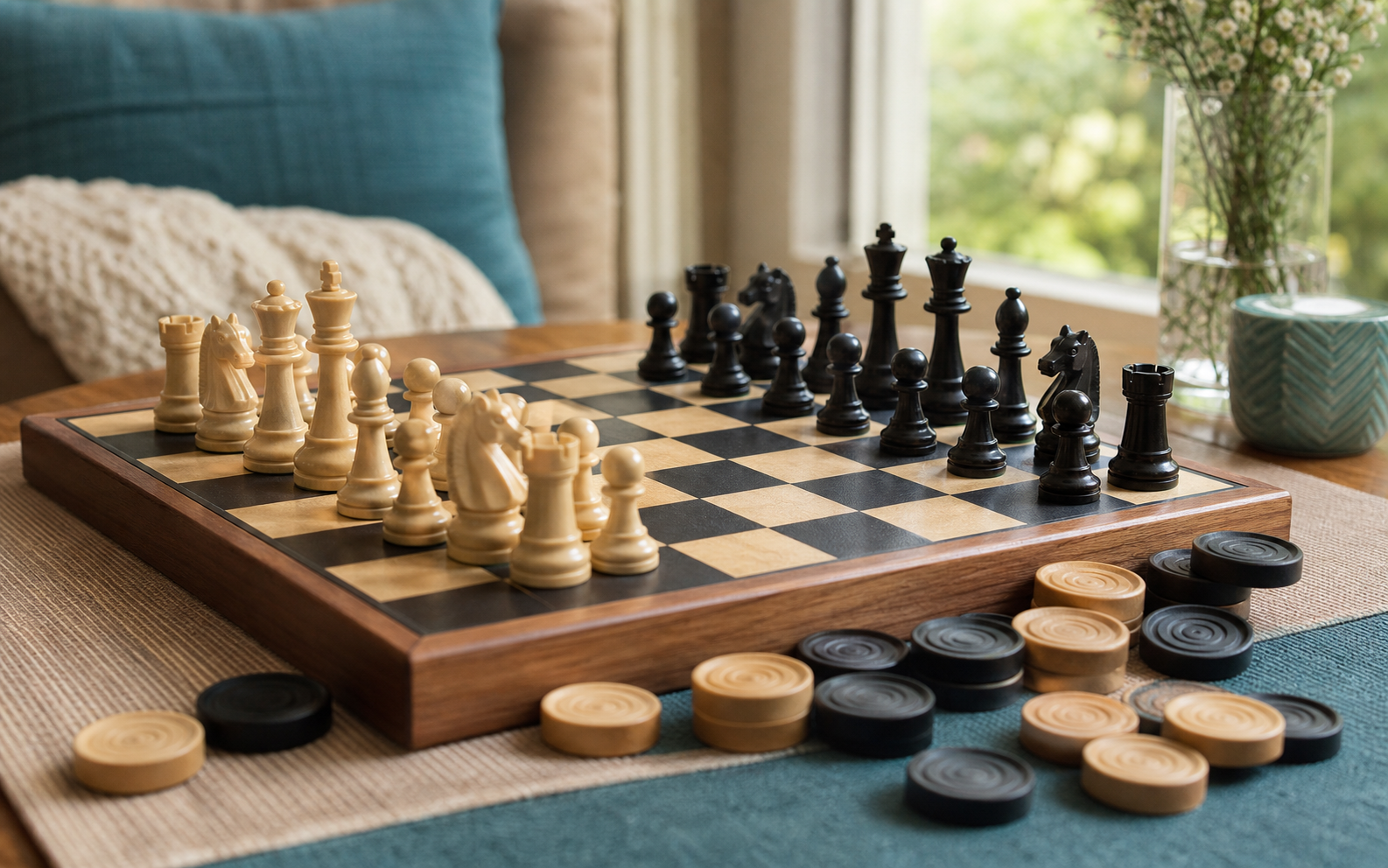
Choose the teaching path first
Look for a board, prompts, and storage that work together
Preview the actual lesson aids before choosing a kit. The board should stay readable after cards, a booklet, and captured pieces share the table.
What to Look for in a Parent-Led Teaching Set
- Readable coordinates: letters and numbers around the board help parent and learner identify a square together without pointing ambiguously.
- Recognizable pieces: familiar Staunton-style shapes make books, diagrams, and later replacement pieces easier to match.
- A visible lesson sequence: look for sample cards or contents that move from piece names and legal moves to captures, check, and simple games.
- Short activities: a good aid creates a ten- or fifteen-minute stopping point instead of expecting a full game immediately.
- Plain-language answers: parents learning alongside a child need explanations, not only a correct square or unexplained notation.
- Complete storage: confirm that pieces, cards, booklet, and board all fit back into the box or bag without bending the learning aids.
- Honest age fit: use the maker's current age guidance, then preview reading load, piece size, and activity length for the particular learner.
Best Overall Format: Coordinate Board with Short Lesson Cards
For most parent-and-child beginners, the most manageable format is a standard-looking board with coordinates plus a small deck of one-idea lesson cards. The cards should begin with piece identification and movement, then introduce captures and simple goals. A parent can choose one card, set up only the pieces it needs, and finish while attention is still good.
Check that card diagrams use the same board orientation and piece symbols as the physical set. Tiny print, crowded arrows, or unexplained algebraic notation can make a “guided” kit harder than a plain set. Cards should support conversation across the board, not replace it.
Best for: parents who want a clear next activity without committing to a long curriculum.
Skip it if: sample cards are unavailable, the diagrams are hard to read, or the deck teaches tricks before basic legal moves.
Best for Starting from Zero: Color-Cued or Movement-Guide Sets
Some teaching sets use printed movement reminders, highlighted destinations, or separate visual guides to show how each piece travels. These can help during the first sessions when names and movement patterns are still unfamiliar. Prefer removable cards or a separate guide over a busy permanent board; the learner should eventually see an ordinary 8-by-8 playing surface.
Visual cues are not automatically self-explanatory. Preview whether arrows distinguish sliding pieces from knights, whether captures are addressed, and whether the guide explains that a legal move can still be a poor choice. Parent narration remains important.
Best for: visual learners who need repeated movement reminders and parents who are also learning the rules.
Skip it if: the colors clutter the squares, the symbols do not match other learning materials, or the learner already knows every piece's legal move.
Best for a Planned Course: Board-and-Workbook Kits
A kit with a workbook or structured booklet can suit a family that wants a repeatable sequence across several weeks. Look for a contents page, short lessons, board exercises, review activities, and an answer section that an inexperienced adult can follow. The board should be large enough to rebuild diagrams without pieces crowding their squares.
The risk is overbuying structure. A thick workbook is not valuable if each lesson requires lengthy reading or if the child mainly wants to move pieces. Compare the actual sample pages with the learner's reading level and the parent's available preparation time.
Best for: homeschool routines and families that enjoy sitting down for scheduled lessons.
Skip it if: the learner prefers play-based discovery, the parent wants zero preparation, or the workbook is sold separately from the edition shown.
Best for Play-First Families: Standard Set with a Simple Rule Card
Not every family needs a specialized kit. A readable coordinate board, familiar pieces, and one concise movement card may be the better teaching set when the parent plans to use mini-games: pawns racing, rook mazes, bishop color practice, or king-and-rook checkmates after the basics are secure.
This format transitions cleanly into ordinary play and makes replacement pieces easier to find. It asks more of the adult, though. Pair it with our guide to how chess pieces move and keep each session focused on one rule or piece.
Best for: parents comfortable choosing activities and children eager to touch the pieces quickly.
Skip it if: the adult needs a prepared lesson sequence or the included rule card is too condensed for a true beginner.
Quick Comparison Framework
- Choose lesson cards for the easiest balance of guidance, short sessions, and flexible pacing.
- Choose movement guides when piece movement is the main barrier and the cues remain visually simple.
- Choose a workbook kit for a family that wants a planned multi-week path and will preview each lesson.
- Choose a standard coordinate set when the parent can supply mini-games and wants the cleanest transition to regular chess.
- Choose a separate book and set when the bundled aids look weak but the board itself fits the family.
How Parents Can Check a Kit Before Buying
First, inventory the current listing: 32 chess pieces, board, every promised card or booklet, and the stated storage. Confirm whether coordinates appear on all four sides, whether a folding board lies flat in seller photos, and whether the piece bases fit comfortably inside each square. Do not infer dimensions from staged photography.
Next, preview a middle lesson rather than trusting the cover. Can a parent explain the goal in one sentence? Can the learner complete it with the included pieces? Does the answer explain why? Finally, check that the materials progress toward a real game rather than depending forever on proprietary colors or symbols.
Who Should Skip a Bundled Teaching Set?
Skip a specialized kit if the learner already knows legal moves and mainly needs practice, if a readable set is already at home, or if the bundled curriculum cannot be previewed. A separate beginner chess book and existing board may offer a clearer learning path.
Also skip the purchase when the adult expects the product to teach unattended. Young beginners usually benefit from a partner who keeps sessions short, answers questions, and notices frustration. If the family wants one box for both classic games, compare family chess and checkers gift sets; a chess-only teaching kit is a poor fit when checkers and mixed-age game night matter equally.
Bottom Line
The best chess teaching set for most parents is a readable coordinate board with recognizable pieces, short lesson prompts, clear answers, and storage for every component. Choose the learning format before the box: cards for flexible sessions, visual guides for movement help, a workbook for planned study, or a standard set for play-first mini-games. Preview the real materials and buy only the guidance the family will actually use.