
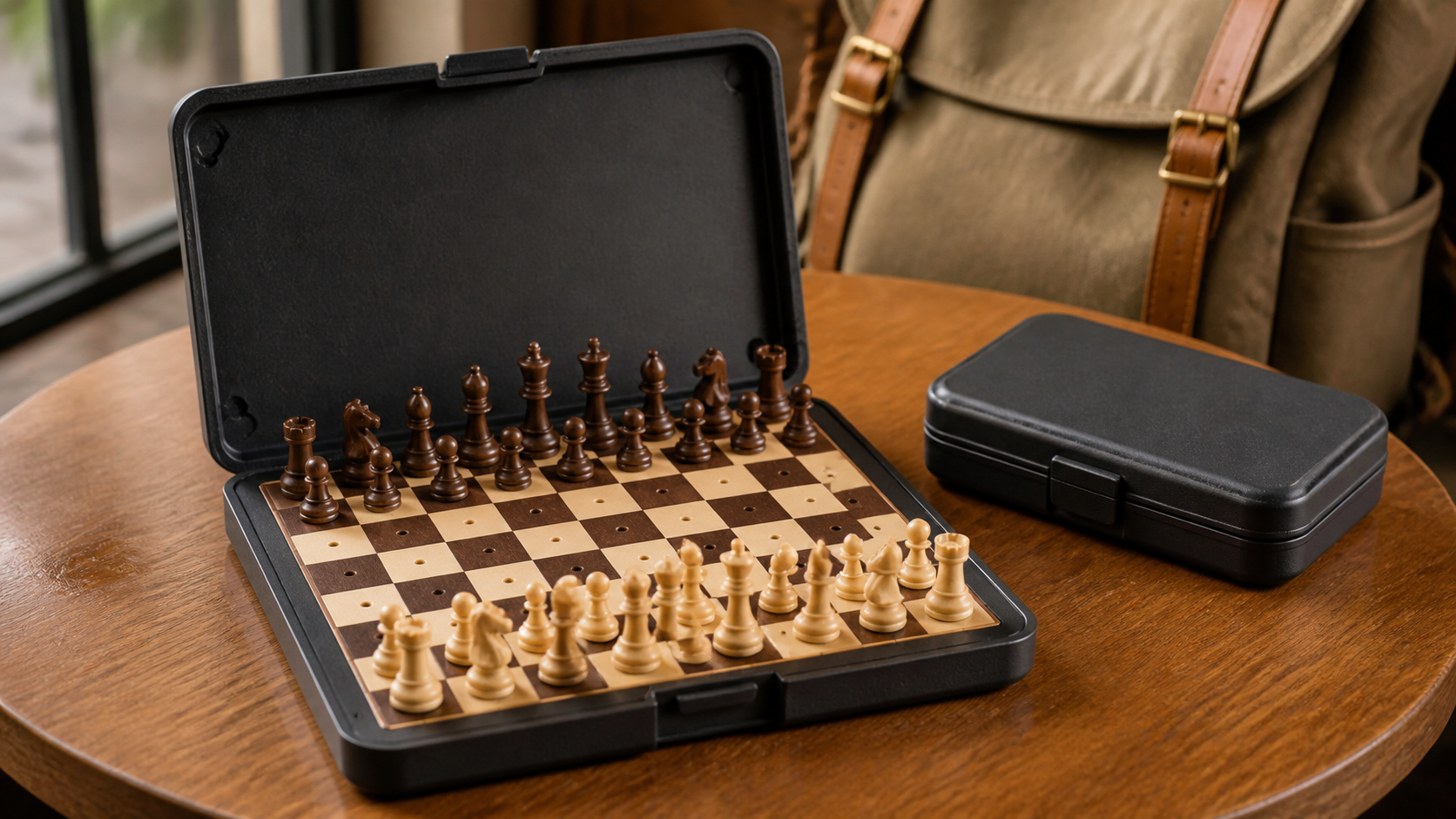
A peg chess set solves one specific travel problem: each piece sits in a hole instead of resting loosely on a square. That can keep a position usable on a cramped table or during a careful move between seats, but the tiny board and narrow pieces can be harder to read and handle than an ordinary travel set.
This is a product-category comparison, not a named-product ranking or hands-on test. Listings change, so verify open and closed dimensions, the complete piece count, storage layout, materials, and return terms before buying.
The Good Chess & Checkers may earn commissions from qualifying purchases.
Quick decision aid
Start with usable board space, not the smallest closed case
Compare the open board, piece shapes, peg fit, closure, and storage together. A pocket-size case is only useful if both players can identify and move the pieces comfortably.
Quick selection framework
- Open dimensions: judge the playing surface separately from the closed case. Check whether two hands can reach the center without knocking neighboring pieces.
- Piece recognition: every piece type should have a distinct silhouette. Tiny decorative shapes can turn an already small board into guesswork.
- Peg retention: pieces should seat consistently without requiring force. Listings should show the holes and peg bases clearly.
- Complete storage: confirm space for all 32 pieces, including captured pieces, and whether the case closes without pressure on them.
- Board contrast: light and dark squares and the two armies should remain easy to distinguish around the holes.
- Closure and materials: compare latch, hinge, hole finish, piece stems, and care directions rather than trusting “travel” wording.
Best for coat pockets and very small bags: micro peg sets
The smallest peg sets prioritize closed size above everything else. They can work for a traveler who already recognizes chess pieces instantly and wants a board for slow games during waits. Look for clearly shaped kings, queens, bishops, knights, and rooks; color alone is not enough on a crowded board.
Best for: experienced casual players carrying as little as possible.
Skip it if: either player needs larger pieces, is learning piece shapes, or wants to scan the whole position quickly.
Best balance for ordinary travel: compact folding peg sets
A slightly larger folding case usually offers a more useful compromise. The open board can provide clearer squares while the closed halves protect pieces and reduce packed length. Check whether the fold creates a distracting center gap and whether every captured piece has a secure place during play.
Best for: backpacks, hotel stays, train tables, and planned games where compact storage matters but pocket size does not.
Skip it if: the hinge prevents flat setup, the case stores only the starting position, or the board still feels cramped.
Best for pausing a study position: fitted-lid peg boards
Some peg boards use a separate or hinged cover over the playing surface. This can help when replaying a position beside a lesson and returning later, provided the lid has enough clearance. Pegs reduce casual sliding; they do not guarantee that a closed board can be shaken, inverted, or carried upright.
Best for: quiet study sessions or a position that may need a short pause.
Skip it if: the lid presses on taller pieces, captured pieces have no compartment, or the set must tolerate rough movement.
Best for easier handling: larger tabletop peg sets
A larger peg board sacrifices pocketability for pieces that are easier to identify and grasp. It remains distinct from an ordinary set because the stems sit in holes, but it may need a tote or luggage compartment rather than a jacket pocket.
Best for: travelers who care more about stable pieces than minimum packed size.
Skip it if: a normal magnetic or folding board offers the same packed convenience with more familiar pieces.
Peg chess vs magnetic travel chess
- Choose peg chess when a very small rigid board and individually seated pieces are the main priorities.
- Choose magnetic chess when you want more conventional piece shapes and a wider range of board sizes.
- Choose a plain folding set when games happen on stable tables and readability matters more than retention.
- Choose an app when physical piece handling is unimportant and carrying no board is the goal.
The magnetic travel-set guide covers the closest alternative. Pegs and magnets both resist movement, but neither label tells you whether a board is readable, complete, or pleasant to handle.
Pre-purchase checklist
- Measure the open board and closed case against the table, pocket, or bag you plan to use.
- Confirm there are 32 recognizable chess pieces and storage for captured pieces.
- Look for clear listing photos of the peg stems, holes, hinge, latch, and closed case.
- Check whether the board can remain set up when covered; do not infer this from “travel” wording.
- Compare the tallest piece with the case’s internal clearance.
- Verify material-specific care instructions and keep crumbs or grit out of the holes.
- Treat very small pieces as easy to lose and unsuitable wherever loose small parts create a concern.
Who should skip a peg chess set?
Skip this category if either player is learning to identify pieces, finds narrow pegs awkward to grasp, or mainly plays at a steady full-size table. Families wanting both games should also skip a chess-only peg set unless the listing genuinely includes a usable checkers mode; an ordinary magnetic chess and checkers travel set may fit better.
If portability is only occasional, use the travel-set buying checklist before accepting the readability tradeoff.
Bottom line
The best peg chess set for playing on the go is the smallest format both players can still read and handle comfortably. Favor a clear 8-by-8 board, distinct pieces, consistent peg fit, storage for every piece, and a closure that matches how the set will travel. Choose micro size only when pocketability truly matters; otherwise, a larger peg, magnetic, or ordinary folding set will often be easier to use. If retention method is still the open question, compare magnetic and peg travel chess sets directly.