
This is a category comparison, not a named-product ranking or a claim that every magnet or peg performs alike. Verify the open dimensions, piece shapes, retention method, closure, and included storage on the current listing before buying.
The Good Chess & Checkers may earn commissions from qualifying purchases.
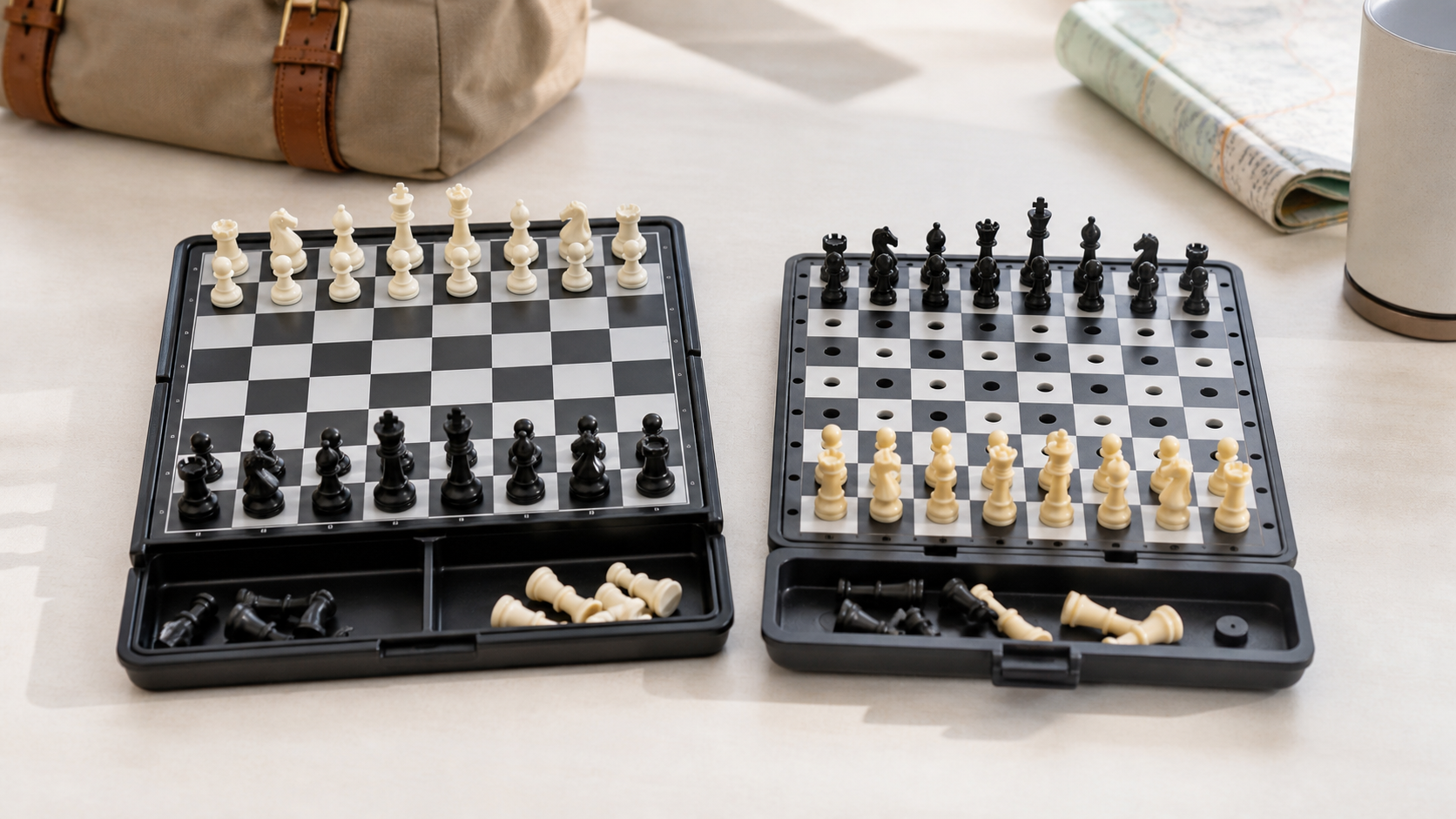
Quick decision aid
Check the open board before choosing the smallest case
Use listing measurements and close photos to compare playable square size, piece recognition, magnet or peg engagement, captured-piece storage, and the closed-case shape.
Quick answer
Choose magnetic when you want recognizable upright pieces, a board that feels closer to ordinary chess, and enough surface area for a beginner or family game. It is usually the more approachable format for a table, lap desk, hotel room, or quiet waiting period.
Choose peg when firm piece retention and very compact storage matter more than familiar handling. It can suit a player who already recognizes miniature symbols and expects to play on a small, temporary surface.
Skip both when the board is too small to read comfortably, the pieces are hard to grip, captured pieces have nowhere secure to go, or you will mainly play at a stable full-size table.
Magnetic vs peg at a glance
| Decision | Magnetic set | Peg set |
|---|---|---|
| Retention | Magnetic attraction under each piece; strength varies by set | Stem seats in a board hole; fit varies by set |
| Piece handling | Lift and place much like ordinary pieces | Pull out and insert; narrow pieces may need more precision |
| Board readability | Often available in more beginner-friendly sizes | Commonly optimized for compactness |
| Interrupted positions | Pieces can stay put if the board remains open and level enough | Seated pegs resist sliding, but the case still needs a safe way to close |
| Storage | Folding boards may store pieces in fitted or loose compartments | Small cases can be efficient, but every peg needs a counted storage place |
| Best fit | Families, beginners, hotels, tables, and lap desks | Experienced travelers, tiny spaces, and compact carry |
Who a magnetic travel set fits
A magnetic travel set fits players who want travel stability without changing the basic lift-and-place motion of chess. Larger versions can preserve recognizable Staunton-style silhouettes and leave visible space around each base, which makes a position easier to scan than many pocket peg boards.
Magnet strength is not a universal specification. A strong hold can resist a light bump but make small pieces awkward to lift; a weak hold may add little on a tilted surface. Treat current photos, dimensions, and seller or maker specifications as the evidence for the particular set.
Good fit: beginner families, hotel and campsite tables, lap-desk play, paused analysis positions, and buyers who also want checkers when the set explicitly includes it.
Magnetic tradeoffs and skip criteria
Magnetic pieces can still shift if the board is jolted, turned sharply, or packed while open. Hinges may create a raised center, and a shallow interior can press pieces together when the board closes. A magnetic chess-and-checkers set also needs enough room for stacked kings if checkers matters.
Skip magnetic when the listing hides square size or piece dimensions, the closed case stores pieces loose against the board, the intended player struggles to lift small magnetized bases, or the trip requires a pocket-size format above all else.
Who a peg travel set fits
A peg set mechanically locates each piece in a hole. That can be useful on a narrow tray or temporary surface because pieces do not rely on their flat bases for position. Peg boards also scale down efficiently, so they can fit pockets or small bag compartments that will not hold a comfortable magnetic set.
The compactness works best for someone who already knows the piece shapes and can grasp narrow stems. A tiny king, queen, bishop, and pawn need to remain distinguishable from a normal viewing distance; retention is not useful if players cannot read the position.
Good fit: experienced casual players, solo position review, compact luggage, and trips where the smallest usable case is the priority.
Peg tradeoffs and skip criteria
Peg fit may be too tight, too loose, or inconsistent, so do not infer performance from the category name alone. Repeated insertion also changes the playing motion: a player must pull vertically without disturbing adjacent miniature pieces. Very small boards can turn ordinary moves into a dexterity task.
Skip peg for a first chess set, for players who find small pieces difficult to pinch, when piece silhouettes are ambiguous, or when a missing proprietary peg would be hard to replace. Skip chess-only versions if the family expects the same purchase to support checkers.
Setup: inspect the whole travel system
Open the board and count every piece before leaving home. Check that each side has a complete army, that the two colors remain distinct, and that captured pieces have a contained place during play. If the set folds, test whether pieces must be removed before closing; do not assume the case preserves an unfinished position.
Measure the actual surface you expect to use. Tray tables, armrests, lap desks, and small café tables can have raised edges or cup recesses that reduce usable area. For broader size, closure, and travel-condition questions, use how to choose a travel chess and checkers set.
Maintenance and replacement issues
Keep grit away from magnetic bases and peg holes, and follow the maker's care instructions for the actual materials. Wipe pieces dry before closing the case. Do not soak a wooden board or assume a printed surface tolerates cleaners. A small inventory card can make it easier to count all 32 chess pieces before packing.
Replacement compatibility is a real limitation. Ordinary loose pieces will not replace a magnetized base or a fitted peg, and another maker's parts may differ in diameter, polarity, stem shape, or storage fit. Buyers who routinely lose pieces may be better served by a larger, common-format set with easy-to-source replacements.
Choose by travel situation
- Hotel or vacation rental: a medium magnetic set usually offers the easier shared game.
- Backpack with limited room: compare the closed dimensions; a readable peg set may pack smaller.
- Beginner or child: prioritize piece recognition and grip over maximum compactness.
- Solo study: either format works if coordinates and pieces remain readable.
- Chess and checkers in one box: magnetic combination sets are more common; verify the included checker count and kinging method.
- Moving vehicle: retention reduces small bumps but does not make play safe in every condition; pause whenever the surface or situation is unstable.
Bottom line
Choose a magnetic travel chess set when familiar handling, readable pieces, and flexible family use matter most. Choose a peg set when a compact board must hold every active piece in a defined location and the players are comfortable with miniature components.
Neither mechanism rescues a cramped, unclear board. Start with the smallest open board both players can comfortably read and handle, then compare retention, closure, captured-piece storage, and replacement risk. Continue with the magnetic travel-set categories or the peg travel-set categories only after that format decision is clear.