
A few missing checkers can sideline an otherwise useful classroom board. Replacement packs are the sensible fix when the boards are still readable and flat—but only if the new discs match the square size, stack reliably for kings, and give every table a complete, consistent set.
This is a product-category comparison, not a named-product ranking or hands-on test. Listings and pack contents change, so confirm measurements, exact color counts, material, and included storage before ordering.
As an Amazon Associate, The Good Chess & Checkers may earn from qualifying purchases.
Product-category guide
Measure one board and one original checker first
Match diameter, thickness, stackable shape, color contrast, and the number of pieces per color. A bulk pack is useful only when it completes the boards you already own.
What to verify before buying replacement checkers
- Diameter: measure an original disc and one board square. The checker needs room to move without crowding adjacent squares.
- Thickness and rim: pieces should be easy to pick up and sit steadily when two are stacked to represent a king.
- Color contrast: choose two colors that remain easy to distinguish from each other and from the playable squares.
- Count by color: a common 8-by-8 American checkers setup uses 12 pieces per side. Verify the variant your group plays and the listing's split, not just its total count.
- Consistency: matching pieces across boards makes setup, cleanup, and spare-parts storage simpler.
- Storage: allow room for the complete 24-piece table set plus a separately labeled reserve.
Best for several matching boards: equal-count bulk packs
A bulk pack with equal quantities of two clearly contrasting colors is the simplest category for replenishing several identical boards. Divide it into complete 12-per-color table sets before class, then keep the remaining pieces in a labeled reserve rather than scattering extras among bags.
Best for: classrooms, libraries, and clubs with several boards that share the same square size.
Skip it if: the listing gives only a total quantity, the color split is unclear, or your boards use different square sizes.
Best for clear kings: stackable, flat-sided discs
Traditional checkers lessons commonly show a king by stacking a second piece. Look for flat faces, compatible rims, and enough stability that a two-disc stack can move without separating easily. Decorative ridges matter less than a level, repeatable stack.
Best for: groups that use stacked kings and need the board state to be obvious from across a shared table.
Skip it if: the set uses marked or reversible kings and your lesson materials depend on that different system.
Best for mixed existing sets: measured refill groups
When classroom boards are not identical, sort them into groups before shopping. Record square width, original checker diameter, and the two color pairs for each group. Buying one compatible refill pack per group is less tidy than one universal standard, but it avoids forcing oversized pieces onto smaller boards.
Best for: donated or gradually collected equipment that is still usable but not standardized.
Skip it if: the time and cost of matching several formats approaches the cost of replacing badly worn sets.
Best for faster resets: pieces paired with labeled pouches
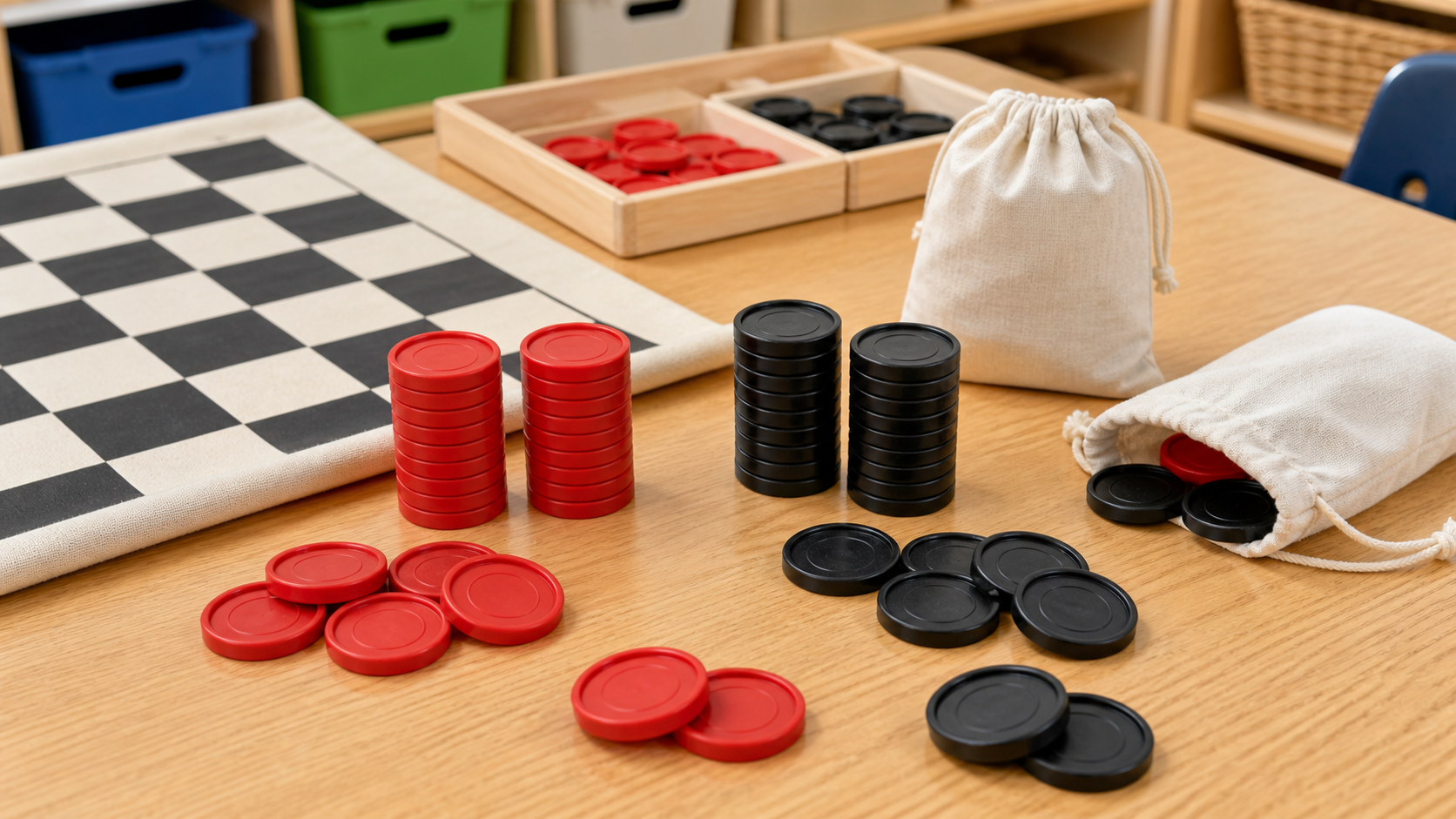
Loose bulk pieces become useful classroom inventory only after they have a home. Assign one pouch to each numbered board, place 12 of each color inside, and keep the reserve in a different container. A quick color-and-count check then restores the station without mixing every spare into circulation.
Best for: rooms where different helpers handle setup and cleanup.
Skip it if: the original folding boards already have fitted storage that a new checker diameter will not fit.
Quick comparison framework
- Choose an equal-count bulk pack when several boards use the same dimensions.
- Prioritize flat, stable stacking when kings are represented by doubled pieces.
- Create separate measured groups when donated boards vary in square size.
- Add one labeled pouch per board when faster inventory checks matter.
- Replace the complete set when the board is damaged, unreadable, or incompatible with readily available pieces.
A practical classroom inventory method
- Set aside damaged boards and group the usable ones by square size.
- Measure one original checker from each group across its widest point.
- Confirm the checkers variant and required starting count for each side.
- Write the needed red and black quantities—or the actual colors used—before opening a shopping page.
- Verify listing measurements and per-color counts; do not infer either from photos.
- After arrival, build complete table bags and label the reserve by compatible board group.
Who should skip replacement pieces?
Skip this purchase if boards are peeling, strongly curled, hard to read, or inconsistent enough that no one checker size fits well. A complete classroom set may also be the clearer path when storage is missing or when chess and checkers must share every station. The plastic classroom combo-set guide explains that broader replacement decision.
If only one home set is missing a few pieces, the general replacement guide is a better fit. This page is specifically for creating repeatable inventory across multiple learning stations.
Bottom line
The best replacement checkers pieces for classroom sets are not simply the largest bulk pack. They are measured discs with a known per-color count, dependable king stacking, clear contrast, and a storage plan that keeps each board complete. Standardize where practical, group mismatched boards where necessary, and replace the whole set when the board—not the pieces—is the real problem.