
A good classroom checkers set makes crowning obvious, survives repeated setup, and lets a helper replace one missing piece without retiring the whole board. For most groups, the strongest starting category is a high-contrast roll-up board with large, flat, stackable checkers and one labeled bag per table.
This is a category comparison based on visible specifications and classroom workflow—not a claim that we physically tested or ranked particular products. If the room also teaches chess, compare combined chess and checkers classroom sets instead.
If you are buying boards separately from pieces, first compare rigid and roll-up checkers boards for classrooms. The format changes storage space, setup time, and how reliably the playing surface stays flat.
As an Amazon Associate, The Good Chess & Checkers may earn from qualifying purchases.
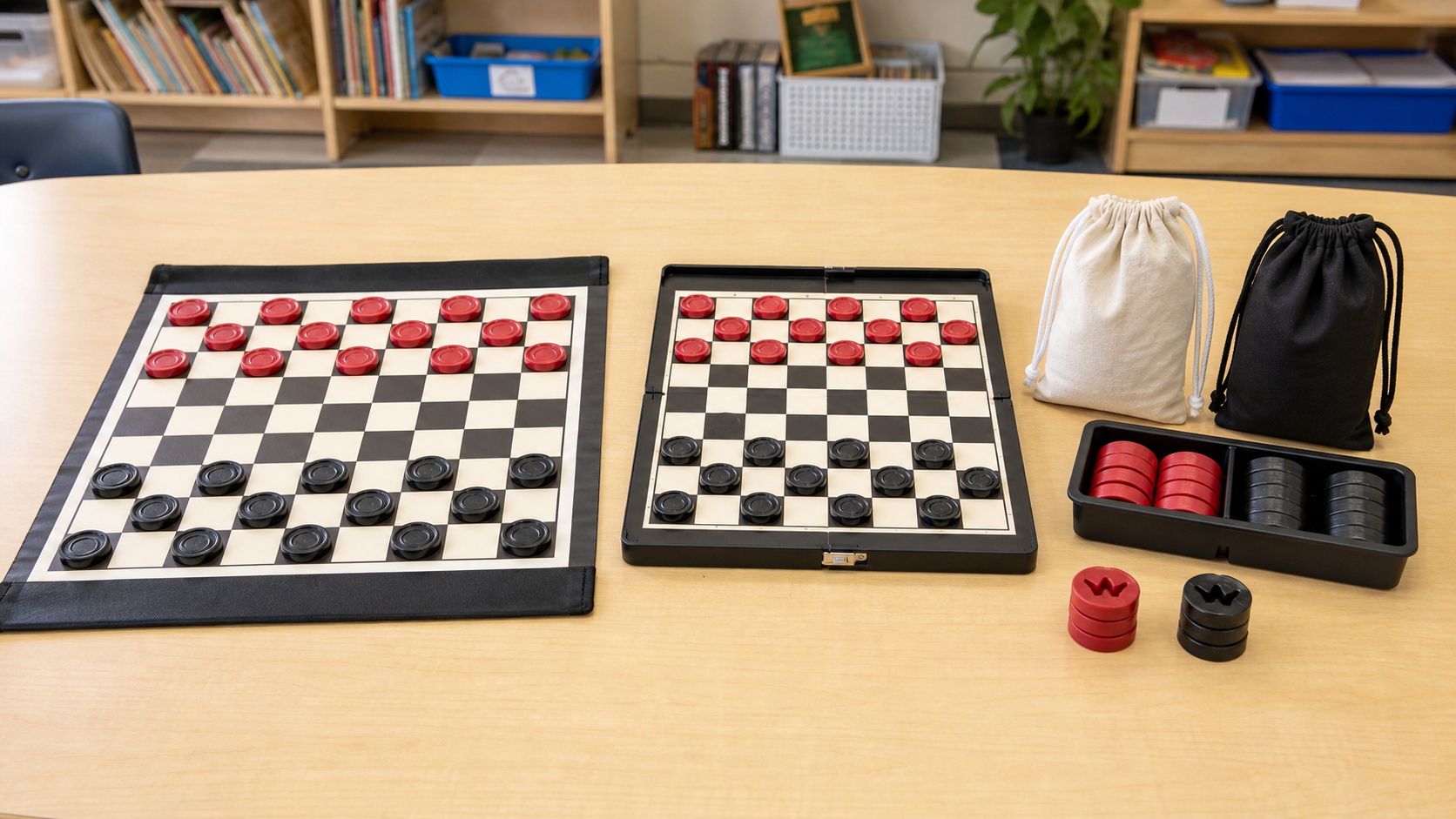
Quick decision aid
Start with pieces that stack and match
Confirm that each board includes 12 pieces per side, that two pieces stack securely as a king, and that listed diameters fit the board squares.
Selection Criteria That Matter in a Classroom
- Clear crowning: flat, stable pieces should stack without sliding so a king is immediately recognizable.
- Complete counts: standard American checkers starts with 12 pieces per player. A classroom set needs 24 playable pieces, plus any separately labeled spares.
- Board contrast: playable dark squares should be easy to follow from across a shared table.
- Piece-to-square fit: a checker should sit comfortably inside one square with room for fingers around it.
- Replacement fit: common colors and published piece diameters are easier to match later than unusual molded sets.
- Storage and reset: one numbered board and bag per table makes missing pieces easier to locate.
- Rule fit: this guide assumes common 8-by-8 American checkers. Other draughts variants may use different boards, counts, or crowning rules.
Best Overall: Roll-Up Boards with Large Stackable Checkers
This modular format is usually the easiest to scale. Boards can be stored together, each piece set can have its own bag, and a common checker diameter gives organizers a realistic replacement path. Favor a board that lies flat and has crisp square contrast; avoid storing it with a hard crease.
Best for: repeated lessons, after-school groups, clubs, and several matching tables.
Skip it if: the room has no practical way to roll boards loosely or keep every table's pieces together.
Best for Fast Handout: Complete Board-and-Bag Kits
A kit that arrives as one board, 24 checkers, and a bag reduces sorting before class. Read the included-parts list carefully: “game set” does not always mean a storage bag or spare pieces are included. Number the board and bag as a pair before putting it into rotation.
Best for: teachers and volunteers who need quick distribution and collection.
Skip it if: the listing omits checker diameter, piece count, or board dimensions, or uses a proprietary piece shape that will be difficult to match.
Best for Existing Boards: Bulk Matching Checkers
If the classroom already owns readable 8-by-8 boards, replacing incomplete piece sets may be more sensible than buying new boards. Measure the square width and an existing checker before ordering. Match diameter, thickness, color, and stacking surface—not color alone. Use the replacement classroom checkers guide to compare bulk-pack formats and set up a labeled reserve.
Best for: restoring several standard boards or building a controlled spare-parts supply.
Skip it if: boards vary in square size or the bulk pack does not state exact counts for both colors.
Best for Contained Storage: Folding Checkers Sets
Folding boards can keep their pieces inside, which works well for a tutoring room or a small number of stations. Check whether the closed board has compartments or merely an open cavity, and whether the hinge lets the playing surface sit flat.
Best for: small programs that value self-contained storage over interchangeable parts.
Skip it if: the class needs many identical sets, rapid replacement, or boards that can be stacked compactly.
Best for Younger Beginners: Larger Easy-Grip Pieces
Larger checkers can be easier to sort and move, but “large” only helps when the pieces still fit the squares. Look for a visible rim or textured edge and a broad, level surface for stacking. Do not infer an age or safety claim from size alone; follow the maker's stated age guidance and the program's own supervision policy.
Best for: beginner groups where handling and quick visual sorting matter.
Skip it if: one checker nearly fills a square or two stacked pieces become unstable.
Quick Comparison Framework
If a program already owns complete, stackable pieces, compare roll-up checkers boards for clubs and classrooms before replacing the full sets. That guide focuses on square size, piece fit, flatness, material, and compact storage.
- Choose roll-up sets for the strongest balance of scale, storage, and replacement flexibility.
- Choose complete kits when fast handout matters more than mixing components later.
- Choose bulk pieces when the boards are already good and their square size is known.
- Choose folding sets for a few self-contained stations with dependable shelf space.
- Choose larger pieces only after confirming square fit and stable king stacks.
How Many Sets Should a Classroom Buy?
Plan one complete board for every pair expected to play at the same time. For 12 active players, that means six complete sets; for 20, it means ten. A single matching spare set can be more useful than a loose assortment because it can replace an entire damaged or incomplete station while the organizer sorts the problem later.
Keep 24 normal pieces in each numbered bag and store replacement pieces separately. That preserves a simple reset check instead of turning every table bag into a different count.
Who Should Skip a Checkers-Only Classroom Set?
Skip this buying path if the program truly needs chess and checkers at every station, has very limited shelf space, or teaches a draughts variant that does not use the common 8-by-8 board and 12-piece setup. In those cases, use the plastic combo-set comparison or verify the exact variant before ordering.
When every set needs a faster 12-and-12 inventory check, compare checker-piece storage trays for classrooms before replacing otherwise usable boards.
Bottom Line
For most checkers-first classrooms, choose matching roll-up boards, large stackable pieces, and one labeled bag per table. Confirm 24 pieces, strong board contrast, stable king stacks, published dimensions, and a replacement plan. Those details will matter longer than decorative styling or an unsupported “classroom approved” label.