
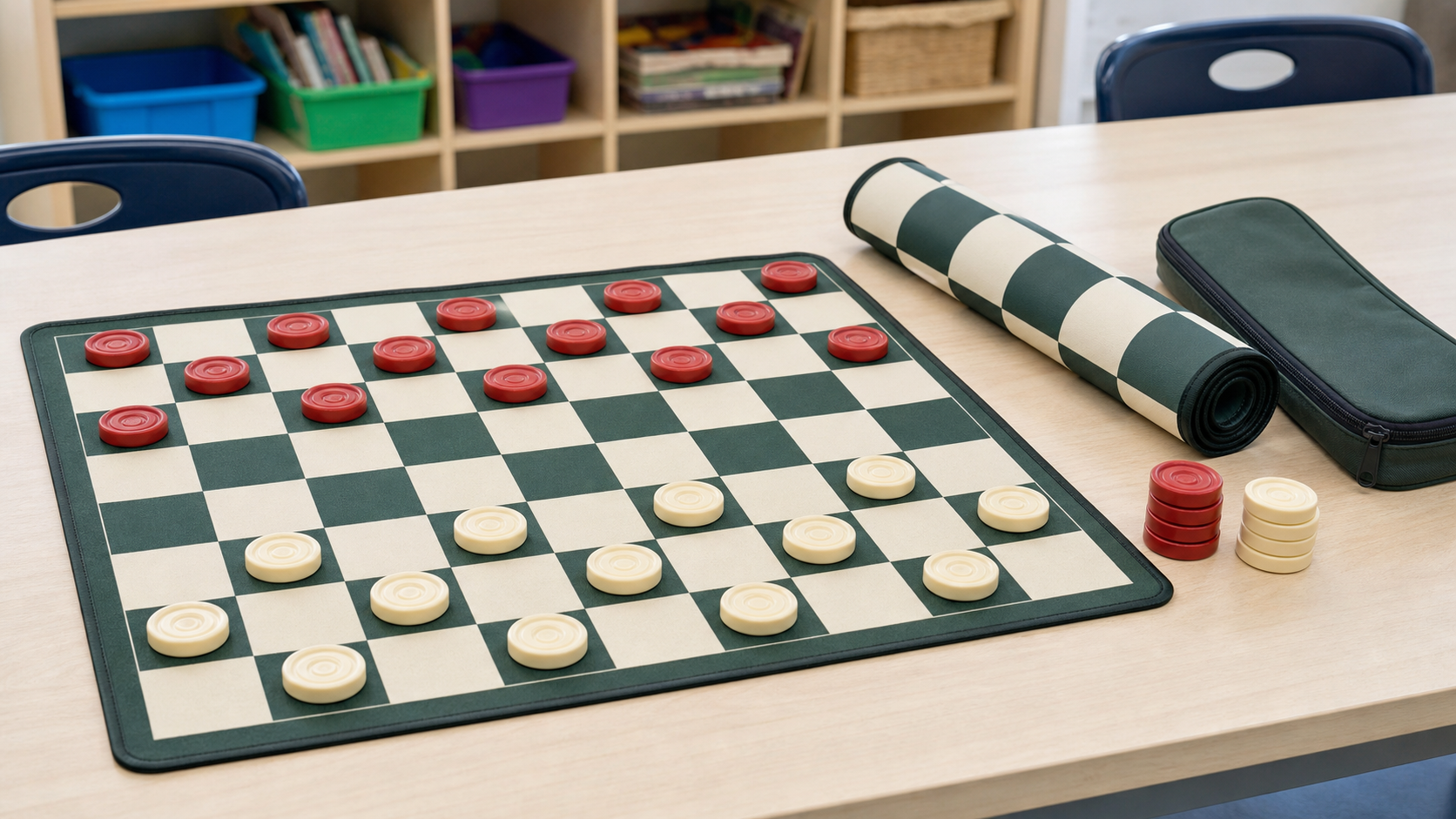
A roll-up checkers board can turn a bag of loose pieces into a portable group set without taking over a storage shelf. The useful choice is not simply the board that rolls smallest: it must open flat enough to play, show a clear 8-by-8 grid, and give your checkers enough room to move and stack.
This guide compares practical board formats and selection criteria, not products we have personally tested. Verify the current listing’s grid, dimensions, material, and included pieces before ordering.
As an Amazon Associate, The Good Chess & Checkers may earn from qualifying purchases.
Best starting point
Choose the board around your pieces and storage routine
Look for a clearly pictured 8-by-8 board, stated square dimensions, strong color contrast, and a material that matches how often the board will be packed away.
Selection Criteria That Matter
- Correct grid: ordinary American checkers uses an 8-by-8 board. Do not assume every rolled game mat uses that layout.
- Square size: compare one square with the diameter of your checkers. Pieces need visible clearance and two pieces must stack without crowding nearby squares.
- Contrast: the playable dark squares, light squares, and both piece colors should remain distinct under normal room lighting.
- Flatness: thin vinyl is compact but may remember a tight roll. Heavier mousepad-style material usually needs more storage space but is less likely to slide.
- Edges and printing: look for a complete, straight grid without decorative borders that make the playable area ambiguous.
- Storage: plan for the board, 24 playing pieces, spare pieces, and a rule card in one clearly labeled bag or tube.
- Reset speed: matching boards, pieces, and bags across several tables makes counting and cleanup easier.
Best Overall Format: Full-Size Vinyl Roll-Up Board
A plain vinyl board is the practical default when a club or classroom needs several inexpensive, space-efficient playing surfaces. It wipes clean with methods allowed by the manufacturer, rolls into a narrow bundle, and can share a carrying bag with loose plastic pieces.
Choose a listing that states the overall board size or individual square size. A compact mat may look adequate in a photo yet leave ordinary checkers crowded. Store the board around a wide tube or in a loose roll rather than folding it; creases can interrupt both flatness and the printed grid.
Best for: groups that value compact storage, matching stations, and easy transport.
Skip it if: boards will be kept tightly rolled for long periods or players strongly prefer a cushioned, non-slip surface.
Best for Staying Put: Mousepad-Style Checkers Board
A fabric-topped rubber mat usually grips a smooth table better than thin vinyl and tends to settle quickly after being unrolled. That can help at busy tables where elbows and piece bags are moving around. The tradeoff is bulk: several cushioned boards form a much larger roll and can be awkward in a narrow tube.
Confirm that the product is actually printed for checkers. Some soft boards are chess boards with coordinates, which can still work for checkers, but the extra labels may distract very new players. Others are sold as generic 8-by-8 mats without pieces, bags, or rule cards.
Best for: smooth tables, frequent setup, and programs with enough shelf or tote space.
Skip it if: minimum storage volume and the lightest possible kit matter most.
Best for Existing Pieces: Board-Only Replacement Mat
A board-only mat makes sense when a program already owns complete, stackable checkers but has cracked folding boards or missing playing surfaces. It also lets organizers standardize board contrast without discarding usable pieces.
Measure before buying. Divide the playable width by eight to estimate the square size, then compare that number with one checker’s diameter. Leave room around the piece, and test whether a two-piece king stays inside its square. Our guide to large checkers pieces explains the same fit check in more detail.
Best for: replacing worn boards while keeping compatible pieces and bags.
Skip it if: existing pieces are incomplete, cannot stack for kings, or blend into the new board colors.
Quick Comparison Framework
- Choose vinyl when low storage volume and matching multiple stations are the priorities.
- Choose mousepad-style material when table grip and quick settling matter more than bulk.
- Choose a board-only mat when the program already owns measured, complete pieces.
- Choose a complete classroom set when boards, pieces, storage, and spares all need to be purchased together.
- Choose a rigid board when the playing surface must be ready immediately and storage space is not a concern.
Plan the Group Kit, Not Just the Board
- Count the number of simultaneous games the group actually needs.
- Give every station 12 pieces per side and add compatible spares to a separate supply bag.
- Match piece diameter to the board’s stated square size.
- Use one pouch or tube per station and label it consistently.
- Roll boards printed-side out only if the maker recommends it; otherwise follow the product’s storage directions.
- Keep a short rule reference with each kit, especially if the group uses a checkers variant with different capture or king rules.
If learners still need the basics, pair the equipment with our beginner checkers rules guide. For a broader buying decision that includes boards, pieces, and storage together, use the beginner checkers set guide.
Who Should Skip a Roll-Up Board?
Skip this format if the board will remain set up permanently, if players need a rigid edge to orient the board, or if the available storage forces a very tight roll. A folding or flat board may be easier when immediate flatness matters more than portability.
Also skip a board-only purchase when the program’s loose pieces vary widely in diameter, color, or stackability. Standardizing a complete set can prevent mismatched bags and hard-to-read kings.
Bottom Line
The best roll-up checkers board for a club or classroom is the one that fits the actual pieces, opens into a clear 8-by-8 grid, stays readable on the available tables, and returns to storage without a complicated reset. Start with measured square fit and material, then decide whether compact vinyl, grippier mousepad material, or a complete set best matches the group’s routine.