
A parent or tutor teaching two to four beginners usually needs a board everyone can see and reach—not a wall-mounted classroom board. The best tabletop demonstration setup keeps the position clear from several seats, lets learners take turns moving pieces, and packs away without turning every lesson into an equipment project.
This guide compares product categories rather than named winners. It is not based on hands-on testing, and it does not claim that a category is right for every room. Check current listing dimensions, included pieces, storage, and return terms before buying.
As an Amazon Associate, The Good Chess & Checkers may earn from qualifying purchases.
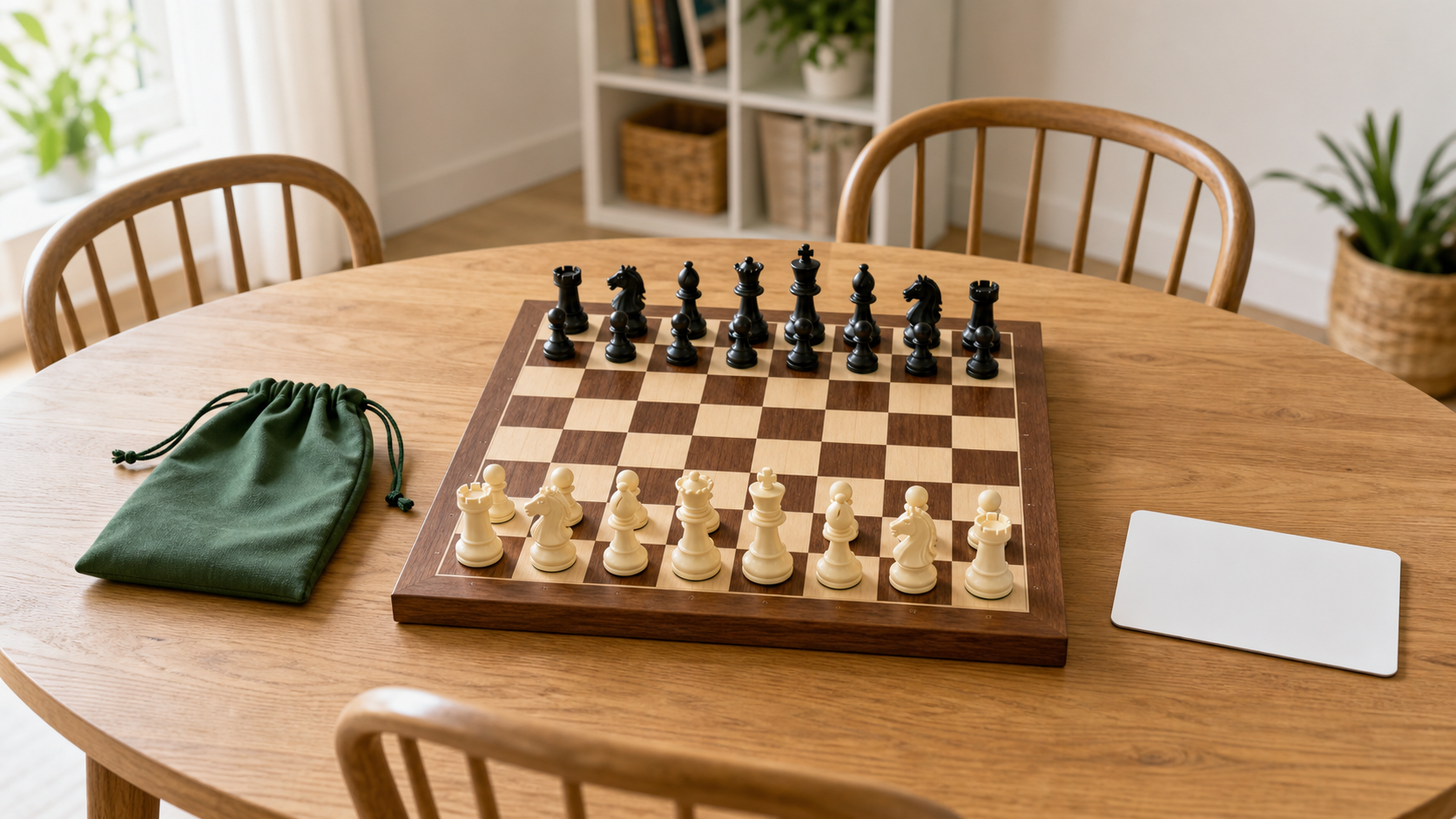
Product-category guide
Start with a board the farthest learner can read
For a small group, compare square size, piece contrast, viewing angle, board stability, coordinates, and storage before decorative materials or bundled extras.
What makes a tabletop set work for group teaching?
- Visibility: use strong square and piece contrast, recognizable piece shapes, and a board large enough to read from the farthest chair.
- Reach: learners should be able to make a move without leaning across fragile pieces or blocking everyone else's view.
- Stability: a flat board and broad-based pieces reduce accidental position changes as people rotate around the table.
- Coordinates: clear edge labels help learners connect spoken moves, books, score sheets, and replay exercises.
- Reset speed: familiar piece shapes and complete storage make it easier to rebuild a starting position or short exercise.
- Participation: one shared board works best when the teacher invites predictions and lets learners move the pieces in turn.
Best all-around format: a full-size standard chess set
A conventional board with high-contrast squares and recognizable Staunton-style pieces is the simplest choice for a parent or tutor seated with two or three learners. It supports normal games, short drills, and replay from a book without introducing a special demonstration format.
Best for: a dining table, tutoring desk, homeschool group, or family lesson where everyone can sit close.
Skip it if: learners must watch from several rows, the table is too narrow for comfortable reach, or the board will be carried between rooms every session without a case.
Best for frequent setup: roll-up board, pieces, and storage tube
A roll-up board can provide generous squares while packing more easily than a rigid board. Pair it with pieces whose bases fit comfortably within the squares, plus a pouch and a tube or bag that keeps the board from being sharply folded.
Best for: tutors who travel, community rooms, and tables that must be cleared after every lesson.
Skip it if: the material curls strongly after storage, the pieces and board have no single carrying system, or setup time regularly consumes the lesson.
Best for crowded tables: a weighted or magnetic tabletop set
Pieces with a stable base can help preserve a teaching position when several learners point, reach, or pass materials around the board. Light magnetic retention can also help, but very small travel sets trade away the visibility that makes a demonstration useful.
Best for: lively groups, narrow shared tables, and exercises where the position should stay in place between turns.
Skip it if: the board is too small to see from every seat or the magnetic pull makes pieces awkward for beginners to lift.
Best for recording positions: a coordinate board with a lesson card
Coordinates around the board help a group name squares and reconstruct positions. A blank card or small dry-erase board can hold the move, question, or objective for the exercise without crowding the chessboard itself.
Best for: learners beginning notation, replaying short lines, or taking turns explaining a move.
Skip it if: edge labels are tiny, low-contrast, or distracting to learners who are still identifying the pieces.
Quick comparison framework
- Choose a standard full-size set when everyone sits close and the set can remain nearby.
- Choose a roll-up setup when storage and transport matter but you still need generous squares.
- Choose stable or lightly magnetic pieces when accidental bumps repeatedly disturb exercises.
- Choose a coordinate board when square names and position replay are part of the lesson.
- Choose a wall demonstration board instead when more than a small group must see from a distance.
Pre-purchase checklist
- Arrange the intended chairs and measure the available tabletop area.
- Estimate the viewing distance from the farthest learner, then favor contrast and square size over compactness.
- Confirm that the listing includes a complete board and 32 pieces; some demonstration products are board-only.
- Compare piece base diameter with square size so pieces do not crowd neighboring squares.
- Check whether coordinates are present, readable from the likely seats, and oriented on all useful edges.
- Verify how the board and pieces pack together, especially if the lesson space must be cleared.
- Ignore unsupported “professional” or “tournament” labels and choose from the dimensions and teaching needs you can verify.
Who should skip a tabletop demonstration set?
Skip this category if you are teaching a full classroom, club meeting, or audience that cannot gather around one table. A larger wall-style demonstration board gives distant learners a clearer shared view. Also skip specialized gear when a readable chess set you already own fits the table and every learner can see it.
If the real challenge is lesson structure rather than visibility, use the one-piece-at-a-time versus all-at-once teaching guide. If learners need individual practice, adding a second ordinary board may create more useful turns than buying one larger centerpiece.
Bottom line
For most groups of two to four learners, the best tabletop chess demonstration set is a stable, high-contrast standard board with recognizable pieces and simple storage. Move to a roll-up setup for travel, steadier pieces for crowded tables, coordinates for notation work, or a wall board when the audience is too large to gather close.