
Weighted checkers pieces can make a family board feel calmer to use: a small bump is less likely to shift a piece, and a substantial checker is easier to place deliberately. Weight alone does not make a good replacement set, though. The pieces still need to fit each square, stack clearly as kings, contrast with the board, and fit the storage you already own.
This is a category guide, not a ranking of named products. It makes no hands-on testing, current price, rating, or availability claims. Use the measurements and stated weight in a current listing to check fit before ordering.
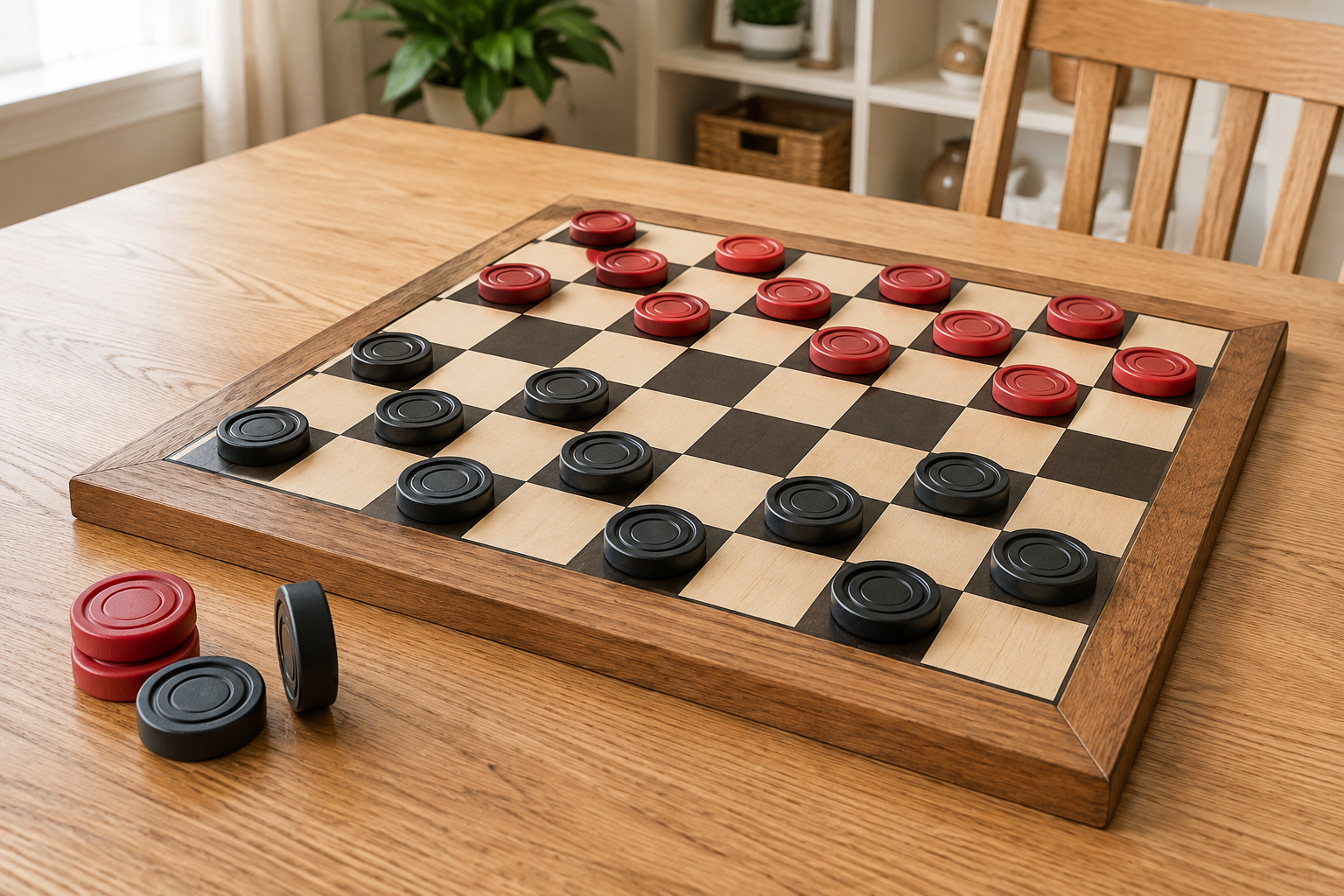
Start With the Board, Not the Piece Label
Measure one playable square on the board. A checker should sit comfortably inside it with visible space around the edge, so fingers can lift the piece without disturbing neighbors. Compare that square measurement with the listed checker diameter rather than assuming “standard size” means the same thing across sellers.
Then measure the available storage space. Weighted pieces may be thicker than the originals, and a complete set plus spare kinging pieces can outgrow a shallow drawer or fitted insert. If the board also needs replacing, it is usually simpler to choose a complete beginner checkers set whose board, pieces, and storage were designed together.
What “Weighted” Needs to Tell You
The useful fact is a stated weight per piece or a clearly described construction—not a vague adjective such as “heavy” or “premium.” When two listings use different units, convert them before comparing. If a listing omits weight entirely, you cannot reliably tell whether the pieces will feel meaningfully different from ordinary solid plastic checkers.
Weight should be evenly centered so the checker rests flat. A listing photograph cannot prove balance, so prioritize clear specifications and a straightforward return policy. Do not infer durability or safer use from weight; those are separate questions that need their own evidence.
Best Fit for Most Family Boards: Moderately Weighted, Stackable Pieces
For ordinary table play, the practical category is a round, moderately weighted checker with a flat or interlocking face that lets two pieces form an obvious king. It should feel settled without becoming awkward for repeated jumps and cleanup. A molded rim can make the edge easier to grasp, but deep decorative faces may interfere with stacking.
Choose this format when: the existing board is sound, the original pieces feel too easy to nudge, and the listing provides enough dimensions to verify fit.
Skip it when: the board is tiny, the storage is fitted to thin pieces, or the main problem is poor color contrast rather than piece movement.
Best for Clear Kings: Flat or Nesting Faces
Family games are easier to follow when a king is unmistakable. Test the idea on paper before buying: add the listed thickness of two pieces and check whether that stack will still feel proportionate to the square. Smooth flat faces can stack well; shallow nesting rings may add alignment. Tall domed or deeply patterned faces can make a king wobble.
If king visibility is the central problem, compare the broader options in our guide to checkers pieces for crowning and kinging. Weight is helpful only if the stack itself remains clear and steady.
Best for Larger Boards: Wider Pieces With Verified Clearance
A wider weighted checker can suit a roomy wooden family board, but diameter and mass are different attributes. Do not buy a wide piece merely because it looks substantial. Leave enough exposed square around each piece for diagonal moves, jumps, and easy pickup.
For visibility-led shopping, use the large checkers pieces guide. It focuses on diameter and handling; this guide focuses on whether added mass is useful without compromising fit.
A Five-Minute Fit Check
- Measure one playable square and the depth of the current storage area.
- Confirm the listing states checker diameter, thickness, quantity, and weight or weighted construction.
- Check that the set supplies two distinct, high-contrast sides and enough pieces for the way your family marks kings.
- Add two listed thicknesses to estimate the height of a crowned stack.
- Compare the return terms in case the real handling or color differs from what the listing communicates.
Who Should Skip Weighted Checkers Pieces?
Skip this upgrade if ordinary pieces already stay put, if children prefer very light pieces, or if the board travels frequently and carrying weight matters. Also skip loose replacements when you cannot verify square size, storage clearance, or king stacking. A complete matched set is a better answer than forcing attractive pieces onto an incompatible board.
Weighted checkers are not a skill aid, and they do not change the rules. Beginners who still need movement, capture, and kinging help should start with how to play checkers before treating equipment as the solution.
Bottom Line
The best weighted checkers pieces for a family board are the ones whose stated weight, diameter, thickness, count, and stackability all match the board you own. Added mass can make placement feel more settled, but verified fit and clear kings matter more than a marketing label.