
Large checkers pieces can make a family board easier to scan, sort, move, and reset. But “large” is useful only when the pieces still fit the board: a wide checker that crowds its square or cannot stack securely for a king creates a different kind of frustration.
This guide compares piece formats and fit criteria, not individual products we have tested. Measure your board and verify the current listing, piece count, dimensions, colors, and storage before ordering.
As an Amazon Associate, The Good Chess & Checkers may earn from qualifying purchases.
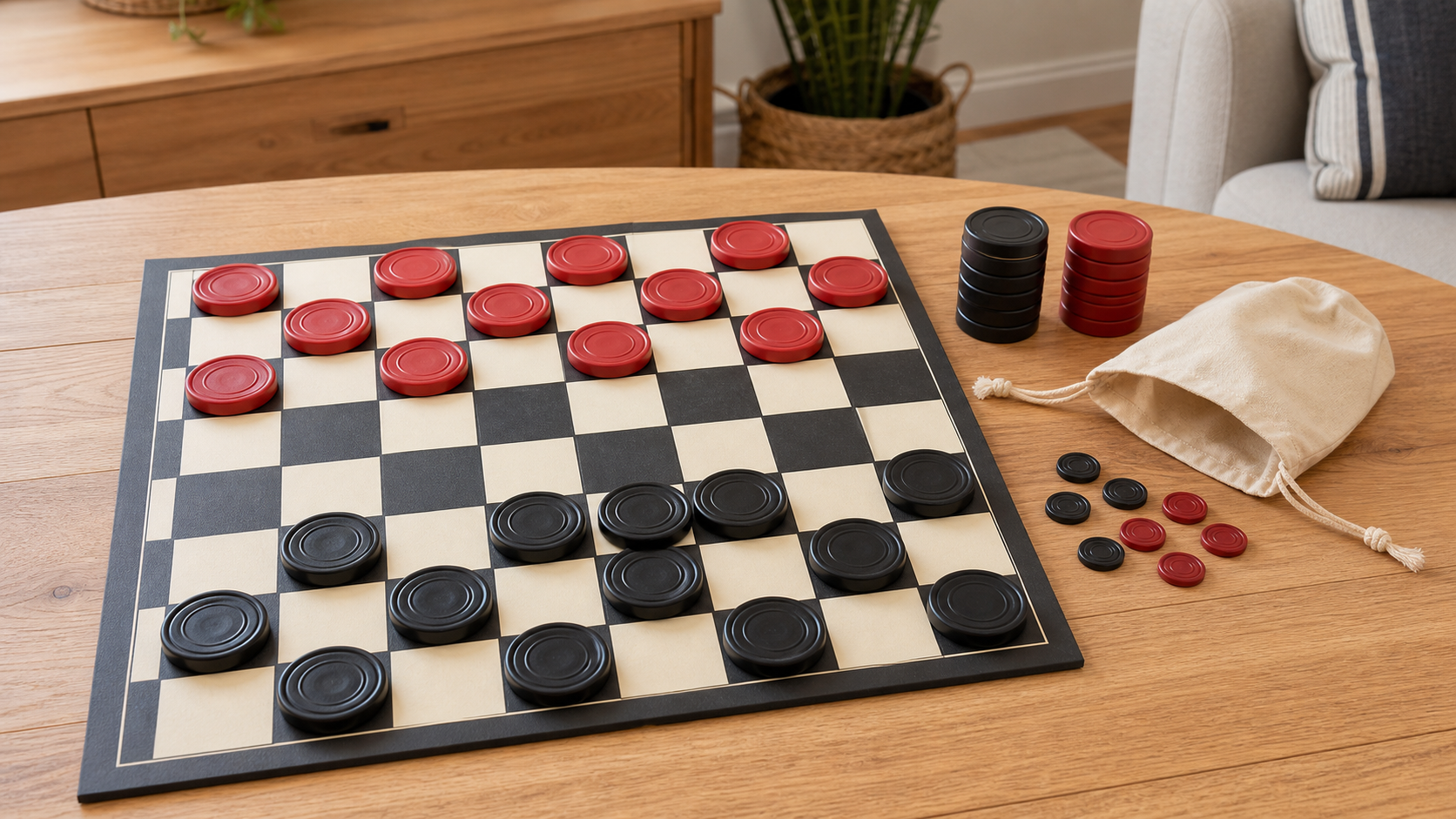
Quick decision aid
Match the checker diameter to the playable square
Start with stackable pieces whose listing gives an actual diameter, thickness, count, and color. Leave visible space around each piece so moves and multiple jumps stay easy to read.
Selection Criteria That Matter
- Square fit: measure one playable dark square, not the full board. The piece needs clearance on every side.
- Stackability: two checkers should nest or sit steadily enough to mark a king without sliding apart during a move.
- Handling: diameter helps visibility, while thickness and a defined edge make a piece easier to pick up.
- Contrast: both colors must stand apart from each other and from the dark playable squares.
- Complete count: standard American checkers starts with 12 pieces per side. A few compatible spares are useful, but verify what a listing includes.
- Storage: larger pieces quickly outgrow a small tray or folding-board compartment.
Best Overall Format: Large Stackable Plastic Checkers
For most families, a plain set of thick, stackable plastic checkers is the sensible first category. It keeps kinging visible, tolerates routine sorting and bag storage, and is usually easier to replace than a decorative piece made for one proprietary board.
Choose molded rims or shallow nesting details rather than smooth flat discs. Confirm that a two-piece king still feels stable and does not become so tall that younger players knock it over during a jump sequence.
Best for: regular family play, shared game shelves, and replacing undersized pieces on a compatible board.
Skip it if: your board has small squares, a fitted storage insert, or a lid that closes tightly over the original pieces.
Best for Visual Clarity: High-Contrast Pieces
Size alone does not guarantee readability. Matte red and cream, red and black, or another strongly separated pair can be easier to follow than two similar wood tones. Compare the pieces with the board itself: black pieces may disappear on black squares, while pale pieces may blend into a low-contrast board border.
A simple crown symbol can identify kings without stacking, but only if both players agree to turn or flip the piece when promoted. For common family play, stackable pieces are the more immediately understood format. Our guide to checkers pieces for crowning and kinging covers that decision in more depth.
Best for: mixed-age tables where players benefit from quick piece recognition.
Skip it if: the colors look clear in a product photo but blend into your actual board.
Best for a Custom or Homemade Board: Measured Replacement Sets
A homemade, printed, or inherited board can pair well with separately purchased pieces, but start with measurements rather than labels such as “jumbo.” Measure a dark square in the same unit used by the listing. Cut a paper circle to the stated checker diameter and place it in the square. Test adjacent diagonal squares too, because large rims should not touch when pieces pass each other.
Check thickness as well as diameter. Thick pieces require more pouch space, and a full set of 24 plus spares may not fit an existing box. If the old board folds, test whether the closed board was designed to hold loose pieces at all.
Best for: a known board whose squares and storage have been measured.
Skip it if: the board dimensions are unknown or the replacement listing omits piece diameter.
Quick Comparison Framework
- Choose large stackable plastic pieces for the broadest family fit and straightforward kinging.
- Choose the strongest color contrast when board reading matters more than matching the original set.
- Choose measured replacements when keeping an existing board is the main goal.
- Choose a complete checkers set instead when the board is also cramped, faded, or missing storage.
- Choose ordinary-size pieces when portability and compact storage matter more than extra handling room.
How to Check Fit Before Ordering
- Measure the width of one dark square.
- Compare that number with the stated checker diameter; do not estimate from listing photos.
- Make a paper circle at the listed diameter and place it on the board.
- Put circles on adjacent playable squares to check clearance during jumps.
- Estimate the space needed for 24 pieces, plus any spares, in your pouch, tray, or box.
- Confirm that the pieces stack or provide another clear way to mark kings.
If board size is still undecided, use our board-size guide. Families starting from scratch may be better served by the beginner checkers set guide, where the board, pieces, and storage are considered together.
Who Should Skip Large Checkers Pieces?
Skip oversized pieces if your board squares are small, your set travels often, or your storage is already tight. Also skip replacement pieces when color matching is essential and the original shade or design cannot be verified. A complete new set can be less frustrating than a visually mismatched collection that still does not fit well.
Large tabletop pieces are not the same as giant lawn checkers. Outdoor sets require a different board, storage plan, setup area, and material evaluation; do not assume a tabletop replacement pack will suit that use.
Bottom Line
The best large checkers pieces for a family are not simply the widest ones. Choose a measured diameter that leaves space inside each square, a thickness that is easy to handle, clear colors, stable kinging, a complete count, and storage that fits the full set. If any of those details are missing from a listing, keep looking rather than guessing.