
Club board transport
Chess Board Storage Tube vs Flat Portfolio: Which Protects Club Boards Better?
Choose the shape that matches the board—not the container that merely looks more protective. A tube keeps a roll-up board compact; a flat portfolio avoids rolling and can carry several thin lesson boards. The board maker’s storage guidance and your real transport route decide which is sensible.
This is a product-category comparison, not a hands-on test or a claim that either format prevents damage. Verify the board material, permitted storage position, inside dimensions, closure, and current care directions before buying.
As an Amazon Associate, The Good Chess & Checkers may earn from qualifying purchases.
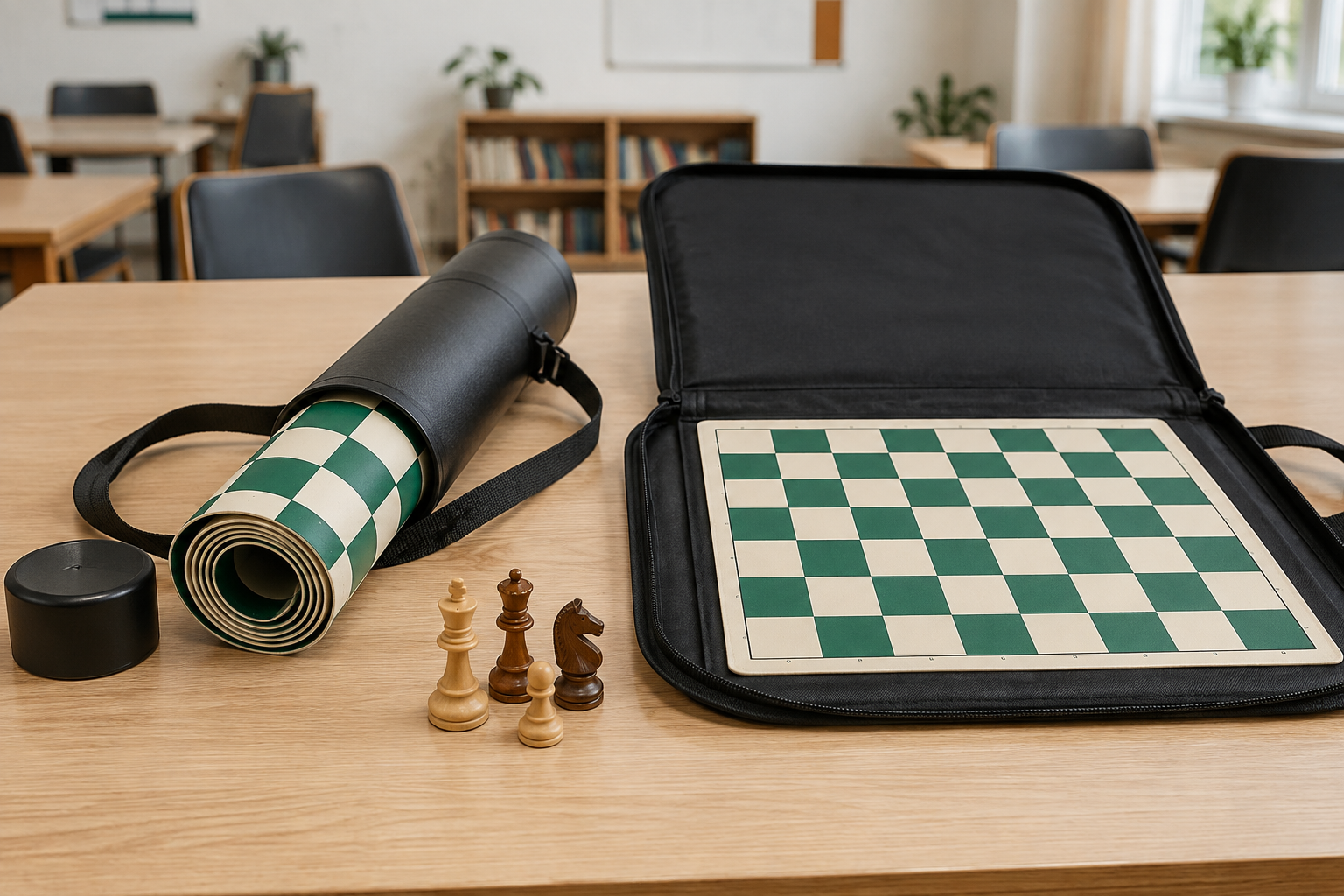
Quick decision aid
Compare rolled and flat carrying formats
Check the board maker’s storage guidance first. Then measure the relaxed roll or full flat footprint, including borders, and compare usable interior space rather than outside dimensions.
Quick Verdict
- Choose a tube when the board is designed to be rolled, the relaxed roll fits without compression, and a narrow cylindrical package is easier to carry and shelve.
- Choose a flat portfolio when the maker recommends flat storage, you carry thin lesson boards or sheets together, and the full rectangular footprint fits the route.
- Choose neither when a complete set bag already keeps the board, pieces, and clock separated without forcing the board into the wrong shape.
First Check: Can the Board Be Rolled?
Vinyl, silicone, mouse-pad-style, laminated, and printed lesson boards do not all share the same storage needs. Use the maker’s directions for the exact board. Do not roll a rigid board, fold a roll-only board, or assume every printed surface can stay pressed against itself.
For a tube, roll the board only as tightly as its directions allow and measure that relaxed cylinder. Compare the tube’s inside length and diameter, then allow room for the cap and easy removal. For a portfolio, measure the full board border and thickness, then check the case’s usable interior width, height, and opening.
Storage Tube: Compact for One Rolled Board
A tube turns a wide board into a long, narrow package. That can work well on club shelves, in a car, or over a shoulder when the route has enough length clearance. Individual labels also make it easy to issue and count boards one at a time.
Advantages: compact cross-section, simple board-by-board labeling, and no broad flat panel to carry through doorways.
Limits: it only suits boards meant to roll; several tubes can become awkward; pieces and clocks need separate storage; and a missing cap can disrupt the system.
Skip it when: the board retains curl, must stay flat, has surface features that should not face inward, or needs to travel with the complete set in one organizer.
Flat Portfolio: Broad but Easy to Inventory
A zippered art or document portfolio can carry a flexible board without rolling it. A large flat opening may also hold several thin demonstration sheets or lesson boards, provided their combined thickness stays within the verified capacity and they cannot slide against hardware or rough edges.
Advantages: preserves a flat shape, offers a broad labeling surface, and may consolidate several compatible thin boards.
Limits: the full board footprint must clear doors, vehicle space, and shelves; soft cases may bend when unsupported; and generic art cases are not automatically sized or constructed for chess boards.
Skip it when: the case must be folded to fit storage, the loaded portfolio will be carried without support, or the zipper and seams touch the playing surface.
Compare the Whole Club Workflow
- Check-out: numbered tubes suit one-board-per-player issue; one portfolio can suit a teacher carrying a planned lesson stack.
- Transport: measure vehicle compartments, stairs, doors, and the distance a volunteer carries the load.
- Shelf fit: a tube needs length and a way to stop rolling; a portfolio needs a tall slot or broad flat shelf.
- Setup: a flat board may be ready sooner; a rolled board may need time to relax according to its material and care guidance.
- Inventory: labels should identify board size, color, or kit number without claiming tournament or school approval.
- Separation: keep pieces, clocks, markers, and sharp supplies from pressing against the board surface.
A No-Spend Test Before You Buy
- Read the board’s current storage and care directions.
- Measure it flat and, only if permitted, as a relaxed roll.
- Make a paper rectangle for the portfolio footprint and a simple cardboard cylinder for the tube envelope.
- Carry each mock-up from the storage shelf to the playing room and through the real vehicle or doorway route.
- Count how many boards and separate piece bags the helper can reasonably manage.
- Buy only if the winning shape improves the complete check-out, transport, setup, and return routine.
Who Should Skip Both?
Skip board-only containers when the club routinely loses track of pieces or clocks; a complete chess set carrying bag may solve the larger problem. Skip new storage when a clean, smooth, correctly sized existing container already follows the board maker’s directions.
For a permanent room with several sets, improve labels and shelf positions before adding another carrying format. The beginner classroom and club station guide connects board storage with piece counts, rule cards, and reset routines.
Bottom Line
Choose a storage tube for a board explicitly designed to roll when a narrow, individually labeled package fits the club’s route. Choose a flat portfolio when the board should stay flat or several compatible lesson boards need one broad carrier. Neither format is inherently more protective: correct board compatibility, verified interior fit, supported carrying, and a repeatable return routine matter more than the container’s appearance.