
A roll-up chess board is easy to carry until it is squeezed under other equipment, bent around loose pieces, or unrolled with a stubborn curl. A storage tube gives the board its own protected space, but the useful choice depends on the board's rolled length and thickness, how often it travels, and whether it is completely dry before storage.
This is a category comparison, not a ranking of named products or a claim of hands-on testing. Current tube dimensions, closures, straps, and materials vary by listing, so measure your rolled board and confirm the seller's current specifications before buying.
As an Amazon Associate, The Good Chess & Checkers may earn from qualifying purchases.
Protect the board by itself
Compare tubes sized for a rolled chess board
Start with the board's rolled length and diameter, then compare rigid cases, adjustable document tubes, and simple shelf-storage tubes by closure, carrying method, ventilation, and labeling.
Measure the Rolled Board Before Comparing Tubes
Lay the board flat, roll it loosely in the direction recommended for its material, and measure the finished roll. Record its length and widest diameter without forcing it tighter. The tube's usable inner dimensions matter; an outside measurement or total length that includes thick end caps can overstate the available space.
- Inner length: allow enough clearance that the cap closes without pressing the board's edge.
- Inner diameter: leave room for a natural roll rather than compressing the surface into a tight coil.
- Cap security: choose a closure that will not release when the tube is lifted or placed in a shared bin.
- Ventilation: never seal a damp or freshly cleaned board in a closed tube; follow the board maker's care directions.
- Identification: make sure a club or classroom can label the tube without covering a latch or adjustment point.
Best Overall Format: A Rigid Tube With a Strap
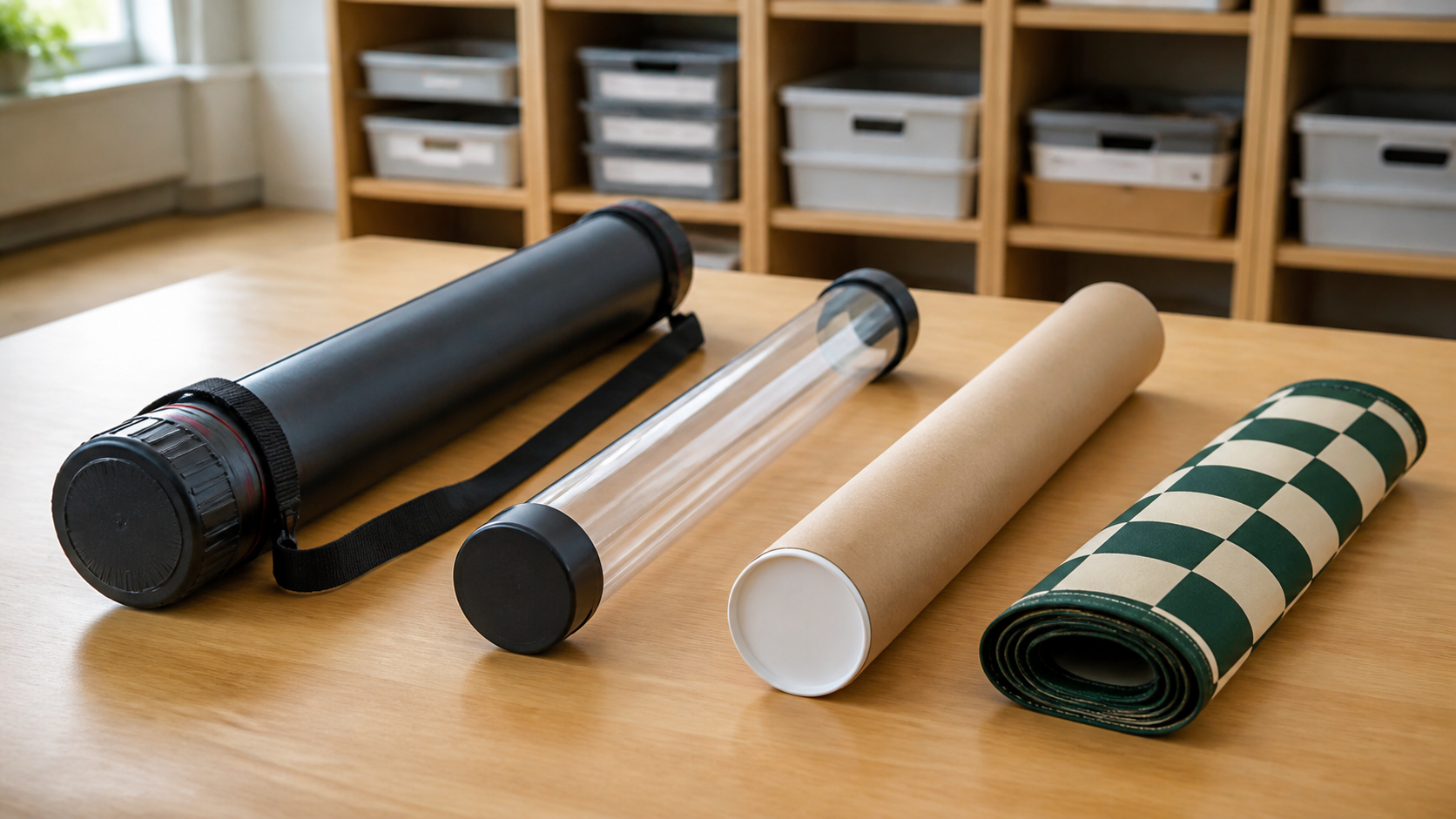
A rigid plastic tube with a secure cap and shoulder strap is the most practical all-around format when one board travels between home, class, and club. The shell helps keep the rolled board from being crushed, while a strap frees a hand for pieces or books. Check the strap anchors and cap design in current photos and specifications rather than assuming every document tube is meant for repeated carrying.
Best for: one frequently transported roll-up board and players who already store pieces separately.
Skip it if: the tube is much longer or wider than the board, or if you need one case to hold pieces, a clock, and scoresheets too.
Best for Different Board Sizes: An Adjustable Document Tube
A telescoping document tube can fit boards of different rolled lengths and may work well for shared equipment that changes over time. Locking the adjustment matters: a tube that shortens unexpectedly can press against the board's edges. Confirm both the minimum and maximum usable inner length, not merely the overall advertised range.
Best for: clubs or families that rotate among several board sizes.
Skip it if: the sliding joint catches the board, the adjustment cannot be secured, or the tube rattles excessively at the chosen length.
Best for Visible Inventory: A Clear Tube
A clear tube makes it easier to see whether a board is inside and can speed up inventory in a classroom or club cupboard. That visibility does not replace a label, and clear plastic should not be treated as protection from sunlight or heat. Store the tube in a suitable indoor location according to the board material's care guidance.
Best for: shared shelves where helpers need to identify board colors or contents quickly.
Skip it if: the storage area receives direct sun, the cap is easy to misplace, or privacy and appearance matter more than quick identification.
Best for a Dry Home Shelf: A Simple Cardboard Tube
A sturdy cardboard mailing or poster tube can be a low-complexity option for a board that mostly stays on a dry shelf. It should be clean, wide enough for a relaxed roll, and capped at both ends. Cardboard is less suitable for wet entryways, car trunks, crowded equipment carts, or repeated knocks.
Best for: inexpensive, labeled board-only storage in a stable indoor space.
Skip it if: the tube will be exposed to moisture, heavy stacking, or frequent travel.
Best for Several Boards: Labeled Individual Tubes
For a club or classroom, individual tubes make check-in and replacement easier than pushing several boards into one oversized cylinder. Match a tube number to the board and, if useful, to a separate piece bag. A simple label can note the board color or size without making an unsupported claim about tournament status.
Best for: repeat-use programs that count and distribute boards separately from pieces.
Skip it if: the collection already moves efficiently in divided bins or full-set carrying bags.
Quick Comparison Framework
- Choose a rigid strapped tube for frequent travel and crush protection.
- Choose an adjustable tube when several board lengths must share one storage format.
- Choose a clear tube when fast visual inventory is valuable.
- Choose a cardboard tube for simple dry-shelf storage with little handling.
- Choose labeled individual tubes when boards are issued and counted one at a time.
What a Board Tube Does Not Store Well
A narrow tube is not a complete chess-kit organizer. Loose pieces can mark the board, become trapped at the bottom, or make the board roll unevenly. A clock can damage both the tube and the playing surface. Keep pieces in a pouch or divided box and use a purpose-built carrying bag when the goal is to move the complete set together.
If storage is only one part of a larger shared setup, continue with the family chess and checkers storage guide or the club starter-kit guide. Checkers players using a roll-up board can apply the same measuring approach, while confirming that their board material and square layout suit the intended checkers rules.
Who Should Skip a Storage Tube?
Skip a tube if your board already lies flat in a protected drawer, if the manufacturer directs you to store it flat, or if rolling creates persistent curl or surface stress. Skip board-only storage when one complete carrying bag would make setup and cleanup simpler. Also skip any tube that requires the board to be forced, folded, or stored before it is dry.
Compare Rolled and Flat Transport Before Buying
A tube is only one transport workflow. If your board can or should remain flat, compare it with a flat portfolio for carrying club chess boards before choosing board-only storage.
Bottom Line
For a roll-up chess board that travels often, start with a rigid tube whose verified inner dimensions leave comfortable clearance and whose cap stays secure in transit. Adjustable and clear tubes solve specific inventory problems, while cardboard tubes suit light-duty dry storage. Measure the relaxed roll first, keep pieces and clocks elsewhere, and choose the smallest tube that protects the board without compressing it.