
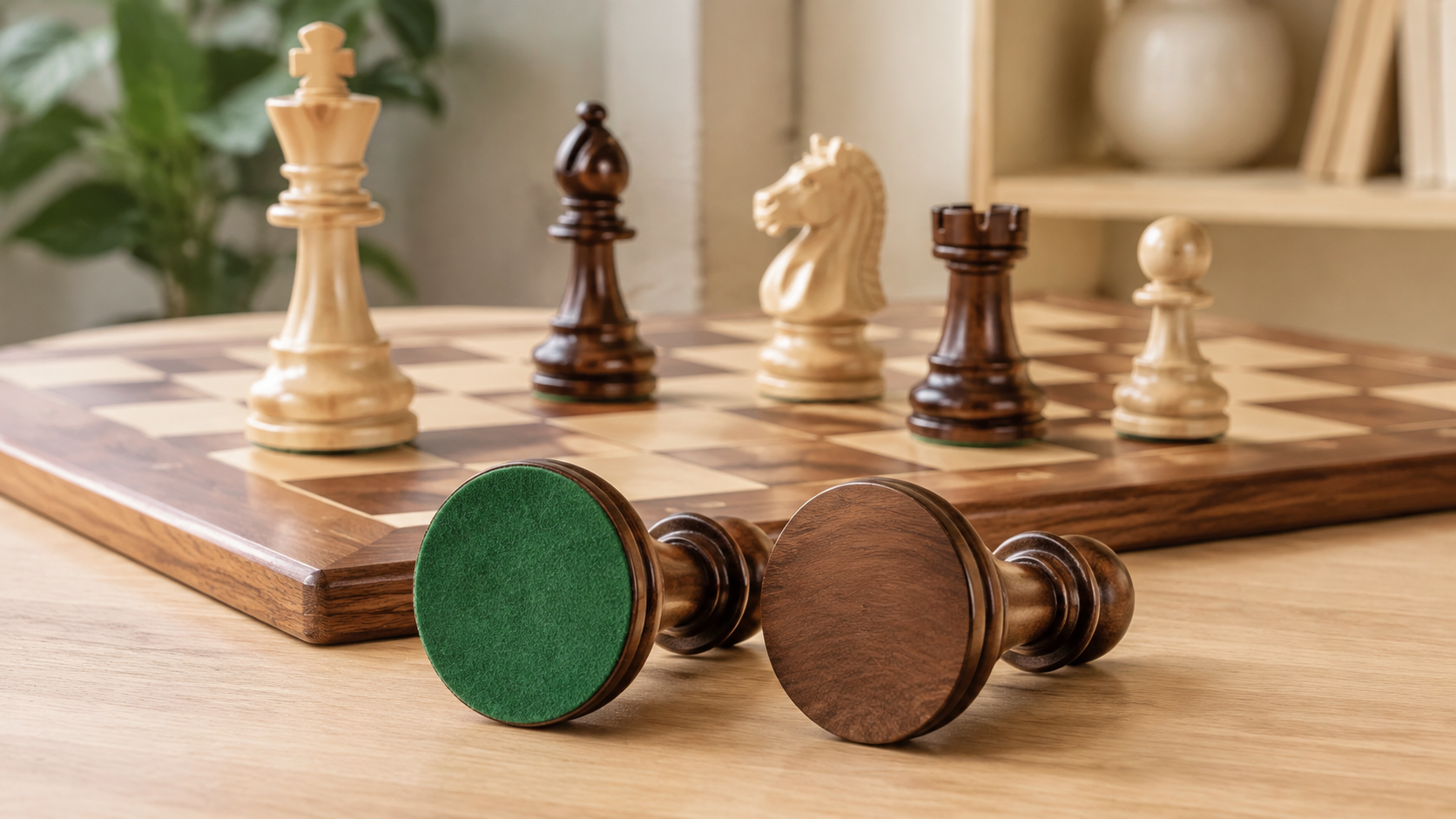
Felted bases are the more familiar choice when you want wooden pieces to glide across a wooden board, but felt is not an automatic guarantee of board protection. Bare bases can be simpler to inspect and clean, yet their finish and edge quality matter. Start with the board maker’s care guidance, then compare actual base diameter, material, condition, and upkeep.
This guide compares base formats, not named products we claim to have tested. A board’s finish, dust or grit, damaged felt, rough edges, and handling all affect contact. Do not assume either base is scratch-proof or suitable for an antique or collectible board.
As an Amazon Associate, The Good Chess & Checkers may earn from qualifying purchases.
Quick decision aid
Compare replacement wooden chess pieces by base finish
Look for stated piece heights and base diameters, clear underside photos, an identified base material, and care guidance. Confirm that the tallest pieces suit the board’s square size before choosing felted or bare bases.
Quick decision
- Choose felted bases when the maker identifies the felt, the pads sit flat and inside the base edge, and you prefer a softer sliding feel.
- Choose bare bases when the manufacturer describes a smooth finished underside and you want a surface that is easy to see and wipe according to its care instructions.
- Choose neither yet when the listing omits base diameter, underside photos, or material details—or when the board or pieces may be valuable.
What felt changes
Felt creates a soft contact layer and changes how a piece sounds and slides. It can also collect lint, crumbs, and grit, so inspect the underside before play rather than treating the material itself as protection. A pad that curls, shifts, sheds, or extends beyond the base edge needs attention.
Thickness matters across the whole set. Mismatched or uneven pads can leave pieces sitting at different heights. If replacement is needed, measure several base groups and follow the piece maker’s instructions; the separate felt-pad comparison explains pre-cut circles and sheet formats without turning this choice into a repair tutorial.
What a bare base changes
A bare base is easier to inspect directly because there is no fabric layer hiding its finish. That does not prove it is smooth enough for every wooden board. Look for clear underside images and a maker-described finish, then check for rough edges, residue, damage, or attached hardware before placing a piece on the board.
Bare bases may suit decorative or unfinished replacement pieces that will receive a maker-approved treatment later. They are a poor shortcut when the listing says nothing about the underside or when you would need to guess at sanding, coating, or adhesive compatibility.
Fit the pieces before comparing feel
Base finish cannot rescue pieces that are too wide for the squares. Find the board’s square size, then compare it with the king’s stated base diameter and the widest other piece. Leave enough visible square around neighboring pieces for comfortable setup and movement. Also check king height, weight description, and storage clearance.
When replacing only a few pieces, matching base diameter, height, color, and style may matter more than switching the whole set from one base format to another. A complete, readable set is usually more useful than a base upgrade that creates mismatched pieces.
Cleaning and maintenance
- Keep the board and piece bases free of visible crumbs and grit before play.
- Follow the board and piece makers’ cleaning instructions; do not assume a household cleaner suits finished wood, felt, adhesive, or weights.
- Lift pieces when debris is present instead of dragging them across the board.
- Store pieces so bases do not press against sharp hardware, loose accessories, or damp material.
- Pause if felt exposes a screw, weight cavity, cracked base, or unknown adhesive.
Who should skip felted pieces?
Skip felted pieces when the pads arrive loose, uneven, overhanging, or made from an unspecified material you cannot maintain. Also skip them if the set will be used where debris routinely collects and nobody will inspect the bases. Bare bases may make inspection simpler, provided their finish is documented and suitable for the intended board.
Who should skip bare-base pieces?
Skip bare bases when the underside looks rough, unfinished, damaged, or poorly documented. Do not buy them on the assumption that you can safely sand, coat, or refelt them later. For a valued board, inherited set, or uncertain finish, ask the maker or a qualified restorer before changing either surface.
Bottom line
For an ordinary wooden home board, well-fitted felted bases are the easier default when their construction and condition are clear. Bare bases can work when the underside is smoothly finished and the maker’s care guidance supports the pairing. In both cases, measured fit, clean contact surfaces, and regular inspection matter more than the label alone.