
The important difference is not decoration. It is what happens when a regular checker becomes a king. Ridged or nesting pieces are designed to sit together; smooth, low-profile pieces may slide, wobble, or need a separate king marker.
Neither format is automatically better for every board. The right choice depends on how your rules mark kings, whether pieces fit the squares, who handles them, and how the set is stored between games.
The Good Chess & Checkers may earn commissions from qualifying purchases.
Quick decision aid
Check piece size and kinging method before buying
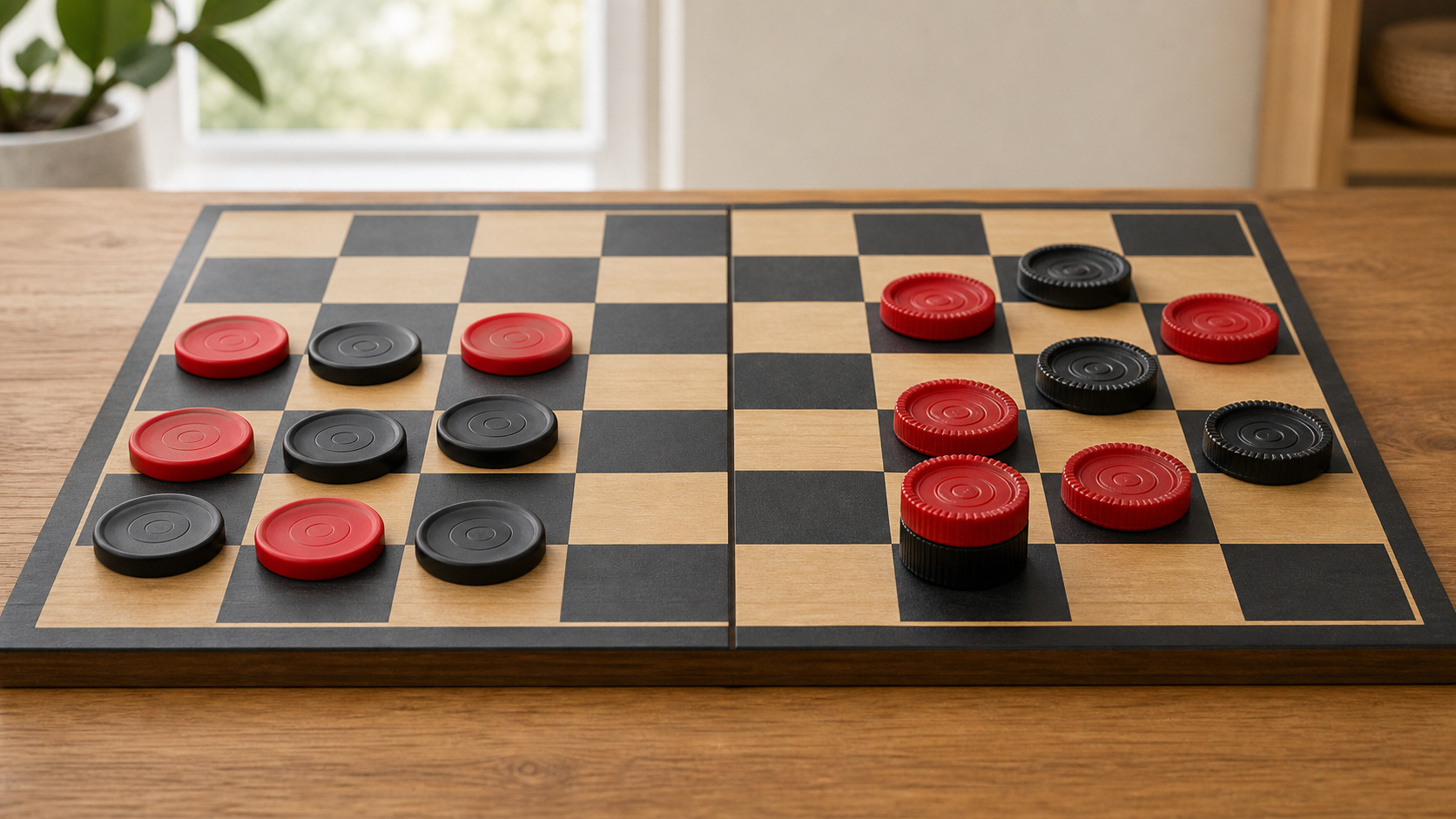
Use the visible dimensions and product photos to confirm diameter, thickness, quantity, board fit, and whether two pieces actually nest into a stable king.
Quick answer
Choose stackable checkers when beginners need a crowned king to be obvious, players use the common two-piece stacking method, or children benefit from ridged edges that are easier to grip.
Choose flat checkers when the board or rules use a separate king marker, a reversible piece, or another clear method; when a shallow travel case cannot hold tall stacks; or when matching an existing set matters more than nesting.
Skip either option if the diameter crowds the board squares, the colors blend into the board, or the set does not provide a reliable way to identify kings.
Side-by-side tradeoffs
| Decision | Flat checkers | Stackable checkers |
|---|---|---|
| King visibility | Depends on a marker, flip side, symbol, or workable loose stack | A two-piece king is usually easy to spot |
| Stack stability | Smooth faces may slide | Ridges or recessed centers can help pieces nest |
| Handling | Low profile can be harder to lift | Textured edges may give fingers more grip |
| Storage | Packs into a shallow space | May need a deeper tray or bag |
| Board fit | Diameter still matters | Diameter and doubled height both matter |
| Best fit | Marked-king sets, compact cases, matching replacements | Families, classrooms, and first-time learners |
Who flat checkers fit
Flat checkers make sense when the set already solves kinging without asking one piece to nest on another. Some pieces flip to show a crown or a contrasting symbol. Some boards include separate king markers. In those setups, a smooth profile is not a teaching problem because the king remains visible.
They can also work in thin folding boards and travel cases where every millimeter of storage depth matters. Replacement buyers may need flat pieces simply to match the height, color, and feel of the surviving pieces.
Flat pieces fit: marked or reversible king systems, shallow cases, decorative sets with a clear king marker, and repairs where a visual match is important.
Flat-piece tradeoffs and skip criteria
A smooth checker is only beginner-friendly if players can tell a king from a regular piece at normal viewing distance. Subtle engraving may disappear under room light, and a loose two-piece stack can slide apart during a jump. Very thin discs can also be awkward for small hands or anyone who has difficulty pinching a low edge.
Skip flat pieces when your family expects to stack two checkers for a king, the faces slide easily, the king symbol is hard to see, or the pieces are difficult for the intended players to lift.
Who stackable checkers fit
Stackable checkers are shaped so one piece can sit more securely on another. The resulting double-height piece gives beginners a simple visual rule: one checker is a regular piece; two together are a king. That clarity helps families and classrooms reset the board without searching for separate markers.
Ridged edges can also improve handling. The feature is useful only when the ridges actually align and the stack remains inside one square, so close product photos and stated dimensions matter more than the word “stackable” in a title.
Stackable pieces fit: beginner lessons, family sets, classroom bins, replacement supplies, and common American-checkers games that show kings with a second checker.
Stackable-piece tradeoffs and skip criteria
A nesting shape does not fix pieces that are too wide for the board. Two neighboring kings still need space between them, and a tall stack should not topple when a player reaches across the board. Deep decorative grooves can collect dust or crumbs, while unusually shaped pieces may be hard to replace later.
Skip stackable pieces when the doubled height will not fit the case, the ridges make the stack lean, the diameter nearly fills each square, or your set already has a clearer built-in king marker.
Measure board fit before choosing
Measure one playable square, then compare that number with the stated piece diameter. A checker should sit comfortably inside its square with visible space around the edge. That gap helps fingers lift pieces and keeps neighboring kings from looking crowded.
Do not rely on “standard size.” Boards and replacement pieces vary, and a piece that suits a large family board may overwhelm a compact travel board. If both the board and pieces need replacing, start with the chess and checkers board-size guide before choosing a piece style.
Setup and maintenance issues
Before the first game, agree on how a king will be marked. In common American checkers, families often stack a captured or spare checker on the promoted piece, but other checkers and draughts variants may use different equipment and rules. Follow the instructions for the version you play rather than assuming one convention is universal.
Count the pieces after play and keep replacements separate from the active set. Washable plastic pieces are practical for shared tables, but cleaning methods depend on the material and finish: use the maker's instructions, avoid soaking wood, and dry grooves before storage. A small labeled bag keeps flat pieces from disappearing and prevents stackable pieces from mixing with a different diameter.
Which format fits each setting?
- Family beginner games: stackable pieces usually give the clearest king signal.
- Young players: choose the easier edge to grip, then verify that the piece is not oversized.
- Classrooms and clubs: choose one consistent, replaceable format across every board.
- Travel sets: test whether a two-piece king fits the square and whether all pieces fit the closed case.
- Decorative wooden boards: matching flat pieces can work when king markers remain unmistakable.
- Replacement purchases: match diameter, thickness, color, material, and kinging method—not just color.
When to skip a pieces-only purchase
Do not buy replacement pieces to rescue a board that is already hard to use. Low contrast, cramped squares, a raised folding seam, or missing storage can frustrate beginners even when the checkers stack perfectly. A complete set may be the simpler fix.
Use the beginner checkers-set guide when board readability is also a problem. If the board is sound and only the kinging pieces need attention, continue to checkers pieces for crowning and kinging for a broader category checklist.
Bottom line
Stackable checkers are the safer default for beginners because a two-piece king is easy to recognize and needs no separate marker. Flat checkers remain a good choice when the set clearly marks kings another way, storage is very shallow, or replacements must match an existing design.
Whichever format you choose, prioritize clear kings, comfortable handling, visible contrast, and enough room inside each square. Those details matter more than decorative styling.