
A board that looks perfect online can feel awkward at the table. If the squares are too small, chess pieces crowd together and checkers are hard to pick up. If the board is too large, younger players may have trouble reaching the far side, and the set may stop being something your family actually uses.
The right size depends less on what looks official and more on where the set will live: a kitchen table, a classroom shelf, a club cabinet, a coffee table, or a travel bag. Here is a practical way to choose. If you are also deciding whether one board should serve both games, start with one board for chess and checkers.
As an Amazon Associate, The Good Chess & Checkers may earn from qualifying purchases.
Quick decision aid
Choose by board size and piece fit
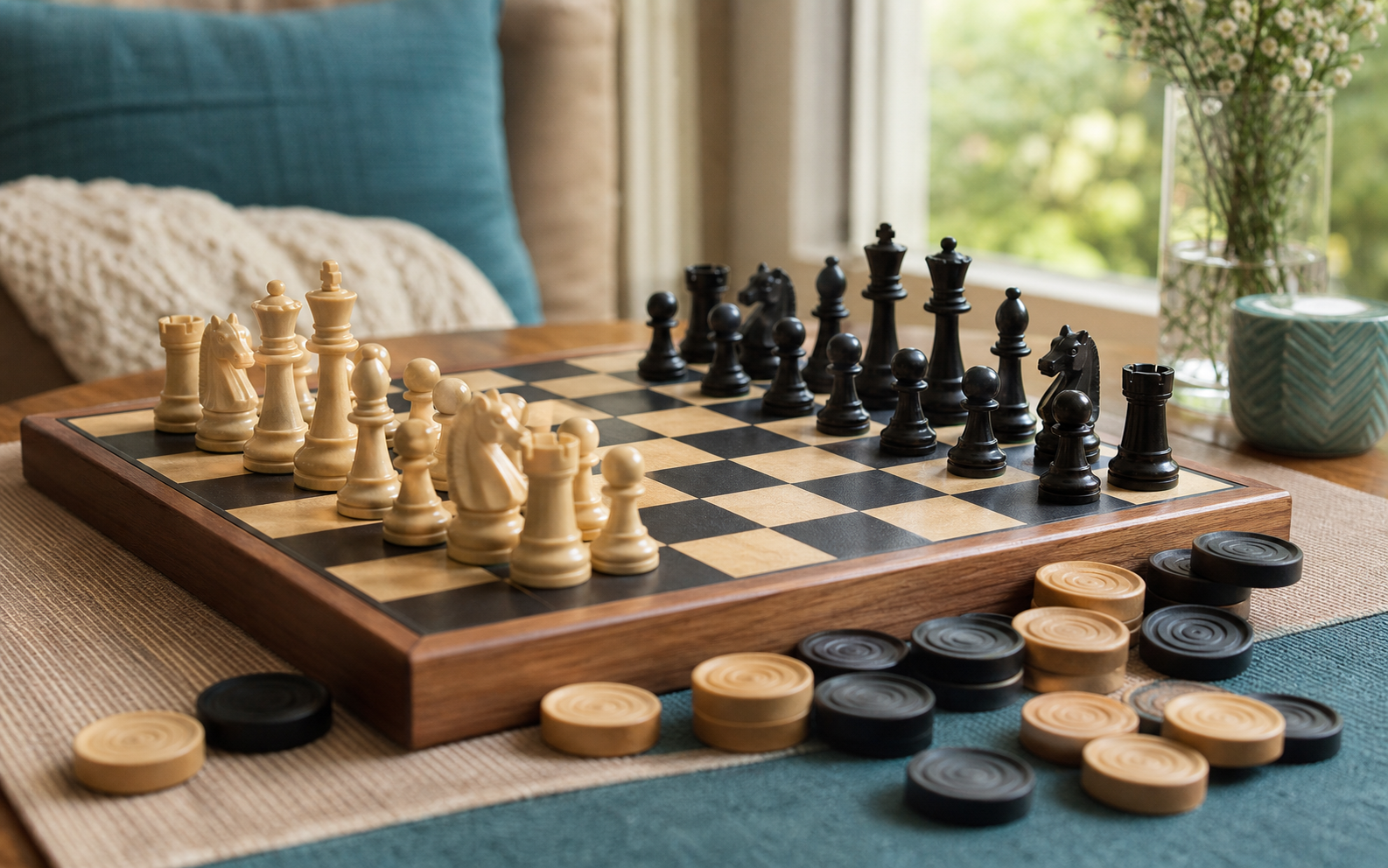
Compare full-size, folding, and large-piece sets first, then use the size guidance below to check whether the pieces match the squares and the table.
Helpful product path
Start With the Square Size
Chess and checkers boards both use an 8 by 8 grid. The important measurement is the size of each square, because that determines how crowded the pieces or checkers feel.
For a home set, many casual players are comfortable with squares around 1.75 to 2.25 inches. Smaller squares save space, while larger squares are easier to see and handle. For checkers, the pieces usually have a little more room because they are flat discs, but they still need enough diameter and thickness to stack cleanly. If crowning is the main trouble spot, compare checkers pieces for crowning and kinging before replacing the whole board. For chess, taller pieces need enough base room so the board does not feel cluttered.
Match Chess Pieces to the Board
If you are buying a chess set, check the king height and base diameter. A simple rule of thumb is that the king's base should take up roughly 70% to 80% of a square. That leaves enough room to move pieces without knocking over neighbors.
For example, a chess set with a larger king usually needs a larger board. A compact magnetic travel set can use much smaller squares because the pieces are designed for that format.
Think About Who Will Play
For families with children, readability and reach matter. A board with clear color contrast and pieces that are easy to grip is often better than a fancy set with delicate details. Children may also do better with a board that fits fully in front of them without needing to stretch across the table.
For classrooms or clubs, choose boards that are consistent, durable, and easy to reset. Roll-up vinyl-style boards and stackable plastic pieces are popular for group settings because they store neatly and tolerate frequent use. For gift buyers, a wooden folding board can feel more special, but it should still be practical enough to use.
Match the Board to the Table, Not Just the Box
Board dimensions on a listing do not tell the whole story. A board also needs room for captured pieces, a rule card, a clock if timed chess is part of the plan, and enough elbow space for players to turn the board or reach the far side. A set that barely fits the table may technically work but still feel crowded.
For coffee tables, check the open board footprint and the viewing angle from a sofa or chair. Low tables can make tall chess pieces easier to knock over, while tiny boards can make checkers jumps hard to follow. For more living-room tradeoffs, compare this with coffee-table chess and checkers sets.
For classrooms, clubs, and libraries, consistency often matters more than display size. Matched boards help beginners move between tables without relearning square colors, piece scale, or storage habits. If the board is part of a group setup, pair the size choice with a beginner-friendly chess and checkers station.
Consider Checkers Piece Fit
Checkers pieces should sit comfortably inside each square without touching the square edges. This is especially important when pieces are stacked as kings, since players need to lift and move them cleanly.
Rule variations can affect how crowded the board feels. In common American checkers, pieces move diagonally on dark squares and kings are made by reaching the far row. Some regional or international draughts games use different board sizes or rules, so check the version you plan to play before buying a specialized set. If jump rules are the source of confusion, settle them with do you have to jump in checkers? before treating the board as the problem.
Choose by Use Case
For Family Game Night
Look for a medium board with strong contrast, stable pieces, and storage that keeps everything together. A set that is easy to set up will get used more often than one that feels precious.
For Travel
Prioritize portability, magnetic pieces, secure storage, and a board that opens flat. Travel sets are usually smaller, so readability becomes the key tradeoff. For a full travel buying path, use how to choose a travel chess and checkers set.
For Classrooms and Clubs
Choose durable, repeatable sets. Clear coordinates around the board can help when teaching chess notation, while sturdy checkers pieces make group play easier for beginners.
For Display or Gifts
A larger wooden set can be beautiful, but confirm the board will fit the recipient's table or shelf. Also check whether the pieces store inside the board, in a separate box, or not at all.
Quick Buying Checklist
- Board footprint: Will it fit the table with room for captured pieces or drinks nearby?
- Square size: Are the squares large enough for the chess pieces or checkers?
- Contrast: Are the light and dark squares easy to tell apart?
- Piece handling: Can children or beginners pick up pieces comfortably?
- Storage: Does the set keep pieces together between games?
- Portability: Is it meant to stay home, travel, or serve a classroom?
- Durability: Will the materials survive frequent use?
A Sensible Default
If you are unsure, choose a medium-size set with clear markings, comfortable pieces, and built-in storage. It may not be the fanciest option, but it is the kind of set that works for chess practice, checkers games, family nights, and beginner lessons without much fuss. For a full beginner buying path, continue with best chess and checkers sets for beginners.
The best board is not just the one with the nicest materials. It is the one people can see, reach, understand, and enjoy using again.