
A chess notation workbook is worth it when a beginner understands how the pieces move but needs short, ordered exercises to connect squares, piece letters, captures, checks, and complete move records. A plain scorebook is better once the learner can already record games; a free worksheet is enough for someone only testing whether the habit will stick.
The useful difference is instruction, not the cover. A workbook should teach one convention at a time, provide room to answer, and include a dependable way to check the work.
As an Amazon Associate, The Good Chess & Checkers may earn from qualifying purchases.
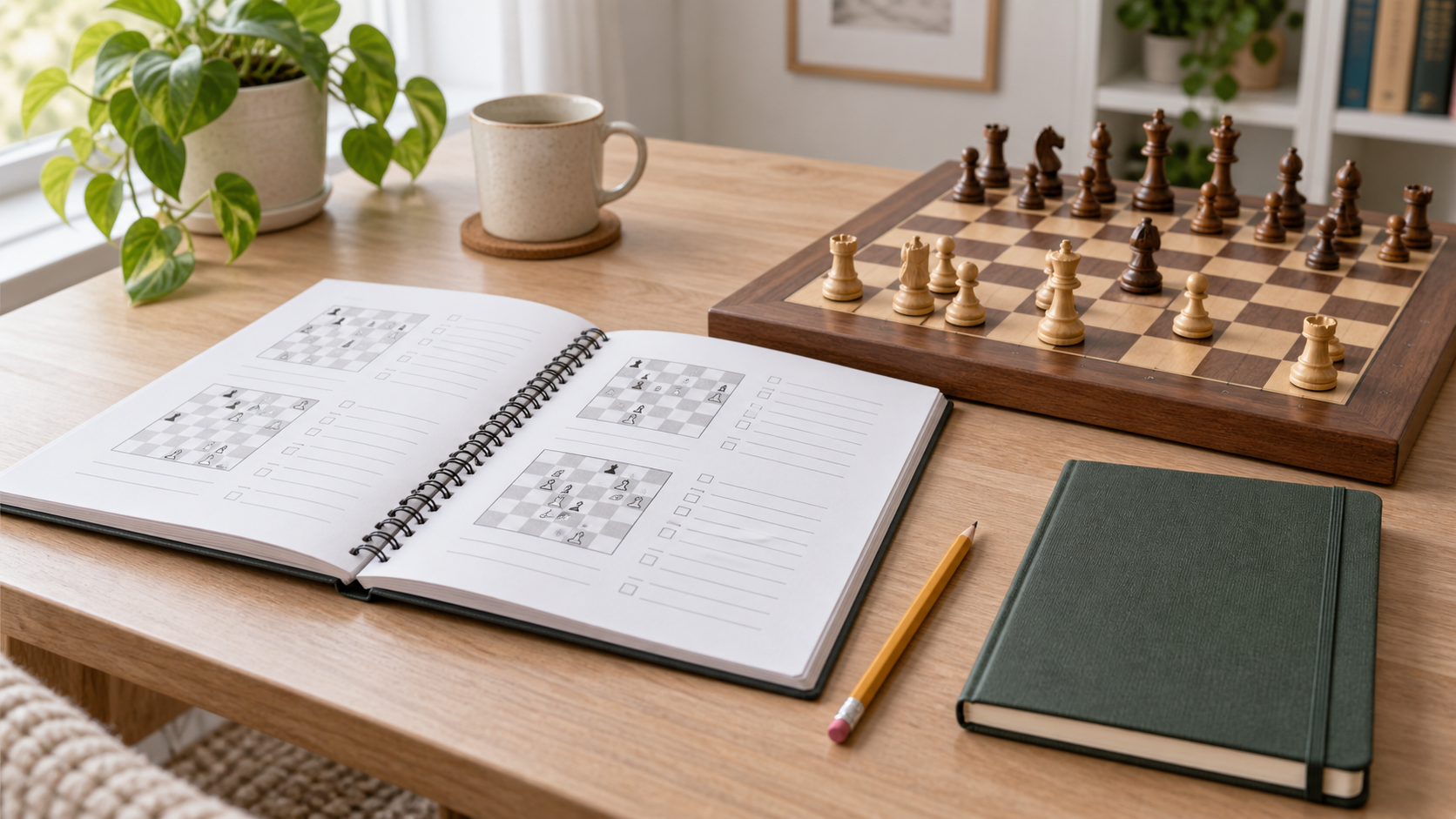
Look inside before choosing
Browse beginner notation workbooks
Verify sample pages, notation convention, exercise order, answer section, binding, page size, and intended level. Do not assume every book teaches notation rather than merely providing blank records.
Quick verdict
- Buy or borrow one when the learner wants a clear sequence and will practice beside a board each week.
- Use a free worksheet first when practice habits are unknown.
- Choose a blank scorebook when the learner already reads coordinates and needs to record full games.
- Wait when legal moves, board orientation, and square names still cause confusion.
What a workbook adds
A useful workbook breaks a large task into small checks: identify a square, name a move, record a capture, notice check, and reconstruct a short sequence. Guided progression is the reason to buy one. Pages filled only with blank move columns are a scorebook, even if the cover says “beginner.”
Notation varies by language and context. English-language algebraic notation commonly uses piece letters, while pawn moves omit one. Books may introduce captures, check, castling, promotion, and annotations in different orders; choose one that states and consistently uses its convention.
Five checks before buying
- Lesson order: square coordinates should come before dense game records.
- Answers: exercises need answers or worked examples so mistakes do not become habits.
- Writing space: lines and diagrams should fit the learner's handwriting.
- Page behavior: pages should stay open beside a board without covering squares.
- Level: “beginner chess” may still assume legal moves and basic algebraic notation.
Use the board, not just the page
Set up each diagram on a board, say the starting and destination squares, write the move, then move the piece. Reverse the exercise by reading a written move and finding it on the board. Ten focused minutes beats rushing through pages without checking.
If coordinates are the obstacle, start with a coordinate chessboard. If pages crowd the pieces, compare book stands for board study.
When a cheaper alternative is enough
A printed sheet can test the routine. A notebook can hold copied positions and corrections. A scorebook fits real-game recording after instruction is no longer needed. A digital lesson can give immediate feedback, but may not build the same paper-recording habit.
Who should skip it?
Skip the purchase if the learner cannot orient the board reliably, dislikes workbook exercises, studies only in an app, or already records games accurately. Also skip a book whose sample pages, answers, notation convention, or level cannot be verified from current publisher or listing information.
Bottom line
A notation workbook earns its place when it provides teaching, practice, and answers—not just blank paper. Preview the pages, test the habit cheaply, and use each exercise with a board. Once the learner can record and replay a game, move on to an ordinary scorebook.