
A printed scorebook is usually better when a beginner plays over a physical board, wants fewer screen distractions, and can already write basic algebraic notation. A digital record is usually better when the game is played online, moves are captured automatically, or the learner wants to replay a game without reconstructing it from handwriting.
The useful question is not which format has more features. It is which one preserves a complete, understandable record without getting in the way of the game—and which one the learner will reopen afterward.
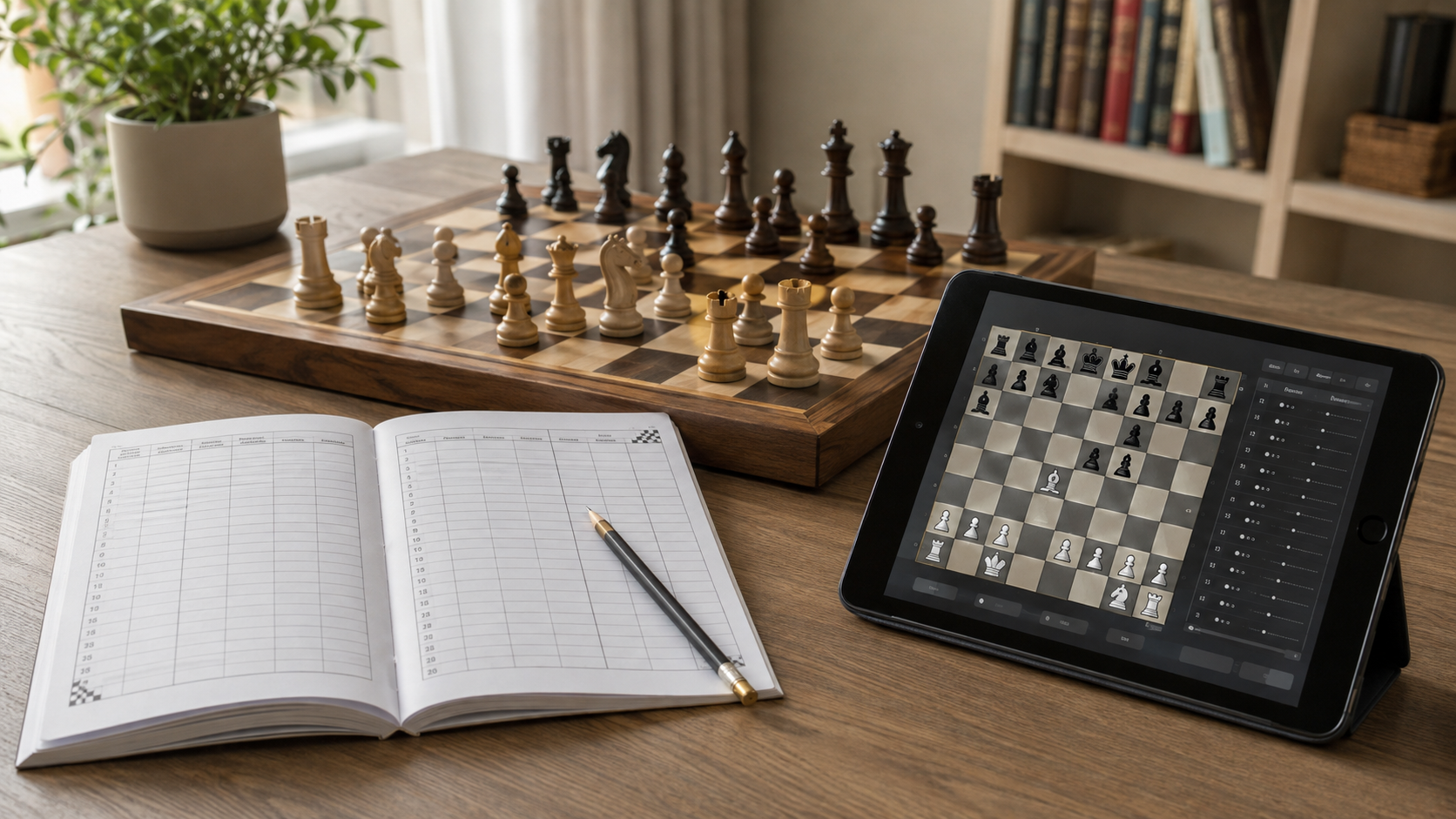
Quick Decision
- Choose a printed scorebook for over-the-board games when handwriting reinforces notation and a screen would compete for attention.
- Choose a digital record when moves are captured automatically or fast replay matters more than a physical archive.
- Use both selectively when paper supports focused play and a later manual digital copy supports review.
- Skip full records for now when notation causes frequent pauses or the learner never reviews completed games.
The Main Difference: Deliberate Capture vs Convenient Replay
Paper asks the player to identify and write every move during the game. That can reinforce square names and move notation, but it also divides attention. A bound book creates a simple chronological archive that does not depend on an account, charging, or a compatible file.
A digital record can remove much of the replay setup, especially when an online platform saves moves automatically. For a game played on a physical board, however, digital capture may still require manual entry during or after play. A screen does not guarantee an accurate record, and importing or exporting may depend on the particular tool.
When a Printed Scorebook Fits Better
Paper suits a learner who can write moves without losing the position, plays mainly on a physical board, and wants one visible archive. Look for numbered rows, separate White and Black columns, enough room for captures and promotions, and a binding that remains open beside the board.
Advantages: no account, battery, notification, or file-management step; quick margin notes; and an easy habit of dating each game.
Limits: unclear handwriting can make replay impossible, corrections can crowd a row, and searching across many games is slow. Paper does not check whether the notation describes a legal move.
Skip it when: the learner still needs most attention for legal moves, plays almost entirely online, or cannot comfortably write in the available space.
When a Digital Game Record Fits Better
Digital records suit games already played through a website or app because the move list can be saved without a second task at the board. A beginner can usually step through positions without physically rebuilding every move, then add a short note about the first confusing moment.
Before relying on a tool, check its current account requirements, offline behavior, export formats, deletion controls, and whether saved games remain accessible if a subscription changes. Do not assume an app stores records forever or exports them in a portable format.
Advantages: fast replay, easier duplication, and less risk that one illegible symbol breaks the remaining record.
Limits: notifications and extra features can distract; manual entry can be awkward; and an account, device, connection, or provider may become part of the archive.
Skip it when: setup delays the game, the learner wants a screen-free session, or the tool's storage and export rules are unclear.
Side-by-Side Beginner Tradeoffs
- Capture during play: paper makes notation practice explicit; automatic digital capture asks less of the player.
- Error recovery: a paper correction remains visible but may be cramped; a digital editor may be cleaner, provided the original position can be identified.
- Replay: paper requires a board or visualization; digital records can step through positions when the tool supports it.
- Focus: paper is quieter; a multipurpose device needs notifications and unrelated apps kept out of the session.
- Portability: a small book is self-contained; digital records travel easily only while the required device, account, and access remain available.
- Ownership: paper stays on the shelf; digital durability depends on backups and export options.
- Notes: margins invite quick handwriting; digital notes can be searchable but may be tied to one service.
Try Each Workflow With the Same Review Goal
- Choose one casual game where notation will not create time pressure.
- Record it on paper, then replay it on a board within a day.
- For another game, use a digital record that is created automatically or entered after play.
- For each game, find the first move where you no longer understand the plan.
- Write one plain-language note, such as “I stopped checking captures here.”
- Choose the format that produced the more complete record and the review you were more willing to finish.
If neither record gets reviewed, reduce the task. Photograph or rebuild one important position and discuss that instead of preserving every move.
Can You Use Paper and Digital Together?
Yes, but duplication should serve a reason. A learner might write an over-the-board game on paper, then enter only selected games digitally for easier replay. Keep the paper original until the digital copy has been checked move by move; one early transcription error can change every later position.
A hybrid routine is unnecessary when the platform already captured the online game accurately and one short review note is enough. Copying every record into a second system can become clerical work instead of chess study.
Who Should Delay Both?
A brand-new player should first learn piece movement, captures, check, and basic board coordinates. Use the beginner chess movement guide before asking notation to share attention with legal play.
If the buy-or-skip question comes first, see whether a chess notation scorebook is worth it. If the immediate need is repeated notation practice rather than a bound archive, compare dry-erase and paper chess score sheets. If paper has already won, compare scorebook page and binding formats.
Bottom Line
Choose a printed scorebook when a beginner plays over a real board, knows notation, and benefits from a quiet physical archive. Choose a digital record when moves are already captured online or quick step-through replay is the priority. Test the complete path from move capture to one useful review; the better format is the one that preserves the game without distracting from it and brings the learner back afterward.