
A first checkers tournament can be worth entering when you can complete a game under the event's stated ruleset, want several focused games, and understand the full schedule and cost. Observe or ask about a beginner division first when the event routine is unfamiliar. Delay if required captures, multiple jumps, or king movement still interrupt most games. Skip when the format, travel, pressure, or commitment does not fit why you play.
“Checkers” does not identify one universal competition format. Board size, starting position, capture rules, king movement, time controls, scoring, eligibility, and conduct procedures can vary by ruleset and organizer. Verify the current event page and ask the organizer directly; this guide does not replace their rules.
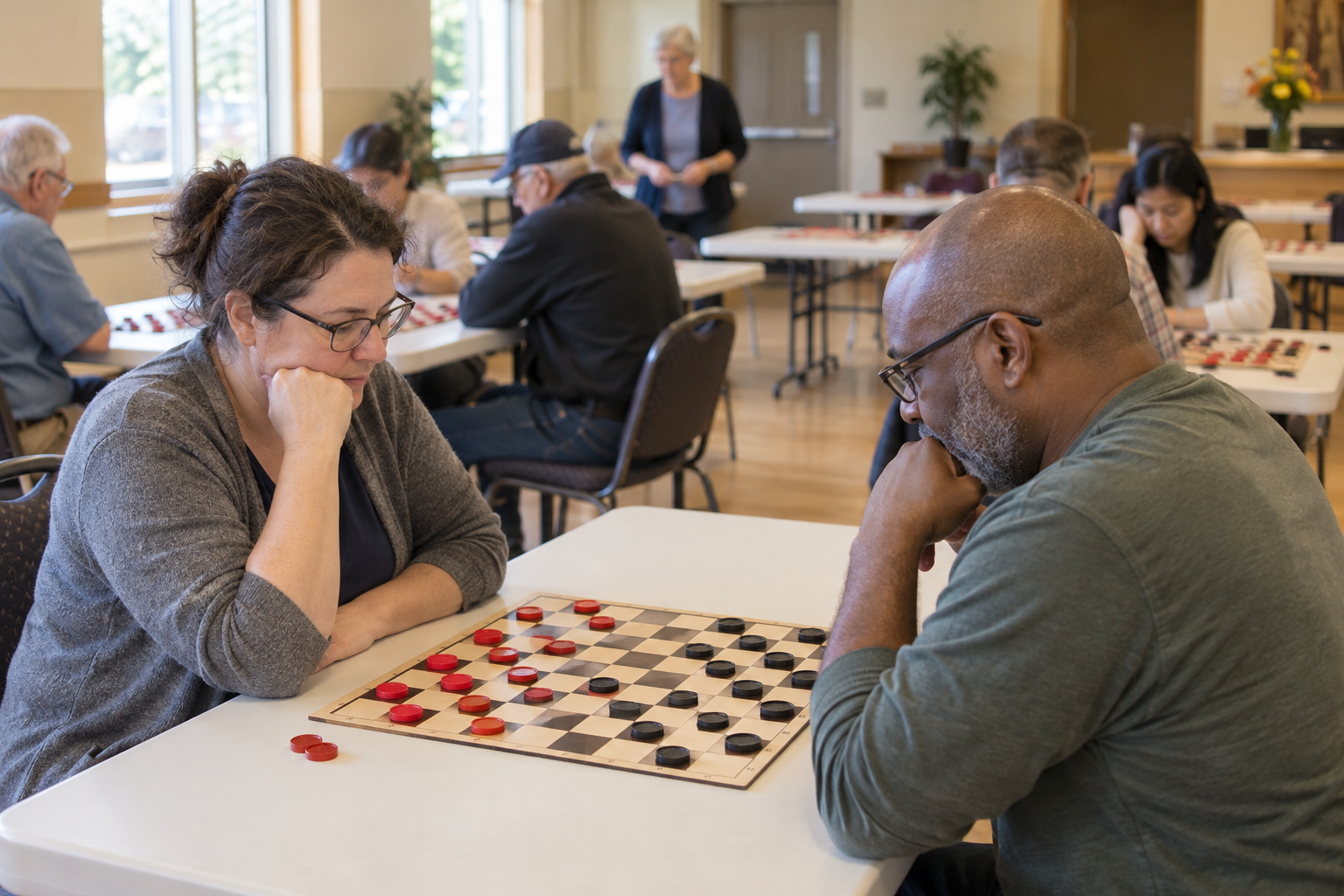
Quick verdict: enter, observe, delay, choose an alternative, or skip
- Enter when you can play a complete legal game under the named ruleset, accept the event pace, and want the experience even if you lose.
- Observe or ask for a trial route when the room, check-in, pairings, clocks, or match procedures are the main unknowns.
- Delay when you still need frequent reminders about legal moves, mandatory captures, multiple jumps, or crowning.
- Choose an alternative when a casual club session, library meetup, or planned match gives you useful opponents with less commitment.
- Escalate to the organizer for authoritative answers about eligibility, sections, accessibility, minors, supervision, disputes, equipment, refunds, or withdrawal.
- Skip when the competitive structure would make checkers less enjoyable or the total time and cost outweigh your goal.
Start with the ruleset, not the event name
Ask which checkers or draughts variant governs play and get the current rules from the organizer or named governing source. A beginner familiar with common American checkers may encounter different board sizes, capture choices, king movement, or promotion procedures elsewhere. Do not assume a home rule, app setting, or chess-event custom carries over.
Before paying, you should be able to set up the named game, move regular pieces and kings legally, identify when a capture is required, complete a multiple jump correctly, and recognize the event's stated ending or scoring conditions. Review how to play checkers for beginners for common American checkers basics, then compare those basics with the event's actual rules.
Check these practical criteria
| Decision check | Ready to proceed | Reason to pause |
|---|---|---|
| Ruleset | The organizer names it and provides or points to the governing rules. | The listing says only “checkers” and rules questions go unanswered. |
| Beginner fit | Eligibility and section placement for a first-time entrant are clear. | “All levels” is advertised without explaining pairings or divisions. |
| Format | You understand rounds or matches, timing, scoring, breaks, and expected completion. | The likely finish time or commitment cannot be estimated. |
| Equipment | The organizer states what is supplied and what players must bring. | You feel pushed to buy gear before requirements are confirmed. |
| Total cost | Entry, membership if any, travel, parking, food, and optional extras fit the budget. | Required charges or cancellation terms appear late. |
| Room and support | Access, conduct, assistance, and contact procedures meet your needs. | Questions about accommodations, minors, or concerns are dismissed. |
Cost, setup, and maintenance tradeoffs
Add the entry fee, any required membership, travel, parking or transit, meals, and only the equipment the organizer says you need. Count the entire day from departure through the likely finish. An inexpensive entry can still be poor value when the trip or schedule is exhausting; a higher total may be reasonable if several well-organized games are exactly what you want.
Most beginners should delay equipment purchases until requirements are explicit. If players provide a set, confirm board dimensions, piece colors and count, crown-marking method, and whether a clock or score sheet is required. A readable ordinary set may be enough. Use the beginner checkers set guide for category tradeoffs, but let the organizer—not a shopping page—define event equipment.
Maintenance is modest but real: count pieces before leaving, keep spare crowning pieces if the format uses stacking, clean only as the material allows, and pack the board flat or rolled according to its design. Borrowing can be smarter than buying for a one-time test.
Use one practice match as a readiness test
- Obtain the event's named rules and summarize the capture, king, timing, and ending rules in your own words.
- Play one uninterrupted practice game without move advice or rule prompts.
- If timing is used, practise the actual timing method without treating speed as the main goal.
- Follow the planned start, break, and finish window to see whether the commitment is comfortable.
- Afterward, ask whether you want several games in that structure—not whether you played perfectly.
Red flags
- The ruleset, eligibility, section placement, schedule, scoring, or equipment requirements are unclear.
- The organizer cannot provide current entry, cancellation, refund, late-arrival, or withdrawal terms.
- Marketing promises prizes, rankings, rapid improvement, or advancement as though outcomes are guaranteed.
- A beginner is pressured to buy a special board, clock, book, membership, or coaching package before requirements are verified.
- Questions about accessibility, conduct, disputes, caregivers, or supervision lack a clear contact route.
- The event's competitive tone conflicts with the friendly or instructional experience you want.
Who should skip a checkers tournament?
- A new player who cannot yet finish a game without repeated rules help.
- Someone who enjoys flexible social play more than fixed rounds or match procedures.
- A player who has practised a different variant and does not want to learn the event's ruleset.
- A family whose transport, meal, accessibility, caregiver, or supervision needs are not clearly addressed.
- Anyone whose budget depends on a prize or other uncertain outcome.
Lower-pressure alternatives
A local checkers club trial can reveal whether you enjoy unfamiliar opponents and scheduled play without committing to an event. A library meetup or planned round-robin with friends can supply several games while you practise one agreed ruleset. Online play may help with repetition, but confirm that the app uses the same variant and do not assume its interface teaches in-person procedures.
If the main gap is rules confidence, play short practice positions that focus on mandatory captures, multiple jumps, and kings. Enter later when the event itself—not proving readiness—sounds appealing.
Questions to send the organizer
- Which exact checkers or draughts ruleset governs this event, and where are the current rules?
- Is there an appropriate section or pairing process for a first-time entrant?
- How many rounds or matches are expected, and what are check-in and likely finish times?
- Are timing devices or score sheets used, and what must the player bring?
- What are the current fees, deadlines, cancellation, refund, late-arrival, and withdrawal terms?
- Who handles accessibility, conduct, caregiver, supervision, or other practical questions?
Bottom line
Enter when the named ruleset, beginner placement, schedule, complete cost, and event atmosphere fit you—and when you want structured competition regardless of the result. Observe or try a club when procedures are the main unknown. Delay while legal play still needs frequent help. Choose casual games when flexibility matters more than formal structure, and skip any event whose rules or terms remain unclear.