
A used chess set is worth buying when you can confirm that the playable set is complete, the pieces are easy to recognize, the king and square sizes work together, and the total cost remains attractive after any replacements or storage fixes. Ask for a full inventory and clear condition evidence before paying. Walk away when important details cannot be checked or the cost of making the set usable erases the saving.
This guide is for ordinary sets intended for learning and regular play. It does not authenticate antiques, identify collectible value, guarantee condition from photographs, or prescribe restoration. Treat seller descriptions as a starting point and verify the particular set yourself.
As an Amazon Associate, The Good Chess & Checkers may earn from qualifying purchases.
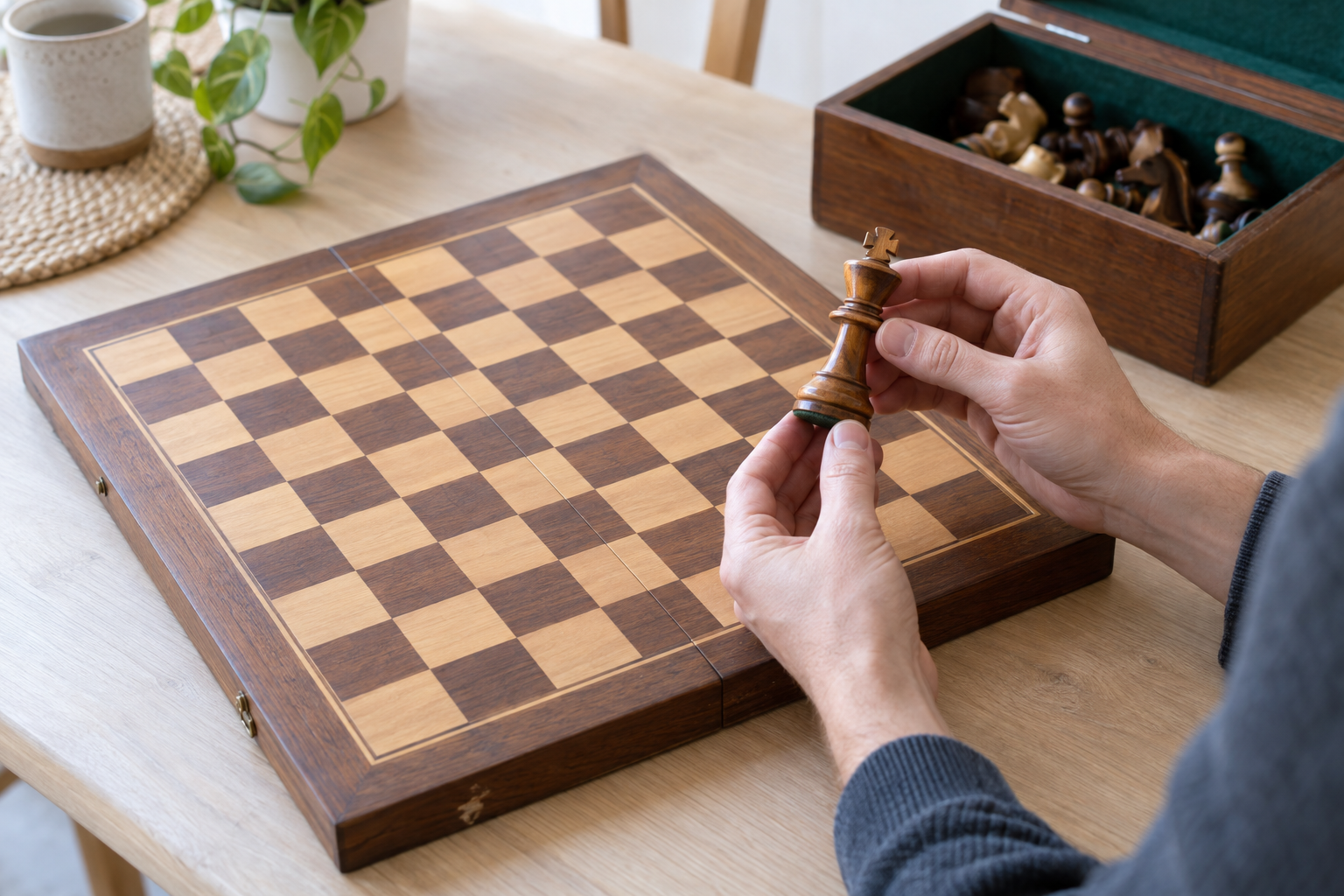
Establish a comparison point
Compare the used set with a basic new set
Use current new-set listings only as a baseline for included pieces, board size, storage, and return terms. A used set is not automatically a bargain simply because its asking price is lower.
Quick verdict
- Buy when the full inventory is visible, ordinary play wear does not interfere with use, board and pieces fit, and the all-in cost makes sense.
- Ask for more evidence when photographs hide piece bases, board edges, hinges, closures, or the complete lineup.
- Negotiate or delay when a replaceable item is missing but you have confirmed a compatible replacement and included its cost.
- Walk away when the seller cannot show all pieces, important damage is unclear, odors or storage history concern you, or returns and pickup inspection are unavailable for an uncertain purchase.
- Choose new instead when a basic complete set with clear specifications and useful return terms costs about the same after every fix.
First, count a complete playable set
An ordinary chess set starts with 32 playing pieces: 16 light and 16 dark. Each side needs one king, one queen, two rooks, two bishops, two knights, and eight pawns. Extra queens are useful for promotion but are not substitutes for missing starting pieces.
Ask for one well-lit photograph showing the entire inventory sorted by color and piece type. A photograph of a starting position can help, but rows are easier to count. Check that paired pieces have the same general design and usable dimensions. A mixed replacement can still play perfectly well, but its readability and resale expectations should be judged honestly.
Inspect the board as a playing surface
Look across the board from a low angle as well as from above. Check whether it lies flat enough for ordinary play, whether folding sections meet without a disruptive ridge, and whether the squares remain easy to distinguish under the lighting where you will use it. Ask for close views of corners, edges, hinges, latches, and any area described as scratched or repaired.
Normal finish variation or a small edge mark may be cosmetic. A board that rocks, will not open flat, has lifted square material, or has hardware that interferes with the playing area creates a different decision. Do not assume photographs reveal warping, odors, loose hardware, or previous repair quality; inspect in person or rely on explicit return terms when those issues matter.
Measure the king, squares, and storage
Ask for the king's height and base diameter, the board's square width, and the board's full outside dimensions. The largest piece base should sit inside one square without crowding neighboring pieces. During a pickup inspection, place several large pieces on adjacent squares and make sure the position remains readable and comfortable to handle.
If the board doubles as a case, confirm that every piece fits in the intended compartment and that the case closes without pressing on crowns, collars, or bases. Check the closed size against the shelf or bag where the set will live. Missing inserts, torn straps, or a weak closure may not stop play, but they belong in the total cost.
Use a condition checklist
| Area | What to verify | Why it matters |
|---|---|---|
| Pieces | Count, recognizable shapes, bases, chips, cracks, loose parts, and matching pairs | Determines whether a complete, readable game can be played |
| Board | Flatness, square contrast, edges, seams, hinges, and surface wear | Affects stability, readability, and setup |
| Fit | King height, base diameter, square width, and adjacent-piece clearance | Prevents an attractive but crowded combination |
| Storage | Compartments, lining, bags, latch or zipper, and closed dimensions | Shows whether the complete set can be kept together |
| Transaction | Actual-set photographs, pickup inspection, return terms, and included items | Defines what can be checked before the decision becomes final |
Calculate the all-in cost
Add the asking price, delivery or travel, replacement pieces, a new storage bag or box, and any cleaning supplies appropriate for the documented materials. Use a replacement cost only after confirming dimensions and style closely enough for your purpose. Decorative, unusually sized, or discontinued pieces may be difficult to match, while a casual practice set may tolerate a visible but readable substitute.
Compare that total with a basic new set that meets the same board-size, piece-readability, and storage needs. Also compare the transaction terms: the chance to inspect a local set can be more useful than vague online photographs, while a clear return window can reduce uncertainty. Do not assign value to claims about rarity, origin, age, or craftsmanship that you cannot verify.
Questions to ask the seller
- Can you show all 32 starting pieces sorted by color and type?
- Are extra queens, checkers, instructions, a clock, or storage inserts included, and are they visible in the photographs?
- What are the board's outside dimensions and square width, and what are the king's height and base diameter?
- Does the board lie flat, and do the hinges, seams, latch, drawer, or zipper work as intended?
- Are any pieces cracked, chipped, loose, repaired, weighted, or missing base material?
- Has the set been stored where moisture, smoke, or strong odors could affect it?
- Can the set be inspected before pickup, or what current return terms apply?
Who should skip a used set?
Skip secondhand shopping when the set must arrive complete on a firm gift date, matching replacement pieces matter greatly, the recipient needs a specific board or piece size, or you cannot inspect uncertain condition and have no useful return option. A new basic set may be the calmer choice when consistency and straightforward replacement matter more than character or potential savings.
Also skip a decorative or antique-looking set when your real goal is an easy first board. Ornate pieces can be harder for beginners to identify, and a seller's age or origin claim does not establish playability or collectible value. For a direct beginner path, compare chess set categories for absolute beginners.
Bottom line
A used chess set can be a sensible purchase, but the verdict belongs to the specific set. Confirm all 32 starting pieces, inspect board and storage condition, measure piece-to-square fit, and compare the complete cost with a suitable new alternative. Buy when the evidence is clear and the set supports regular play; ask for more detail when it is not; and walk away when uncertainty is doing all the work.