
How to Choose a Chess and Checkers Set That Everyone Can Actually Use
Updated October 25, 2026 by The Good Chess & Checkers editorial desk
A chess and checkers set can look perfectly fine online and still be frustrating at the table. The board may be too small for adult hands, the pieces may tip over easily, the checkers may blend into the squares, or the box may be awkward for a classroom shelf. The best set is not always the fanciest one. It is the one people will actually use.
This guide walks through the practical details that matter before you buy, especially if the set is for beginners, children, families, clubs, classrooms, or casual game nights. If you are trying to preserve an existing wooden set instead, first identify whether a worn piece needs replacement felt, a documented base repair, or a complete replacement piece.
As an Amazon Associate, The Good Chess & Checkers may earn from qualifying purchases.
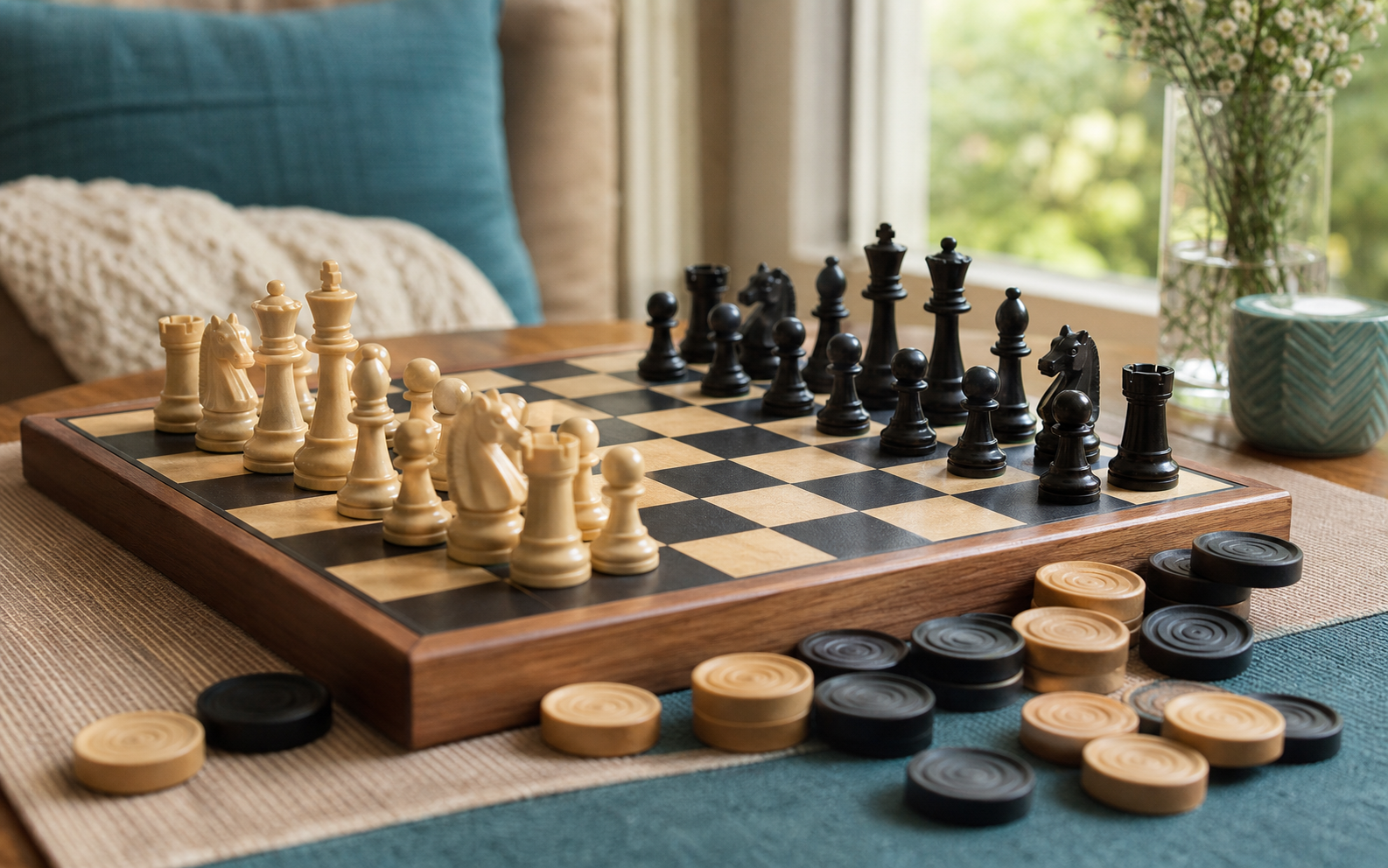
Quick decision aid
Choose usable everyday sets
Look first at readable boards, recognizable pieces, and comfortable checkers, then use the guide to match the set to kids, adults, classrooms, or gifts.
Helpful product path
Start With Who Will Use the Set
Before comparing materials or styles, decide where the set will live and who will handle it most often.
- Family game night: Choose a readable board, stable pieces, and easy storage.
- Young beginners: Prioritize durability, clear colors, and pieces that are not too delicate.
- Classrooms or clubs: Look for sets that are easy to reset, stack, label, and replace.
- Travel: Pick portability and piece security over decorative design.
- Gift buyers: Balance appearance with everyday usability, especially if the recipient is still learning.
Chess and checkers can share the same board, but they do not always have the same needs. Chess depends on distinct piece shapes. Checkers depends on high-contrast squares and stackable pieces for kings. A good shared set handles both clearly.
Board Size: Bigger Is Often Easier, But Not Always Better
Board size affects comfort more than many buyers expect. A tiny board may save space, but it can make pieces feel crowded. A very large board may look impressive, but it can be annoying on a small kitchen table or student desk.
For most homes, a medium board is the safest choice. It gives enough room for chess pieces without making checkers feel oversized. For classrooms, clubs, or repeated casual use, a board that fits neatly on a desk or folding table is often more useful than a display-style board.
When comparing sets, pay attention to square size. Chess pieces should sit comfortably inside each square without touching nearby pieces. Checkers should be easy to pick up and stack without covering too much of the board pattern.
If square size is the main decision, use how to choose the right chess and checkers board size before comparing materials or storage styles.
Measure the table and the pieces before shopping
Use a tape measure and write down the actual usable tabletop width and depth—not the room dimensions. Then measure the widest chess-piece base in the set you already own, if you are buying a board separately. FIDE's current chess-equipment standards are intended for official competitions, not as a requirement for a family purchase. They specify 5–6 cm squares, say four pawns should fit comfortably on one square, and give a piece-base diameter of 40–50% of the piece's height. They do not prescribe a piece-base-to-square-width percentage. For a family purchase, use the listing's actual square and base measurements to judge clearance.
Printable set-fit worksheet
- Usable table width: ________
- Usable table depth: ________
- Listed board/grid width: ________
- Listed square width: ________
- Widest piece-base diameter: ________
- Piece-base ÷ square-width ratio: ________%
- Clear space left beside the board: ________
- Storage opening or bag size: ________
- Checkers stack securely to show kings: yes / no / not stated
Decision: choose / compare another size / ask the seller for a missing dimension / skip.
Piece Size and Stability Matter More Than Fancy Detail
Beginners need pieces they can identify quickly. In chess, the king, queen, bishop, knight, rook, and pawn should look distinct from one another. If a decorative set makes the bishop and pawn hard to tell apart, it may slow down learning.
For checkers, pieces should be thick enough to grip and stack. Since many checkers rule sets use stacked pieces to show kings, thin or slippery pieces can become irritating. If the set is for children or a busy classroom, avoid pieces that roll, chip easily, or scatter too easily.
Weighted chess pieces can feel nicer and tip over less often, but they are not required for casual play. For younger players, simple durable pieces are usually a better choice than fragile carved ones.
Material Tradeoffs: Wood, Plastic, Magnetic, and Folding Sets
Different materials solve different problems. There is no single best material for every player.
- Wood: Often looks gift-worthy and feels pleasant, but quality varies. Some wooden sets are decorative first and practical second.
- Plastic: Usually durable, affordable, and easy to replace. Good for schools, clubs, and beginners.
- Magnetic: Helpful for travel or small spaces, though pieces can be smaller and less comfortable for long games.
- Folding boards: Convenient for storage, but check whether the hinge lies flat and whether pieces fit securely inside.
- Roll-up boards: Practical for clubs and classrooms, especially when paired with a separate bag of pieces.
If the set will be moved often, storage may matter as much as the board itself. A beautiful set that takes too long to pack away may not get used much.
Readability: Choose Clear Contrast Over Novelty Colors
Chess and checkers are easier to learn when the board is easy to read. High contrast helps players track moves, diagonals, captures, and threats. This is especially important for checkers, where diagonal movement is the entire game.
Avoid boards where the light and dark squares are too similar. Also be careful with glossy finishes, which can create glare under kitchen lights or classroom lighting. For children and beginners, traditional color contrast is usually less confusing than themed colors or decorative patterns.
Storage and Setup: The Hidden Difference Between Used and Forgotten
For a portable set, measure the closed case as well as the open board, and confirm how the latch or zipper retains every piece. Magnetic or pegged pieces can help a position survive small bumps, but a travel listing still needs usable square and piece dimensions; “compact” alone does not establish playability.
A set that is easy to set up is more likely to become part of regular play. Check whether the pieces have a clear place to go after the game. For shared spaces, storage should be obvious enough that anyone can clean up without guessing.
If you are considering a secondhand set, use the used chess set inspection guide to count the complete piece inventory, check condition and fit, and compare the all-in cost with a suitable new set.
For families, a folding board with internal storage can work well if the pieces stay in place. For classrooms, separate bags or bins may be better because they are faster to count, replace, and hand out. For clubs, roll-up boards and standard pieces are often practical because they pack tightly and survive repeated use.
Age Fit: Match the Set to Hands, Patience, and Setting
For very young players, avoid tiny pieces and overly delicate designs. Bigger, simpler pieces are easier to grasp and harder to lose. If the set is for a mixed-age family, choose something sturdy enough for children but readable enough for adults.
For older beginners, do not assume they need a premium set. A clear, comfortable set is better for learning than one chosen mainly for display. The goal is to make the next move easier to see.
If the set is mainly for children, compare these general criteria with best chess and checkers sets for kids, which focuses more directly on age labels, handling, storage, and skip criteria.
Rule Variations to Keep in Mind
Chess has a standard board setup, but casual players may still need help remembering piece placement, castling, promotion, and checkmate. A beginner set does not need to explain every rule, but readable pieces make learning much easier.
Checkers has more common household variation than many people realize. Some families play with forced captures, some do not. Some rule sets allow kings to move only one square, while other regional games use longer king moves. If you are buying for a club, classroom, or family that already plays a certain way, make sure the set supports the way they teach kings, captures, and crowning.
For American checkers on an 8-by-8 board, confirm that the set includes a complete 12 dark and 12 light checkers and that each side's pieces can be distinguished and crowned clearly. Other draughts variants can require a different board or piece count, so match the inventory to the ruleset you intend to play.
A Simple Buying Checklist
Use this checklist before choosing a chess and checkers set:
- Can players easily tell the chess pieces apart?
- Are the board squares large enough for the pieces?
- Do the checkers stack cleanly for kings?
- Is the board contrast clear under normal lighting?
- Will the set fit the table, desk, shelf, or travel bag?
- Is the material durable enough for the intended players?
- Can the set be packed away quickly without losing pieces?
- Does it feel appropriate for the recipient: child, beginner, family, club, classroom, or gift?
When a listing omits square size, piece-base diameter, or closed storage dimensions, do not infer them from a photograph. Ask for the measurement or choose a listing that publishes it. A product image can show layout, but it cannot establish scale without a trustworthy reference.
Bottom Line
For most casual players, the best chess and checkers set is clear, sturdy, easy to store, and comfortable to handle. Decorative sets can be lovely gifts, but usability should come first if the goal is regular play.
Choose a board with readable contrast, pieces that are easy to identify, checkers that stack well, and storage that matches the setting. That combination will do more for beginners and families than almost any fancy feature.
For a category-by-category buying path, continue with best chess and checkers sets for beginners.