
A club with one beautiful set can host one game. A club with four complete, readable sets can host four. For a new chess and checkers club, multiple practical sets usually make better use of a small equipment budget because player capacity is the first constraint. One premium shared set makes more sense when the club already has enough tables and needs a teaching, display, final-game, or accessible centerpiece.
This is an allocation framework, not a claim that cheaper equipment always lasts or that a premium label guarantees quality. Compare the visible specifications of each listing and build around the number of people who should play at the same time.
The Good Chess & Checkers may earn commissions from qualifying purchases.
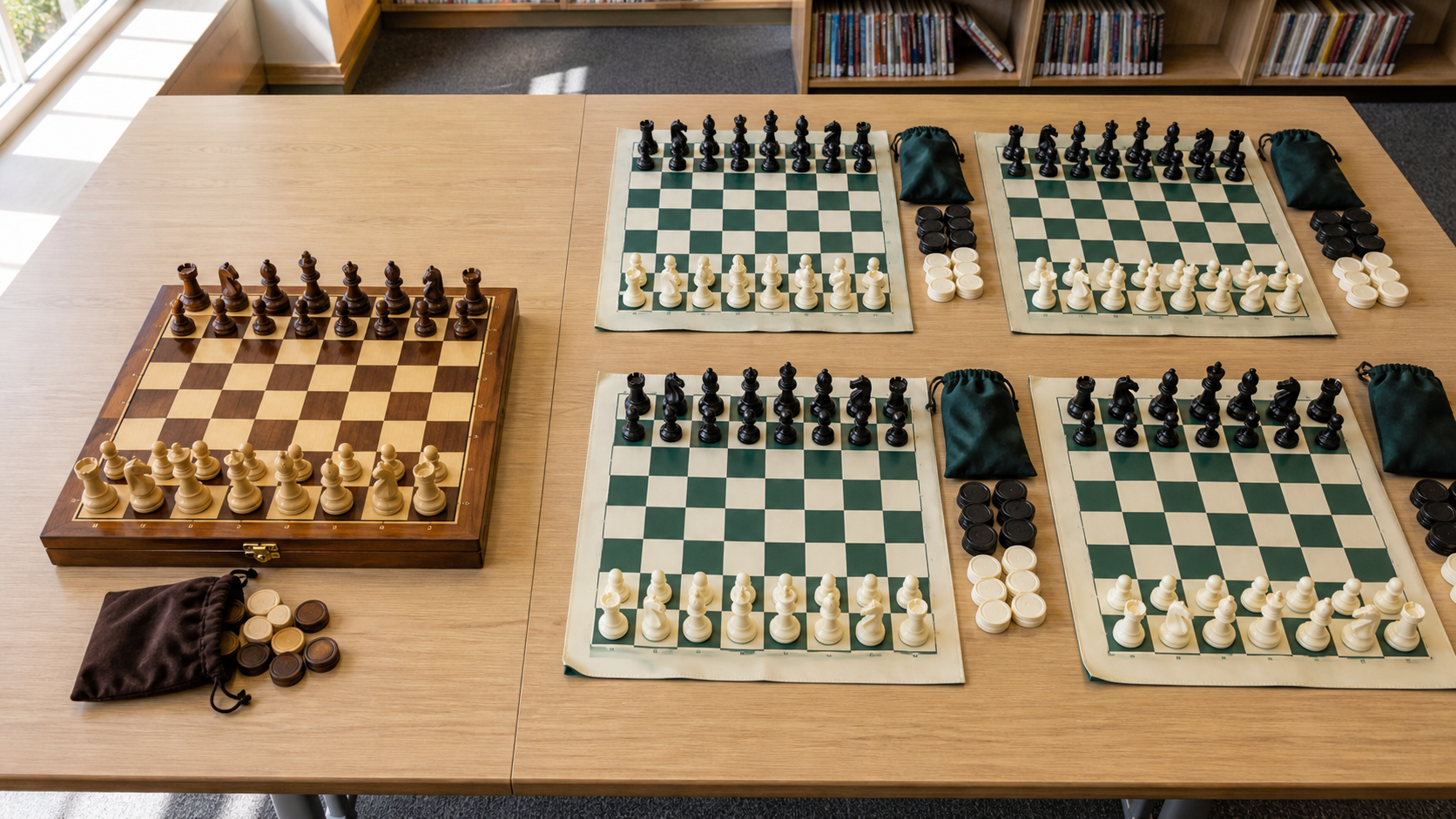
Quick decision aid
Compare complete club-ready set categories
Count complete play positions, then compare board readability, recognizable pieces, checkers support, storage, and replacement compatibility. Do not assume “premium” or “club” describes those details.
Quick Answer
Choose multiple budget-friendly sets when the club lacks enough boards for the expected attendance. Prioritize complete pieces, clear contrast, consistent sizes, contained storage, and parts that can be swapped between matching sets.
Choose one premium shared set when the club already has enough playable tables and has a defined job for the upgrade: a highly visible teaching table, a comfortable set for players who need larger pieces, a display table, or a special final game.
Split the budget when capacity is nearly adequate. Fill the last missing play positions with practical sets, then reserve the remainder for storage, spare pieces, checkers, rule cards, or one better teaching board.
Start With Play Positions, Not Set Count
One complete board normally supports two active players. Divide the number of people expected at a typical meeting by two, then round up. Eight players need four play positions; eleven players need six if everyone should play at once. If the club deliberately rotates between games, puzzles, and teaching, fewer boards may work—but that should be a planned session format, not an equipment surprise.
Count chess and checkers separately when they may run at the same time. An 8-by-8 board can support common American checkers, but only when the club also has a complete, visible set of checkers and agrees on the rule variant. A box labeled “chess and checkers” is useful only if both piece sets are actually manageable.
A Reusable Capacity-Allocation Worksheet
- Expected attendance: use a normal busy meeting, not the largest imaginable event.
- Target simultaneous players: decide whether everyone plays or whether a supervised rotation is intentional.
- Required play positions: divide simultaneous players by two and round up.
- Usable sets already owned: count only complete, readable setups that can be placed on a table today.
- Capacity gap: subtract usable sets from required positions.
- Support allowance: leave room for labeled storage, replacement pieces, checkers, and simple reference materials.
- Upgrade allowance: consider a premium set only after the capacity gap and support needs are covered.
This avoids volatile price comparisons. A useful measure is cost per complete play position: total equipment spend divided by the number of tables that can start a game. Add storage or missing pieces to the equipment cost; an incomplete bargain is not a playable position.
What One Premium Set Does Better
A better-made shared set may offer larger squares, heavier and more recognizable pieces, a board that stays flat, organized internal storage, or a finish suitable for a public-facing table. Those features can help when everyone gathers around one demonstration or when a club wants a calm, consistent setup for teaching.
A premium set can also serve players who find tiny, light, or low-contrast pieces frustrating. Judge that fit by measurements, contrast, and piece shapes rather than price or decorative materials. A costly themed set can be harder for beginners to read than a modest Staunton-style set.
Best fit: a club that already has enough regular boards, small coached groups, a library display table, a final-game board, or a documented need for larger and steadier equipment.
Skip it if: members are waiting for turns, the finish makes volunteers afraid to use it, replacement pieces are hard to match, or the checkers are decorative, incomplete, or awkward to king.
What Multiple Budget Sets Do Better
Several consistent sets create more games, shorter waits, and simpler pairings. Matching boards also make teaching easier: a helper can describe the same square colors, coordinates, and piece shapes at every table. When pieces are interchangeable across the batch, one spare-parts bag can keep more tables active.
Practical does not mean flimsy. Look for readable 8-by-8 boards, recognizable chess pieces with bases that fit comfortably inside the squares, and checkers that contrast with the board and stack clearly when the chosen rules use stacked kings. Flexible boards need gentle rolled storage; folding boards need hinges that open flat.
Best fit: new clubs, growing attendance, classrooms, libraries, after-school groups, and sessions where chess and checkers happen simultaneously.
Skip this approach if: the bundle hides dimensions or piece counts, every set is a different style, the boards arrive too small for beginners, or there is no realistic way to sort and store the extra equipment.
Durability Signals You Can Check Without Fake Testing
- Board information: listings should show the full dimensions, square size, material, and how the board is stored.
- Piece fit: compare the king height and base diameter with the square size; crowded pieces make setup and captures clumsy.
- Recognizable shapes: standard-looking chess pieces reduce relearning when members change tables.
- Checker usability: confirm the count, diameter, contrast, and whether pieces can mark kings clearly.
- Contained storage: closed bags, trays, or labeled bins make missing parts visible before the next meeting.
- Replaceability: standard colors and dimensions are easier to match than unusual finishes or sculpted themes.
Product photos and specifications can reveal these signals, but they cannot prove years of club durability. Avoid treating marketing words such as premium, professional, tournament, school, or heavy-duty as evidence by themselves.
Setup and Maintenance Tradeoffs
One premium folding set may be quick to issue and easy to count if every piece has a fitted slot. It may also demand careful cleaning and storage. Wood and finished surfaces should not be treated as automatically tougher than plastic, and unusual pieces can be difficult to replace.
Multiple sets create more counting and sorting. Give each table a number or color, keep its board and pieces in one closed container, and place a contents card inside. If chess and checkers share a board, give the checker pouch a clear label so it does not disappear into a general spare-parts bin.
Standardize before expanding. Adding two sets that match the existing batch is usually easier to manage than adding two visually impressive sets with different square sizes, colors, storage, and piece shapes. For the complete workflow, use the beginner-friendly club station guide.
Decision Scenarios
- Eight regular players and no equipment: start by trying to cover four complete play positions; one premium set leaves six people without a board.
- Ten players and four usable sets: close the one-set capacity gap first, then improve storage or keep a small replacement reserve.
- Six players and four usable sets: capacity is covered, so a better teaching or accessible set may have a clear role.
- Attendance changes every week: favor consistent, compact sets and a checkout system before buying a centerpiece.
- One coached table plus independent play: one clearer shared set and several practical table sets can be a sensible hybrid.
- Chess and checkers at the same meeting: count the boards, chess armies, and checker sets needed for the planned mix rather than assuming every combo box is ready.
Who Should Skip Both Purchases for Now?
Pause if the club does not yet know its meeting space, likely attendance, available tables, storage rules, or existing donated equipment. Borrowing a few complete sets for an initial session can expose the real capacity and storage problems before money is committed.
Also pause if a school, library, or organization has an approval or purchasing process. This guide does not replace local procurement, supervision, accessibility, or cleaning requirements. Ask the responsible organizer what must be approved, then compare products against those requirements.
Bottom Line
For a club that is short on playable tables, multiple complete and consistent budget-friendly sets are usually the stronger first purchase. They turn the same allocation into more games and make it easier for beginners to move between tables.
One premium set earns its place after capacity is covered or when it solves a specific teaching, visibility, comfort, or presentation problem. Define that job before paying for it. Next, compare chess and checkers club starter kit categories, or use prebuilt kit vs DIY setup when storage, labels, and replacement parts matter as much as the boards.