
The Opera Game shows how developed pieces and usable open lines can matter more than collecting a pawn. Morphy brings his pieces into the fight, then uses the same file with two different rooks. The lesson is to count active pieces and calculate the opponent’s replies before sacrificing material—not to give pieces away whenever your opponent develops slowly.
By The Good Chess & Checkers editorial desk. AI-assisted research organization and drafting; the game record and board positions were checked separately from the prose. This is a lesson from a recorded game, not a report of hands-on product testing.
The game and the notation you need
- Players
- Paul Morphy, White; Duke of Brunswick and Count Isouard, consulting together as Black.
- Place and year
- Paris, 1858. A casual consultation game, not a tournament round or title game.
- Result
- 1–0: White wins; the recorded final position is checkmate.
ChessBase and Chess.com use this game to explain development and attacking play. That makes it a useful teaching example; it does not establish that it changed opening theory or was the objectively best game ever. We use the year only: ChessBase supplies an exact day, but the accepted research did not establish that day from a contemporary record. No particular opera performance or story about Morphy’s feelings is needed for this lesson.
Read each numbered pair as White’s move followed by Black’s. K means king, Q queen, R rook, B bishop and N knight; a move without a piece letter is a pawn move. x means capture, + check, # checkmate, and O-O-O queenside castling. In Nbd7, the extra b tells you which knight moves: the one on the b-file.
If those symbols are distracting, start with our notation guide. If legal moves are still new, use the piece-movement guide first and replay this lesson later.
Moves 1–9: count the pieces that can help
Actual play: 1. e4 e5 2. Nf3 d6 3. d4 Bg4 4. dxe5 Bxf3 5. Qxf3 dxe5 6. Bc4 Nf6 7. Qb3 Qe7 8. Nc3 c6 9. Bg5 b5.
Development means bringing a piece from its starting square into useful play. Minor pieces are bishops and knights. After 9...b5, stop and count the surviving minor pieces that have left their starting squares. Which king could castle now, and which pieces could help in the center?
Answer: White has three developed minor pieces: knights are down to one on c3, with bishops on c4 and g5. White’s other knight was captured on f3. Black has one developed surviving minor piece, the knight on f6; the knight on b8 and bishop on f8 are still at home. Black’s other bishop developed earlier but was captured on f3. This is a board count, not a claim that Black never developed that bishop.
White can castle on either side in this position; Black cannot yet castle on either side because pieces block both paths. White’s c3 knight and bishops already influence central squares. The b-pawn now attacks the bishop on c4, so White must still calculate a reply. A development lead does not cancel threats.
Before move 12: one king move activates a rook
Actual play: 10. Nxb5 cxb5 11. Bxb5+ Nbd7.
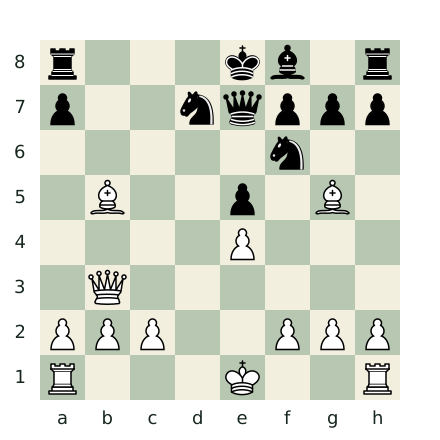
Text board descriptions for both diagrams
Before move 12: White king e1; queen b3; rooks a1, h1; bishops b5, g5; pawns a2, b2, c2, e4, f2, g2, h2. Black king e8; queen e7; rooks a8, h8; bishop f8; knights d7, f6; pawns a7, e5, f7, g7, h7. White to move.
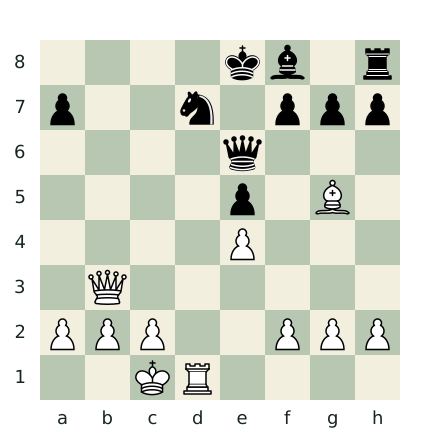
Before move 16: White king c1; queen b3; rook d1; bishop g5; pawns a2, b2, c2, e4, f2, g2, h2. Black king e8; queen e6; rook h8; bishop f8; knight d7; pawns a7, e5, f7, g7, h7. White to move.
Ask before moving: How can White move the king out of the central e-file and put a rook on the d-file in the same turn? The answer is 12.O-O-O: the king goes from e1 to c1 and the a1 rook goes to d1. The d-file has no pawns on it, although Black’s knight on d7 still blocks the rook’s path upward.
Queenside castling is a special king-and-rook move. It requires unused castling rights, an empty path between the pieces, and a king that is not in check and does not cross or land on an attacked square. Here b1, c1 and d1 are empty, and e1, d1 and c1 are not under attack. Moving the king to c1 gets it out of the center in this game; castling is not a guarantee of safety in every position.
Moves 12–15: track the two White rooks
Actual play: 12. O-O-O Rd8 13. Rxd7 Rxd7 14. Rd1 Qe6 15. Bxd7+ Nxd7.
- The rook that began on a1 reaches d1 when White castles. Black’s a8 rook moves to d8.
- On 13.Rxd7, White’s original a1 rook travels from d1 to d7 and captures the knight there. On 13...Rxd7, Black’s original a8 rook captures it from d8.
- On 14.Rd1, White’s other rook—the one that began on h1—crosses g1, f1 and e1 to reach d1. White has replaced the first rook on the same file.
- After 14...Qe6, the bishop on b5 captures Black’s rook on d7 with check. Black’s f6 knight captures that bishop on d7. White’s remaining rook is still on d1.
Do not describe 14.Rd1 as the sacrificed rook returning. It is a second rook using a route opened by development and castling. The sequence makes sense only when the replies are checked on the board.
Before 16.Qb8+: find the reply before giving up the queen
Return to the hero diagram. Black’s king is on e8. Its own bishop on f8 obstructs one neighboring square, and White’s pieces control other routes. From b8, White’s queen would check along c8 and d8 to e8. The current queen on b3 can reach b8 because b4, b5, b6 and b7 are empty.
Before revealing the finish, name the checking line, the piece that can capture the queen, and the square the rook could use next. Work in words first.
Actual finish: 16.Qb8+ Nxb8 17.Rd8#. After Qb8+, the knight on d7 must capture on b8: Black cannot capture with the king, block the eighth-rank check, or move the king to a safe square. The king cannot use d7 because the rook on d1 attacks it; e7 is controlled by the bishop on g5, and f7 and f8 hold Black’s own pieces.
After the knight leaves d7, the rook that started on h1 has a clear route from d1 to d8. On 17.Rd8# that rook gives check along the eighth rank. The bishop on g5 supports d8 through f6 and e7, so the king cannot capture the rook. The king has no safe escape and Black cannot capture or block the checking rook. The queen sacrifice works because of this concrete reply sequence.
A transfer worksheet: words before moves
Use this on paper or beside a board. These are original teaching prompts about the recorded position, not additional moves played by Morphy. No hypothetical variation is presented as actual play.
| Check | Write your answer first | Answer key for this game |
|---|---|---|
| Developed pieces | After 9...b5, name each surviving developed bishop or knight. | White: Nc3, Bc4, Bg5 (three). Black: Nf6 (one). |
| Available checks | Before move 16, identify a check that draws a defender away; name its checking line. | Qb8+ checks the king on e8 along the eighth rank. This prompt selects the game’s check, not a complete list of every legal check. |
| Open file | Which pawn-free file can a rook use? What still obstructs it before move 16? | The d-file. The black knight on d7 blocks the d1 rook’s route to d8 until it captures on b8. |
| Opponent replies | After Qb8+, what must Black do? What supports the final rook? | Nxb8 is the only legal reply; Rd8# follows, with the g5 bishop protecting d8. |
For your next game, repeat the four questions without assuming a sacrifice exists. If you cannot account for the opponent’s replies, keep looking or choose a move you can explain. A quiet developing move may be the useful lesson to transfer.
Continue without buying anything first
Replay once with an ordinary board or free analysis board, then cover the answer column and explain the rook’s journey aloud. For choosing what to study next, compare tactics puzzles and annotated games. If moving pieces physically would help and you need a set, use our wooden versus silicone board comparison to think about readability and storage before shopping.
Sources, score and artwork
Game identity and teaching context: ChessBase’s Morphy lesson and Chess.com’s teaching explanation. The move record was cross-checked with the Opera Game score. Sources checked November 6, 2026; no source annotations or photographs reproduced. Every recorded move and both diagram positions were legally replayed; this is rules validation, not engine-strength analysis.
Original board compositions use Colin M. L. Burnett’s (Cburnett) chess piece paths under the BSD license option, via python-chess 1.11.2. Piece paths are unchanged; placement and board colors are our composition. See the full license below and piece-set license documentation.
Full piece artwork license
Chess piece artwork: Copyright Colin M. L. Burnett (Cburnett). Used under the BSD license option documented at https://commons.wikimedia.org/wiki/File:Chess_klt45.svg and https://python-chess.readthedocs.io/en/latest/svg.html . Piece paths obtained from python-chess v1.11.2 chess/svg.py; paths unchanged, translated/scaled into original board compositions. Board layout and teaching content: The Good Chess & Checkers editorial desk, 2026. No endorsement implied.

Copyright (c) Colin M. L. Burnett.
Redistribution and use in source and binary forms, with or without modification, are permitted provided that the following conditions are met:
1. Redistributions of source code must retain the above copyright notice, this list of conditions and the following disclaimer.
2. Redistributions in binary form must reproduce the above copyright notice, this list of conditions and the following disclaimer in the documentation and/or other materials provided with the distribution.
3. Neither the name of the author nor the names of its contributors may be used to endorse or promote products derived from this software without specific prior written permission.
THIS SOFTWARE IS PROVIDED BY THE AUTHOR AND CONTRIBUTORS "AS IS" AND ANY EXPRESS OR IMPLIED WARRANTIES, INCLUDING, BUT NOT LIMITED TO, THE IMPLIED WARRANTIES OF MERCHANTABILITY AND FITNESS FOR A PARTICULAR PURPOSE ARE DISCLAIMED. IN NO EVENT SHALL THE AUTHOR AND CONTRIBUTORS BE LIABLE FOR ANY DIRECT, INDIRECT, INCIDENTAL, SPECIAL, EXEMPLARY, OR CONSEQUENTIAL DAMAGES (INCLUDING, BUT NOT LIMITED TO, PROCUREMENT OF SUBSTITUTE GOODS OR SERVICES; LOSS OF USE, DATA, OR PROFITS; OR BUSINESS INTERRUPTION) HOWEVER CAUSED AND ON ANY THEORY OF LIABILITY, WHETHER IN CONTRACT, STRICT LIABILITY, OR TORT (INCLUDING NEGLIGENCE OR OTHERWISE) ARISING IN ANY WAY OUT OF THE USE OF THIS SOFTWARE, EVEN IF ADVISED OF THE POSSIBILITY OF SUCH DAMAGE.