
Choose tactics puzzles when the beginner needs a short, focused routine for calculating from one position and checking a concrete answer. Choose annotated games when the learner keeps asking how a position arose, why a plan changed, or what happened after one decision. Neither format is a complete beginner course, and using both does not require buying anything.
This comparison assumes the learner can make legal moves and recognize check. If not, start with how chess pieces move before adding study positions or notation-heavy game records.
Quick decision
- Use tactics puzzles when sessions need to fit into 5–15 minutes, the learner can pause before moving, and a trustworthy answer is available.
- Use annotated games when the learner wants opening-to-ending context and can follow notation or replay moves on a board.
- Alternate them when a puzzle can be connected to a complete game without turning every study session into a long replay.
- Skip both for now when legal moves, check, board orientation, or basic notation still consumes all the learner's attention.
Option A: short chess tactics puzzles
A tactics puzzle starts from a selected position and asks for a move or sequence. The narrow task reduces setup and makes answer checking straightforward when the source identifies whose turn it is, gives the complete position, and explains the reply. It fits a learner who can calculate before touching the pieces rather than guessing until something works.
The tradeoff is missing context. A puzzle usually does not show which earlier choice created the opportunity, whether a simpler move was available, or what happened after the combination. A position chosen because it has a neat answer can also make the learner expect that every real-game turn contains a tactic.
Setup and maintenance
Use a board, diagram, cards, book, or free digital source. Record the side to move, the learner's first candidate, the expected reply, and the lesson from a miss. Retire positions that are too easy to require calculation, too hard to explain, or ambiguous because pieces or orientation are unclear.
Option B: complete annotated games
An annotated game preserves move order and adds explanations at selected decisions. It can show how development, king safety, exchanges, pawn changes, and mistakes connect over time. The learner can pause before an annotated move, choose a candidate, then compare the note with that choice.
The tradeoff is load. A complete game may contain unfamiliar notation, long quiet stretches, unexplained alternatives, and advanced comments. More notes are not automatically more useful: beginner-facing annotations should explain the decision in plain language and avoid assuming the reader already understands every opening name or evaluation symbol.
Setup and maintenance
Replay on a physical board or a board interface that allows stepping backward. Mark only a few decision points on the first pass. Keep a one-page record of the game, the move where the learner's plan changed, and one position worth revisiting; otherwise the replay can become passive piece-moving.
Compare the practice jobs
| Decision | Tactics puzzles | Annotated games |
|---|---|---|
| Main task | Find and verify a move from one position | Follow and question decisions across a whole game |
| Typical setup | One diagram or board position | Starting position plus a move record |
| Feedback | A concrete line or explained solution | Notes at selected moves; coverage varies |
| Context | Usually limited | Earlier causes and later consequences remain visible |
| Notation load | Low if the diagram is clear | Higher because every move must be followed |
| Best fit | Short calculation practice | Longer review and plan comparison |
A two-session no-spend trial
This is a practice comparison, not a claim that either method improves results. Use positions and games you already own, can borrow, or can access lawfully.
- For session one, choose three beginner-level puzzles with a stated side to move and explained answers. Before moving, write one candidate move and the expected reply.
- For session two, choose one short annotated game. Replay it from the initial position and stop at three marked decisions before reading each note.
- After each session, record setup minutes, moments of guessing, questions the answer did not resolve, and one position the learner can explain aloud.
- Choose the format that produces a repeatable next action. Alternate formats if the learner wants both calculation and context.
Original review worksheet
Copy these fields onto paper. They work for either format and keep the session active:
- Source and exact position or game
- Side to move and what changed on the previous move
- Two candidate moves considered before moving
- Expected opponent reply
- Answer or annotation checked
- Why the first choice differed
- One position to replay tomorrow
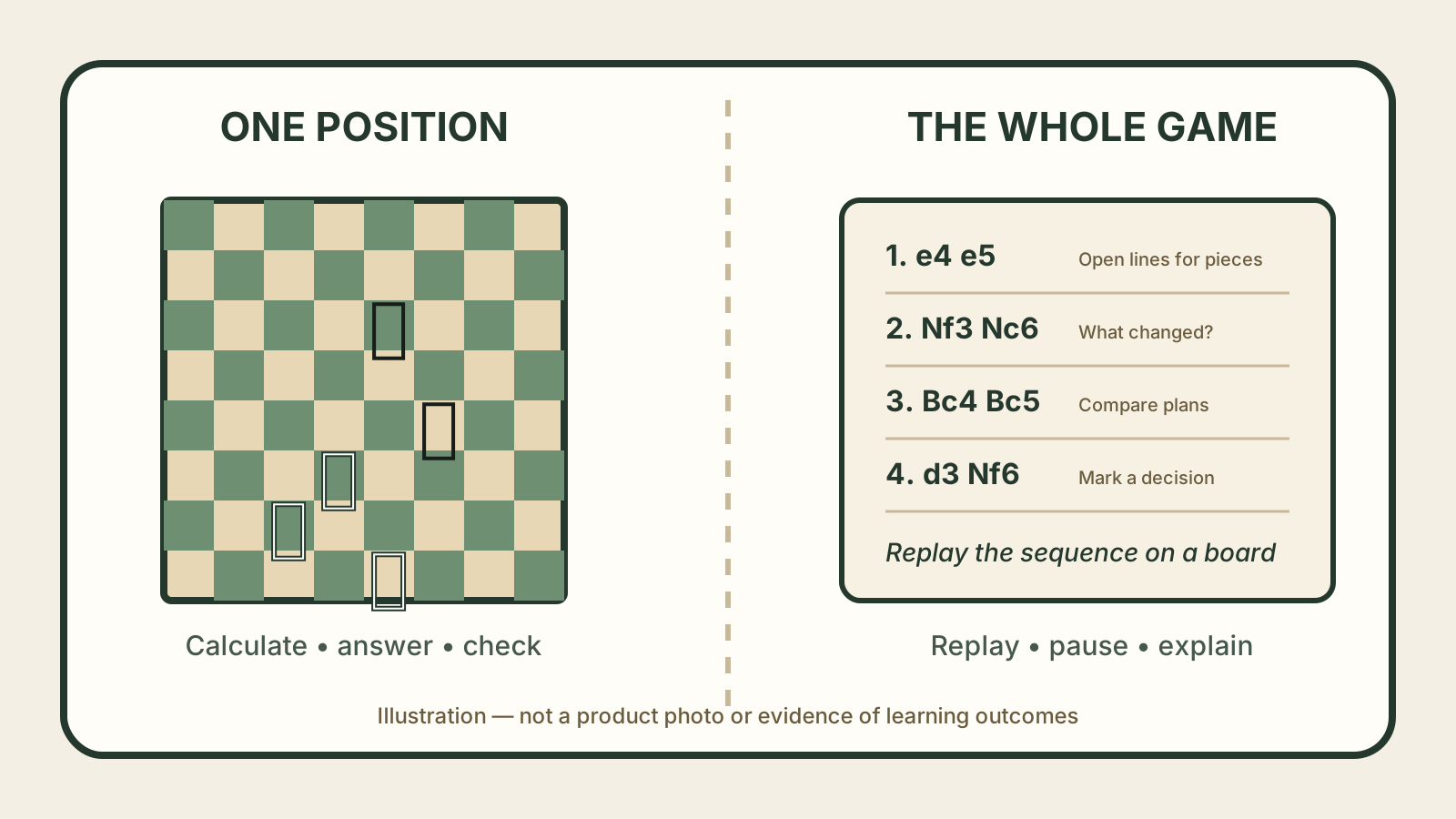
For an original legal replay sequence, start from the normal initial position and play 1. e4 e5 2. Nf3 Nc6 3. Bc4 Bc5 4. d3 Nf6. This sequence is offered only as a notation-and-replay exercise. Pause after each pair of moves and ask which pieces gained mobility, what is attacked, and which candidate moves remain legal; it is not presented as opening advice or a model game.
Answer-quality checks
For a puzzle, reject a source that omits the side to move, crops pieces from the board, or gives only “correct” without the opponent's relevant reply. For an annotated game, look for notes that distinguish the played move from alternatives and explain terms at the learner's level. In either format, verify a surprising move on a board rather than assuming a diagram or transcription is error-free.
Who should skip each option?
Skip tactics puzzles when the learner responds by trial and error, cannot explain the answer, or needs more complete-game experience. Skip annotated games when replaying notation overwhelms the lesson, the notes assume advanced knowledge, or the learner never pauses to make a choice. Skip paid materials when a library book, club game record, or free sample already makes the routine testable.
Sources and boundaries
The primary rules reference is the FIDE Laws of Chess: Article 3 defines how pieces move and Appendix C defines algebraic notation. Those sections support the legal-move and notation foundations used in the original replay exercise. They do not establish that puzzles or annotated games produce better learning outcomes. The comparison framework, trial, prompts, and worksheet are original editorial tools, not reported testing or educational research.
Next steps
If the learner prefers isolated positions but needs to choose a medium, compare a chess puzzle book with a puzzle app. If a longer guided sequence is the real need, compare a chess book with an online course. For a physical-board study routine, the print book versus e-book guide covers navigation, diagrams, notes, and table setup.
Bottom line
Tactics puzzles are the cleaner fit for short, answerable calculation tasks. Annotated games are the better fit for seeing how decisions connect across a game. Test both without spending, demand clear answers or notes, and keep the format that makes the beginner pause, choose, check, and explain.