
Keep replacement queens when the club's sets are otherwise complete and the recurring problem is pawn promotion. Keep one full spare piece set when several kinds of pieces go missing, the active sets use the same scale and style, and someone can manage a labeled donor inventory. Do not buy either until a short count shows which problem the club actually has.
This is a product-category comparison, not a named-product ranking or hands-on test. Match measurements and construction to the club's existing pieces, verify current listing details, and keep ordinary club preferences separate from event-specific equipment requirements.
As an Amazon Associate, The Good Chess & Checkers may earn from qualifying purchases.
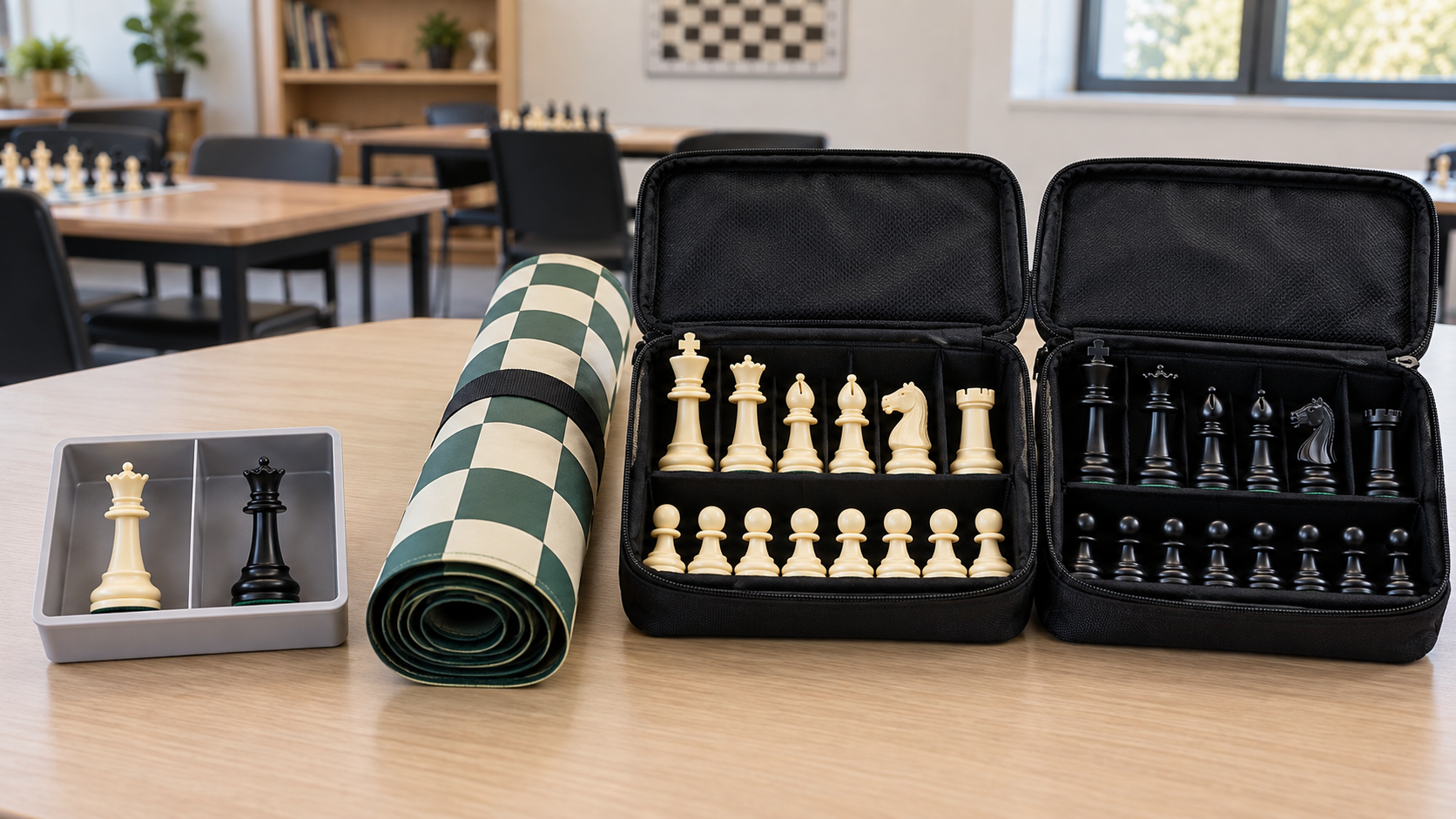
Audit the missing pieces first
Compare a queen pair with a complete spare army
For queens, match height, base diameter, color, weight, and base finish. For a full spare set, verify every piece count, scale, board fit, storage, and whether its parts can be sorted confidently into the club's active sets.
Quick decision
- Choose replacement queens when complete sets regularly reach promotion positions and matching extras are the only repeated shortage.
- Choose a full spare piece set when pawns, rooks, bishops, knights, kings, and queens are all plausible losses and the active sets are standardized.
- Keep a complete playable spare set intact when attendance varies or an entire board may need replacing during a session.
- Skip both purchases when the audit shows rare losses that a clearly agreed temporary marker can handle without confusing beginners.
The core difference: narrow coverage or broad coverage
An extra light queen and dark queen solve one recognizable problem. A pawn that reaches the farthest rank must promote to a queen, rook, bishop, or knight; the queen is common, but not the only choice. A matching spare queen lets the original queen remain on the board without using an improvised marker.
A complete donor set covers many kinds of missing pieces. That flexibility costs shelf space and creates a sorting question: can helpers reliably match each donor piece to the right active set? A nearly matching knight, a different-weight rook, or a base that crowds the square can make a beginner set harder to read.
Compare the practical tradeoffs
| Criterion | Replacement queens | Full spare piece set |
|---|---|---|
| Best use | Promotion support for otherwise complete sets | Replacing several piece types across standardized sets |
| Matching work | Match one shape per side | Match six piece types, colors, scale, and construction |
| Storage | Small labeled compartment or pouch | Full bag, divided box, or counted drawer |
| Inventory risk | Small parts can migrate between sets | The donor supply can quietly become incomplete |
| Session backup | Does not replace another missing man | Can repair several sets, or remain playable if kept intact |
| No-buy alternative | Use one agreed, unmistakable temporary promotion marker | Standardize and recount current sets before adding stock |
Start with a four-session inventory audit
For several meetings, count every returned set and record the missing piece by type and color. Also record when a second queen was needed during actual play or a teaching exercise. Four sessions are not a universal rule; they are a manageable local sample that replaces guessing with the club's own pattern.
Separate permanent losses from pieces found in the wrong bag. If the problem is mixing rather than loss, numbered bags, color-coded bins, or a clearer return count may help more than extra pieces. The numbered-bag versus color-coded-bin guide covers that workflow.
Match the dimensions that affect play
Measure the surviving queen's total height and base diameter. Note its color, recognizable shape, weight category, and whether the base is felted, bare, magnetic, or pegged. A visual color name such as “white,” “ivory,” or “black” is not enough to establish a match.
For a full spare set, compare the widest base with the active board's square width and check every major silhouette. Beginners should be able to distinguish king, queen, rook, bishop, knight, and pawn without relying on height alone. Magnetic and peg sets require compatible pieces; ordinary loose pieces are not substitutes.
Decide whether the spare set is playable or a donor
A playable spare stays complete and can open another table when attendance increases or replace an entire incomplete set. A donor set is intentionally divided to repair matching sets. Trying to make one set do both jobs often leaves an organizer unsure whether its pieces may be borrowed.
Label the choice. If it is a donor, store pieces by type and color with an expected count. If it is playable, keep its 32 starting pieces together and put any separate promotion queens in their own marked pocket. Do not call a mixed box a complete backup until it has been counted.
Use a simple replacement threshold
There is no universal number of missing pieces that makes a donor set worthwhile. A practical local rule is to choose the smallest system that covers the repeated problem. Queen-only demand points toward queen pairs. Losses spread across several piece types point toward a standardized donor supply. Whole kits going unavailable point toward a complete playable spare.
When active sets vary in size, material, color, or style, one donor set may create more sorting work than it solves. In that case, label each set separately and buy a measured replacement only when the match can be verified.
Who should skip replacement queens?
Skip queen packs when promotion situations are rare, dimensions are missing, the pieces cannot be matched clearly, or the club's bigger problem is incomplete sets. Also skip them when volunteers would not know which queen belongs with which scale of pieces. An agreed temporary marker can cover an occasional casual game, provided both players understand it before play.
Who should skip a full spare set?
Skip a donor set when the club uses several incompatible piece styles, lacks closed labeled storage, or cannot maintain a count. If the extra set is likely to be useful as another playable board, preserve it as a complete kit instead of slowly dismantling it.
Bottom line
Replacement queens are the tidy answer to a repeated promotion-piece shortage. A full spare piece set is more flexible only when the club has standardized equipment, loses several piece types, and can maintain a labeled donor inventory. Count first, match measurements rather than color names, decide whether a spare remains playable or becomes a donor, and buy only the coverage the club's own return log supports. For the wider storage routine, continue to the classroom and club game-station guide.